Language can be misleading. As adults, if we laugh out loud in glee when we see a squirrel run up a tree or suddenly skip down the street, most observers would find that odd, or qualify the actions as "childlike." We are expected to be more serious than not, and to prioritize work, work, and more work.
To make things worse, social and traditional media bombard us with stories about celebrities and rich people's lifestyles, making that seem like what we should aspire to. A Rolex watch, an Armani suit, a cruise spent in a bungalow over the water in Bora Bora — these become synonymous with luxury and our supposed life goals.
But that is only the tip of the iceberg. It's time to take back the definition of luxury and start enjoying the small things, happily and simply.
To enjoy the little things in life is to notice and savor the small, ordinary, often-free moments that fill most of an ordinary day — a good cup of coffee, a song that catches you off guard, a neighbor's kid waving from a stroller — instead of waiting for the rare big moments to feel happy. The phrase is shorthand for a deliberate practice of attention.
"There is no way to happiness — happiness is the way." — Thich Nhat Hanh
What Does It Mean to Enjoy the Little Things?
"Enjoying the little things" means letting yourself feel pleasure, gratitude, or quiet awe in response to ordinary moments — without dismissing them as too small to count. It's a practice, not a personality trait. Most people are capable of it; most don't make the time for it.
The phrase pushes back on a cultural script that says happiness lives in the future and depends on something big — the promotion, the trip, the engagement, the house. That script keeps you waiting. The little-things alternative says happiness is mostly already here, in the texture of your actual day, if you can train your attention to land on it.
If you've felt the pull of words like sonder — the realization that every stranger has a life as full as your own — you already know the muscle this practice uses. It's the same one. Pointed inward this time.
Why the Little Things Matter More Than the Big Ones
Two reasons. The first is mathematical: little things happen far more often. A vacation lasts a week; a morning lasts every morning. A wedding happens once; a shared cup of coffee happens a thousand times. If your sense of well-being depends on the rare big events, you've staked your happiness on a small fraction of your life.
The second is psychological. Researchers like Sonja Lyubomirsky have shown that the frequency of positive emotional experiences predicts long-term well-being more reliably than the intensity of any single one. Many small joys compound. One enormous joy doesn't, much.
This is what Stoic philosophers like Marcus Aurelius were getting at two thousand years before the studies confirmed it. (More on that pattern in our guide to Stoicism and our reflection on per aspera ad astra.)
15 Small Things to Enjoy Today
Below is my list of small things — things that do not require any monetary investment or significant change in lifestyle, yet never fail to make my day better. Yours will look different. The point isn't to copy the list; it's to notice that you have one.
When was the last time you…
- Curled up with a good book?
- Took a nap?
- Went to the movies on a sunny day?
- Spent time outdoors, perhaps in a park on your day off?
- Watched the sun set?
- Went to an art exhibit?
- Skipped down the street?
- Experienced a full evening in good company without looking at your phone?
- Took a moment to laugh at dogs playing, squirrels being squirrels, or even a street performer?
- Made a loved one smile?
- Drank a cup of coffee or tea slowly enough to actually taste it?
- Sat in a patch of sun by a window for the length of one song?
- Wrote down three things you were grateful for, in the morning or before bed?
- Said hello to a neighbor or a stranger and meant it?
- Watched the light change in your apartment or yard at dusk?
These actions do not need to take more than a few minutes, or cost anything. The point is to find — and create — moments of happiness throughout your days, and to be aware of them when they happen.
These may be labeled "small" things, and perhaps they are when compared to spending a few weeks on a deserted island accessed by private jet. But between you and me, the island fantasy might be overdone. What if you were able to take such a trip but were not in good company? Or the island is full of mosquitoes? Or upon arrival you realize you forgot sunscreen?
I'm not suggesting you find fault in things unnecessarily, but rather that you add a touch of realism to fantasies if that's what it takes to internalize that happiness is not waiting for you on an island, nor will it be unlocked by an expensive item you wish you had.
The Robert Brault Quote, Properly Told
The most-shared formulation of this idea on the internet is a one-line quote attributed to Robert Brault, an American writer and editor:
"Enjoy the little things in life, for one day you'll look back and realize they were the big things." — Robert Brault
Brault published the line in his long-running Round-Up column. Every part of the quote does work. "Enjoy" is a verb — an instruction. "Little things" doesn't mean trivial things; it means the unspectacular, repeatable kinds of moments that make up most of a life. "One day you'll look back" moves you, gently, into the perspective of an older version of yourself who already knows. And "realize they were the big things" reframes the whole hierarchy: the things you currently call little are what the future-you will call your life.
It's the same observation that ends up at memento mori in Stoic practice and mono no aware in Japanese aesthetics — different cultures, same realization. The small things are the substance of a life, not the filler between the big ones.
How to Actually Notice the Little Things — A Small Daily Practice
Most of us understand the idea. Living it is harder, because attention drifts toward whatever is loudest, and small joys are quiet by definition. A simple practice that works:
- Once a day, name three. Three small, specific moments from the last 24 hours. Not "I was grateful for my family" — too generic. "The way the light hit the kitchen counter while I was making toast." "My kid's accidental pun at dinner." "How quiet the neighborhood was at 6 a.m." Specificity is what trains the attention muscle.
- Write them down, even briefly. A note in your phone, a sentence in a journal, a card on the fridge. Naming alone helps; writing makes it harder for the mind to dismiss the moment as too ordinary to count.
- Let one of them carry the day. Not all three need to feel meaningful. One usually will. Let it.
- Rotate the source. If your three are always about the same person or the same place, expand the frame next time. Look at strangers, weather, light, food, music, your own body, the act of being alive. The practice gets richer the wider you cast.
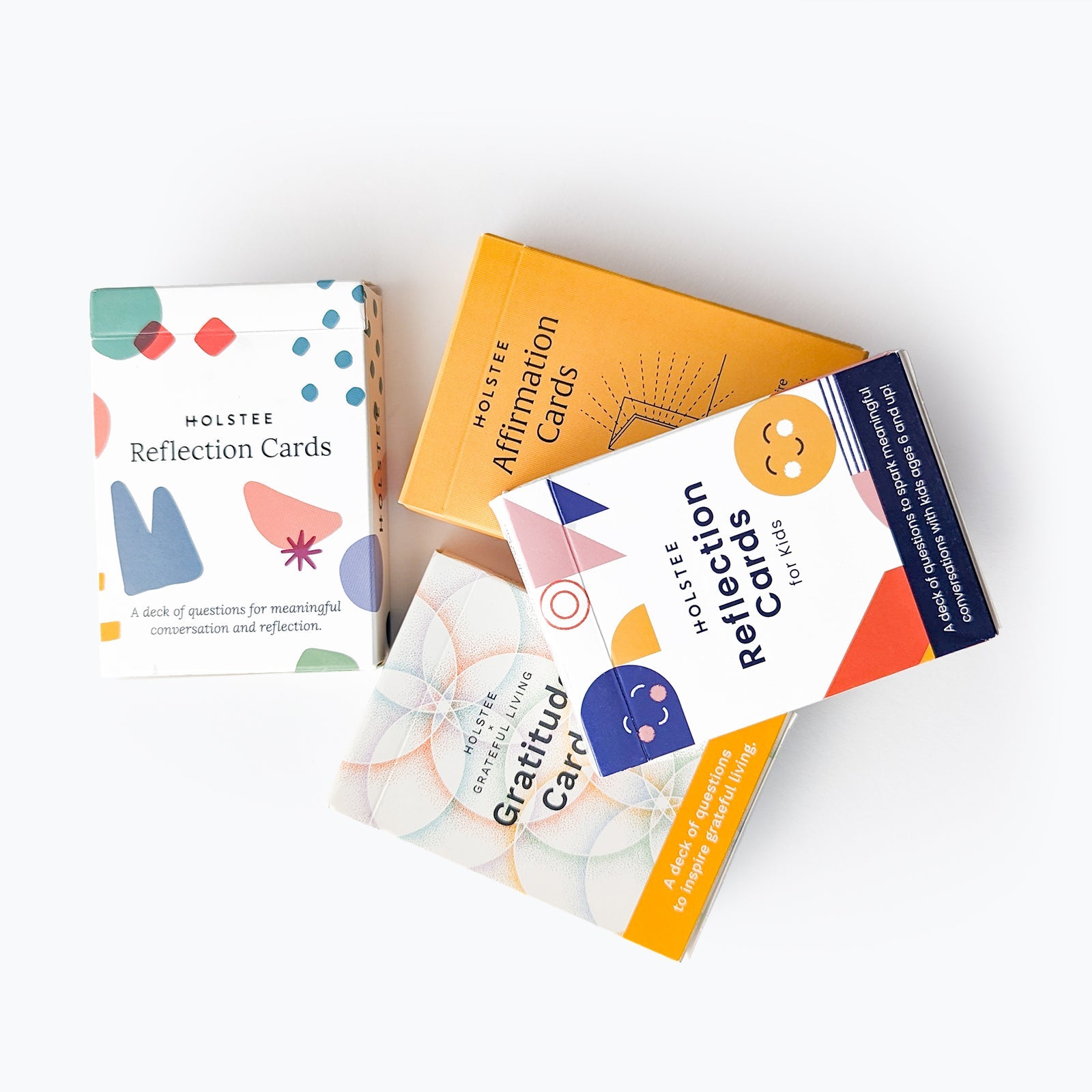
This is more or less the practice our Reflection Cards are built around — each card asks one question that pushes you to look closely at something ordinary and find what's worth saying about it. If the daily-three exercise sounds useful but you'd like a prompt to point you, the cards are the simplest version of the same habit.
The Science: Why Small Joys Compound
The case for noticing small things is not just a feeling. Three findings from positive psychology, in plain English:
- Frequency beats intensity. Sonja Lyubomirsky's research finds that people who experience positive emotion often are happier over time than people who experience it intensely but rarely. Many small good moments compound; rare big ones don't.
- Hedonic adaptation flattens big rewards faster than small ones. A new car or a raise gives a measurable lift, then the brain adjusts and the new state becomes the baseline within months. Small, varied joys resist that adaptation because each one is different.
- Naming a positive moment doubles its effect. Barbara Fredrickson's "broaden-and-build" theory shows that consciously labeling a good feeling extends both how long it lasts and how much it builds psychological resources for the future. Notice + name = more of the good stuff than notice alone.
You don't need to read the studies to use the finding. You just need to point your attention more often, and let the moments register when you do.
If This Resonated
A few ways to keep the thread going:
- Our Reflection Cards are a card-by-card prompt for the kind of attention this post is about — small, specific, daily.
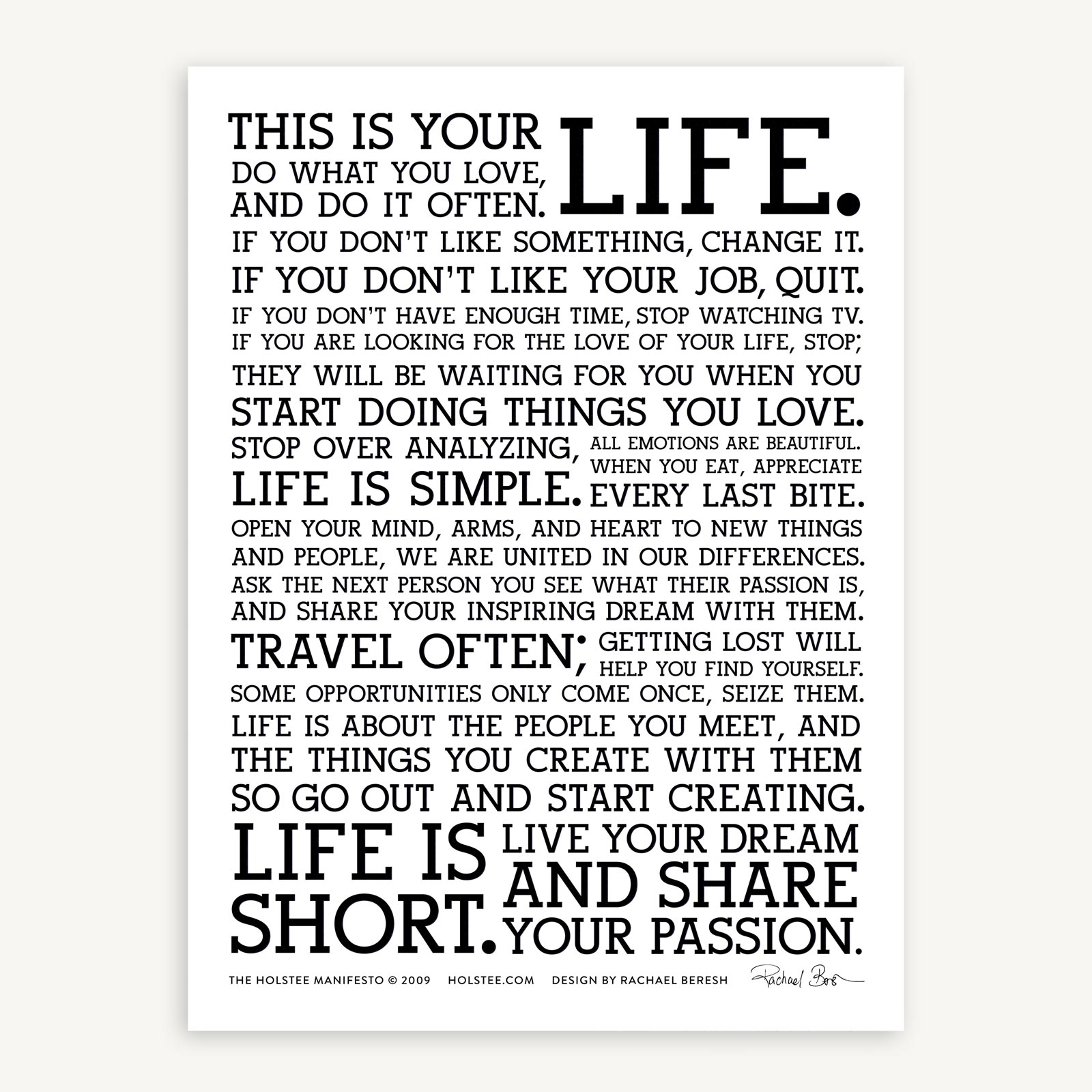
- The original Holstee Manifesto ("This is your life. Do what you love and do it often.") was written as a reminder that the days are made of small choices, not just big ones.
- The Flourishing Life is our membership community for people who want to practice this kind of attention in regular conversation with others who are too. Kinship — the deeper relational frame for the same idea — runs through it.
Frequently Asked Questions
What does "enjoy the little things" mean?
It means deliberately noticing and savoring small, ordinary moments — a good cup of coffee, a familiar song, a friend's laugh — instead of waiting for big rare events to feel happy. The phrase names a practice of attention, not a personality trait. Anyone can build it; most people don't make the time.
Who said "enjoy the little things in life because one day you'll look back and realize they were the big things"?
The line is most often attributed to Robert Brault, an American writer and newspaper columnist, from his long-running Round-Up column. The phrasing has been repeated and lightly modified online for decades, but Brault is the cited source. The exact original wording is: "Enjoy the little things in life, for one day you'll look back and realize they were the big things."
Why is enjoying the little things important?
Because little things happen far more often than big ones, and because positive psychology research finds the frequency of positive emotional experiences predicts long-term well-being more reliably than the intensity of rare big ones. A life of many small joys compounds; a life staked on a few enormous events leaves most of the days unattended.
What are some examples of little things to enjoy in life?
A short list: an unhurried cup of coffee, a few minutes of sun on your face, a good song catching you off guard, a stranger's smile, watching the light change at dusk, a book that's hard to put down, a nap, a kind word from a friend, a shared meal, a walk without your phone, a child's laugh, the first cool night of fall, the smell of rain. Yours will be specific to you — that's the point.
How do you start enjoying the little things?
Practice naming three specific small moments from the previous day, in writing, once daily. Specificity matters: "the way the light hit the counter while I made toast" trains attention; "I'm grateful for my family" doesn't. Do this for two weeks and the noticing starts happening on its own — the practice rewires what the mind reaches for.
Is "enjoy the small things" the same as "enjoy the little things"?
Yes — the two phrases are used interchangeably in everyday English, and both rank for similar searches. "Little" is slightly more common in the canonical Robert Brault quote; "small" is slightly more common in conversation. The practice is the same.
What's the difference between enjoying the little things and being grateful?
Heavy overlap, but a useful distinction. Gratitude is about acknowledgement — recognizing that something good came from somewhere. Enjoying the little things is about presence — being in the moment closely enough to notice it before it passes. You can be grateful in retrospect; you can only enjoy something in the moment it's happening. The two practices reinforce each other.
___________________________________
Shahnaz Radjy's background is Swiss, Bolivian, and Iranian (no, really). She loves food, farming, books, horses, adventure, and silly socks — though not necessarily in that order. Having traveled around the world for a year in 2016-17 to discover, learn, volunteer, and remember how beautiful life is outside an office, she and her husband are now based in Portugal, where they run a farmstay and write about life while enjoying every minute of it. You can read her travel blog, visit her Medium profile, or see photos of her experiences on Instagram.