Mindful Matter



Mokuso.
I recently started going to a small Muay Thai kickboxing school here in Amsterdam. It has been a new experience for me in many ways — my first time engaging in a competitive sport since high school, my first exposure to Muay Thai, and a language immersion as the classes are mostly in Dutch. The founders of the school trained in Japan, and every class begins with the students kneeling in a straight line across from the teacher. The teacher says the word “mokuso” and everyone exhales deeply and closes their eyes. For about a minute, the room is silent. For weeks, I assumed that mokuso (pronounced "mohk-sou") was a Dutch word that I didn’t know. Finally, I Googled it and learned that mokuso is actually a Japanese word, which roughly means, “to prepare one’s mind”. Indeed, this one-minute micro-meditation at the start of each class had helped slow me down, mentally prepare, and help me set my intention for what I am about to do. The teachers’ purpose is to ground the class and each individual student so that we can bring our full awareness to the training about to begin. It’s a tradition that I have taken with me outside of the class as well. Before I begin a big task, a presentation, or a meeting, I close my eyes and say to myself slowly, “mokuso” and exhale. It’s a way of preparing my mind and setting my intention for what’s about to begin. Always start with intention, Dave RadparvarCo-Founder, Holstee P.S. Speaking of awesome words in other languages, here are a few past reflections you may enjoy: Arete, Sonder, Kintsugi, and Shokunin Kishitsu. P.P.S. Looking to dive deeper into setting your Goals and Intentions? Take a look at our Intention Guide PDF (available to all Holstee Members).
Learn more
Won't you take me to… Funkytown?
Yesterday I was cruising through the easy streets of Ventura, dropping off my wife at work. We came to a stop light, and a great song came on the radio. So naturally, I had to dance. Belted into the driver's seat, my moves were limited to shoulder shakes and hands up in the air, but I was grooving. One moment later, the light turned green. The driver in the car ahead of us threw up his hands, looked back, and glared at us, shaking his head angrily. I think he assumed I was waving around my arms in impatience, mad because he wasn’t moving right when the light changed. Little did he know, I was moving to the disco beat. And honestly, I was so deep in dance mode, I hadn’t even realized the light had changed. So I tried to clear the air. Using hand gestures, I tried to explain that my movements were for the song, not for him. But in our complicated web of non-verbal communication, I only added to the confusion. As we went our separate ways, two things occurred to me: Maybe my signature dance moves are a little too erratic, and So much of our lives are shaped by our perspective — how we interpret what we experience. We often don't get the chance to understand the intentions behind others’ actions. We usually just get one side of the story. At Holstee, January is our month of exploring Intention — the purpose behind our actions. In the Intention Guide, you’ll find intention and goal-setting exercises inspired by thinkers like Gretchen Rubin, Leo Babauta, and W.H. Murray. Dance safely out there, Mike RadparvarCo-Founder, Holstee P.S. The song that caused all the confusion (and ultimately insight) was the disco-funk classic Funkytown by Lipps Inc. Honestly, is it even possible to listen to this track and not dance?
Learn more
Life goals.
“Your audacious life goals are fabulous. We're proud of you for having them. But it's possible that those goals are designed to distract you from the thing that's really frightening you — the shift in daily habits that would mean a re–invention of how you see yourself.” - Seth Godin I was recently reflecting on what success looks like in my life. If I were to die in a week, a year, or a few decades, what would it take for me to be able to say, “Well, I did it — I accomplished everything I wanted. I lived a successful life.” In considering this question, I realized that there is nothing particular I feel I need to achieve or complete. There are just ways in which I want to live. I want to live with honesty, with health, with love, and with generosity. I want to have spent meaningful time with the people I care most about. None of these are things I could earn or buy, they are only things I can do — and things I need to keep doing. None are the types of things I can cross off a list and be done with — they are ongoing ways of being. An outlook, an attitude, a habit — a way of life. So when it comes to goals, I realized that it’s important not just to think about what I want to achieve, but also to think about how I want to live. This month’s Intention Guide was designed to facilitate reflection on the role of habits and goals in your life, with a framework for helping you reflect on what goals are right for your definition of success. The journey continues, Dave RadparvarCo-Founder, Holstee P.S. We completely revamped the look, format, and content of our guides for 2018, starting with January’s Intention Guide — take a look at the printed version!
Learn more
A special day.
“Life moves pretty fast. If you don't stop and look around once in awhile, you could miss it.” — Ferris Bueller One of my favorite pieces of pop-culture wisdom. :-) It’s true though, life moves quickly. So quickly that it’s easy to miss. On a normal day, we race around trying to get as much done as possible. In fact, we are often so busy running from one thing to the next that before we realize it, the day is gone. But today is not a normal day. Not just because it’s December 25th, but also because there will never be another day just like it. Let the holidays be a reminder of how special each day is. Precisely because tomorrow is a new day, today is something to celebrate — and tomorrow too, for that matter. Wishing you and your family a wonderful day, today and every day. Thank you for another wonderful year together. With Love, Dave, Mike, Massiel and Jennifer P.S. Some fun Ferris Bueller gifs just 'cause... :-D
Learn more
Call it what it is.
I was recently in a personal conversation that got heated rather quickly. It got intense because everyone involved cared so much. Soon, the rational conversation was overtaken by strong emotions — ending abruptly, and unfortunately without much progress. Later, after having some time to reflect on it, I realized we were lost to our emotions.We had forgotten to practice in this conversation something that I practice often in my morning meditation.We had forgotten that the first step to controlling a runaway emotion is to actually notice that it’s happening. This is a core component of Vipassana Meditation, where the focus is on noting any physical sensations or thoughts during the meditation — a way of maintaining our awareness of the present moment.There is even some science to back this up. Matthew Lieberman, a research psychologist from UCLA, recently performed an experiment in which he showed a “fearful image” to patients hooked up to an fMRI machine. He saw that this immediately generated activity in the amygdala (a region of our brain known for its instinctual “fight or flight” reactions).Later, Lieberman repeated the experiment — but this time, he asked patients to acknowledge and label the emotion they were experiencing. Incredibly, this shifted the brain activity to the prefrontal cortex (a more advanced area of our brain where rational thinking occurs). Instead of defaulting to the reactionary part of their brains, the experiment subjects were able to acknowledge their emotions without fully getting swept up in them. It’s a challenging practice in the quiet of my own mind during meditation — and even more so in the tensions of daily life — but it’s one I have found to be really helpful. Whether fear, anger, resentment or sadness, I have learned that the first step towards separating our thoughts from our emotions is to label them in in our minds, bringing them into our awareness.This time of year can bring with it many conversations from the heart. We hope yours are filled with love, care, and a wonderful awareness of the beautiful spectrum of emotion.Love, Mike RadparvarCo-Founder, Holstee P.S. For the month of December, our Reflection Art is a graphic reminder to look inward. We spend so much of our time looking outward, while there’s so much to discover by listening to and exploring within. Which is why we created and sent all members our Guided Reflection Journal (also available online) — a simple way for you and the people you care most about to reflect on the past year.
Learn moreThe present informs the past.
I was recently listening to some of the mind-bending lectures from the philosopher Alan Watts’ audiobook for “Out Of Your Mind”. At one point, Watts discussed how the present informs the past — the idea that the past is constantly changing with every passing moment. “We must abandon completely the notion of blaming the past for any kind of situation we’re in and reverse our thinking and see that the past always flows back from the present. That now is the creative point of life. So you see, it’s like the idea of forgiving somebody. You change the meaning of the past by doing that … Also, watch the flow of music. The melody as it’s expressed is changed by notes that come later. Just as the meaning of a sentence … you wait till later to find out what the sentence means … The present is always changing the past.” I like to think of myself as open-minded, but I listened to these ideas with some skepticism. Time, as I have experienced, is linear and only progresses. There is no rewind button, there is no changing the past. But the more I let the idea and Watts’ examples sit with me, the more I came to appreciate the truth in them. Watts’ example of a melody resonated most. Every additional note changes the melody of the tune. So while the previous notes don’t actually change, the notes that follow change the tune. In that way, it’s a different tune than the tune in the past. And in that way, the past — or at least how we hear, see and understand it — has changed. Some (chewy) food for thought as we near the end of the year and you take time to reflect on it. Love, Dave RadparvarCo-Founder, Holstee P.S. This year we made our annual Reflection Guide available as a printed journal, as well as a printable PDF and Google Doc template.
Learn more
What does it mean to “live mindfully”?
At Holstee, our mission through our monthly Membership is to encourage people to “live mindfully”. It’s a big goal, but it can also seem like a vague one. In the spirit of reflection, we want to take a moment and consider what mindful living means to us. As a concept, mindfulness has become quite popular in recent years. And as it’s grown in popularity, its definition has become blurry. In talking with our friends and family, we found that “mindful living” means something different to everyone. There were a few common threads, though, and these have contributed to our definition. For us, living mindfully is about five things: presence, awareness, appreciation, reflection, and action. It is about taking moments throughout the day to be fully present with our environment and everything within it. It is about being aware of our individual impact and acknowledging the ripples of each step we take. It is about appreciating what is around us, including the wondrous and serendipitous moments that brought us into the world. Mindfulness is about reflection. It’s about appreciating how the past informs the future. It’s thinking about what we hope to get from our brief lives on earth and what we hope to give back to the forces that brought us here. Finally, it is about action: the steps we take to be present, to internalize our awareness, to voice our appreciation, and to embrace our reflections. Actions are the manifestations of our intentions. We cannot always choose what the world brings to us, but we can always choose how we act in response to it. Mindfully yours, Mike and Dave Mike and Dave RadparvarCo-Founders, Holstee
Learn moreNeurons that fire together, wire together.
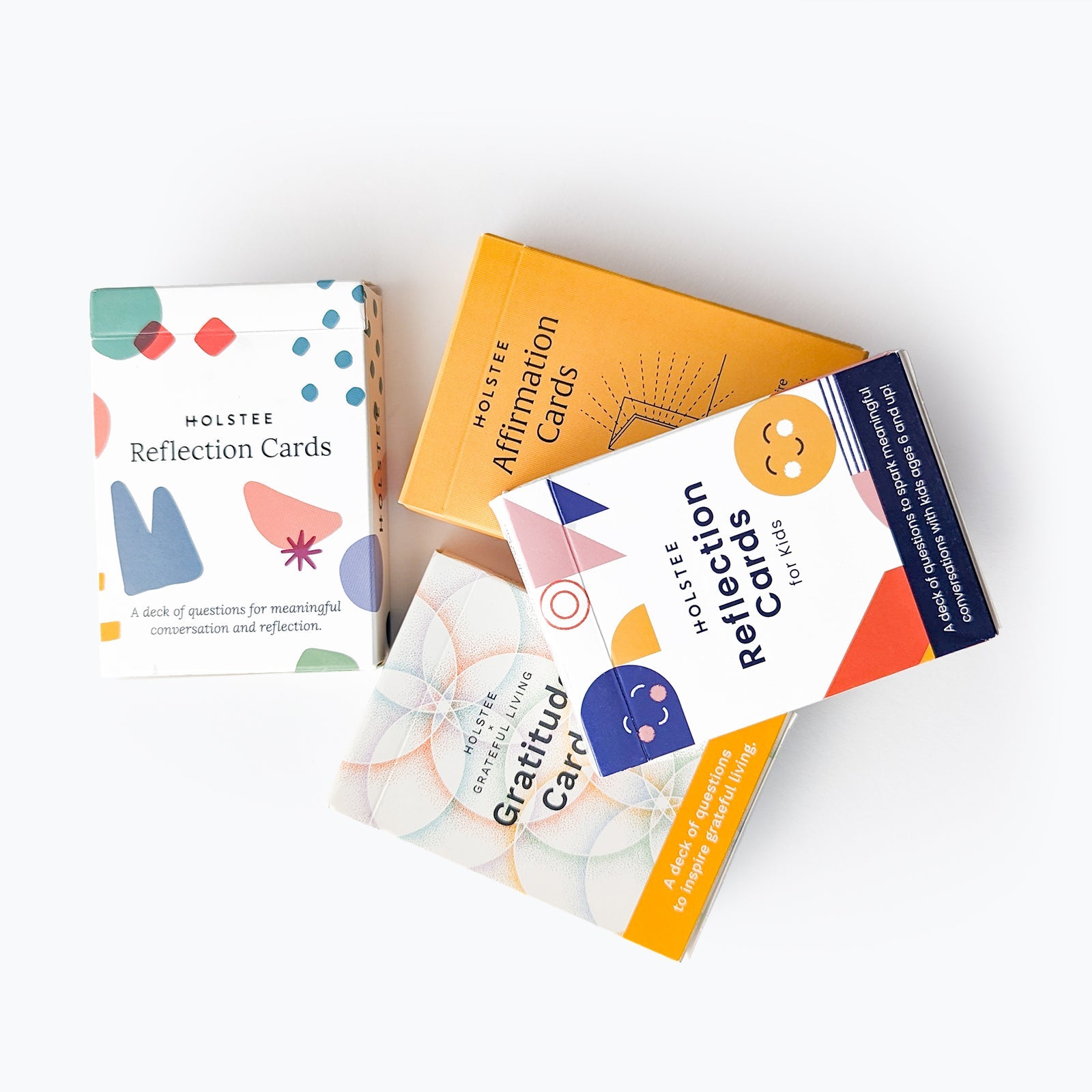
A short read on how repetition shapes you — and what to do with it. "Neurons that fire together, wire together" is a phrase from neuropsychologist Donald Hebb. It means that repeated thoughts and actions strengthen the neural pathways that produce them, making those patterns easier and more automatic over time. Repetition is the wiring. What does "neurons that fire together, wire together" mean? It means your brain wires itself through repetition. Each time two neurons activate together, the connection between them strengthens slightly. Repeat the pattern enough times and the brain treats it as the default — the next time the trigger appears, the same neurons fire together more readily. The phrase is a plain-English shorthand for what neuroscientists call Hebbian learning. The everyday version: whatever you do often, you get better at — including things you didn't mean to practice. Worry, harsh self-talk, and rumination wire together the same way gratitude, attention, and care do. The brain doesn't grade the pattern; it just reinforces what gets repeated. Where the phrase comes from: Donald Hebb and Hebbian learning "Neurons that fire together, wire together." — Donald Hebb Neuropsychologist Donald Hebb first proposed the underlying idea in his 1949 book The Organization of Behavior. Hebb was trying to explain how learning could happen at the cellular level — not as a vague metaphor, but as a physical change in the brain. His proposal, now called Hebb's postulate, was that when one neuron repeatedly helps fire another, the connection between them physically strengthens. Cells that activate together start to bind together. The catchy four-word version of the postulate — "neurons that fire together, wire together" — was actually coined later, by neuroscientist Carla Shatz in 1992. It's the formulation that stuck because it captures Hebb's whole idea in a sentence a non-specialist can remember. Both phrasings now appear in the literature; in popular use, Hebb gets the credit because the underlying theory is his. The phrase people sometimes mix up If you've seen it as "wire together, fire together" or "cells that fire together, wire together," you're not misremembering — both variants circulate. Wire together, fire together is the inverted form (sometimes used to describe the consequence rather than the mechanism). Cells that fire together, wire together is closer to Hebb's original cellular framing. The standard version is "neurons that fire together, wire together," and that's the one to search if you're chasing a citation. Hebbian theory and modern neuroplasticity Hebb's postulate was a precursor to the broader story we now call neuroplasticity: the brain's lifelong capacity to change its structure and function in response to experience. For decades after Hebb, the dominant view was that the adult brain was largely fixed. Research from the late 1990s onward — on stroke recovery, learning new skills in adulthood, mindfulness practice, even London cab drivers' enlarged hippocampi — kept showing that the brain stays plastic. The mechanism Hebb proposed turned out to be one of several that drive that plasticity. Repeated co-activation strengthens connections (long-term potentiation); disuse weakens them (long-term depression). The picture isn't quite as clean as four words make it sound, but the four-word version captures the practical truth: your brain becomes what it practices. Why it matters for daily life: how repetition shapes you This is why the practice of gratitude — the regular journaling and the habitual moments of reflection — can be so powerful. It creates and strengthens pathways in the brain for acknowledging what you have to be grateful for. The more you do it, the more ingrained it becomes, and the easier it gets for the brain to find gratitude on its own. A small repeated input compounds into a default state. The same logic runs the other way for less helpful patterns. If your default is to scan for what's wrong, what's missing, or what someone else has — what psychologists call social comparison — that's also wiring. The path to changing it isn't to "try harder to think positively" — it's to give the brain something specific to repeat, on a small enough scale that you can actually do it daily. A simple practice: noticing the wires you're laying One small daily practice is enough to start shifting which neurons fire together. The format matters less than the consistency. One sentence, every morning or evening. Name a single specific thing you're grateful for. Specific beats abstract — "the way the kitchen light hit the counter this morning" wires more than "my health." Pair it with an existing routine. Brushing teeth, first sip of coffee, walking to the subway. The existing habit is the trigger; the new pattern attaches to it. Use a prompt when you're stuck. "Who made my life easier today?" "What surprised me?" "What did I almost miss?" Prompts cut the friction of staring at a blank page. Our Reflection Cards exist for exactly this — a deck of prompts you draw from when you need a starting point. Keep it small. Five minutes daily beats an hour weekly. Repetition is the wiring; intensity isn't. If you want a deeper read on why willpower-based approaches to changing patterns often backfire — and what to do instead — this piece on habits covers it. The Stoics had a version of the same idea two millennia before Hebb did; our Stoicism 101 primer goes into the practice side of that, and our piece on per aspera ad astra sits right alongside it — the Stoic idea that we grow through hardship, not around it. So get those neurons firing! You'll be grateful you did 😉. Dave RadparvarCo-Founder, Holstee P.S. If you want a starting point for your own daily noticing practice, our Reflection Cards are designed to be exactly that — a small repeated input you can pull from each day. And if you're looking for a community to keep the practice going, our membership is built around shared reflection. P.P.S. If this is the kind of idea you find yourself thinking about, Enjoying the Little Things is a natural next read — it's the practice side of the same wiring. P.P.P.S. And when the repeated input is something you do with other people, Connection Through Shared Ritual looks at how a shared routine wires a group together, not just a single brain.
Learn more