

Mindful Matter

Q&A with Cami Zea
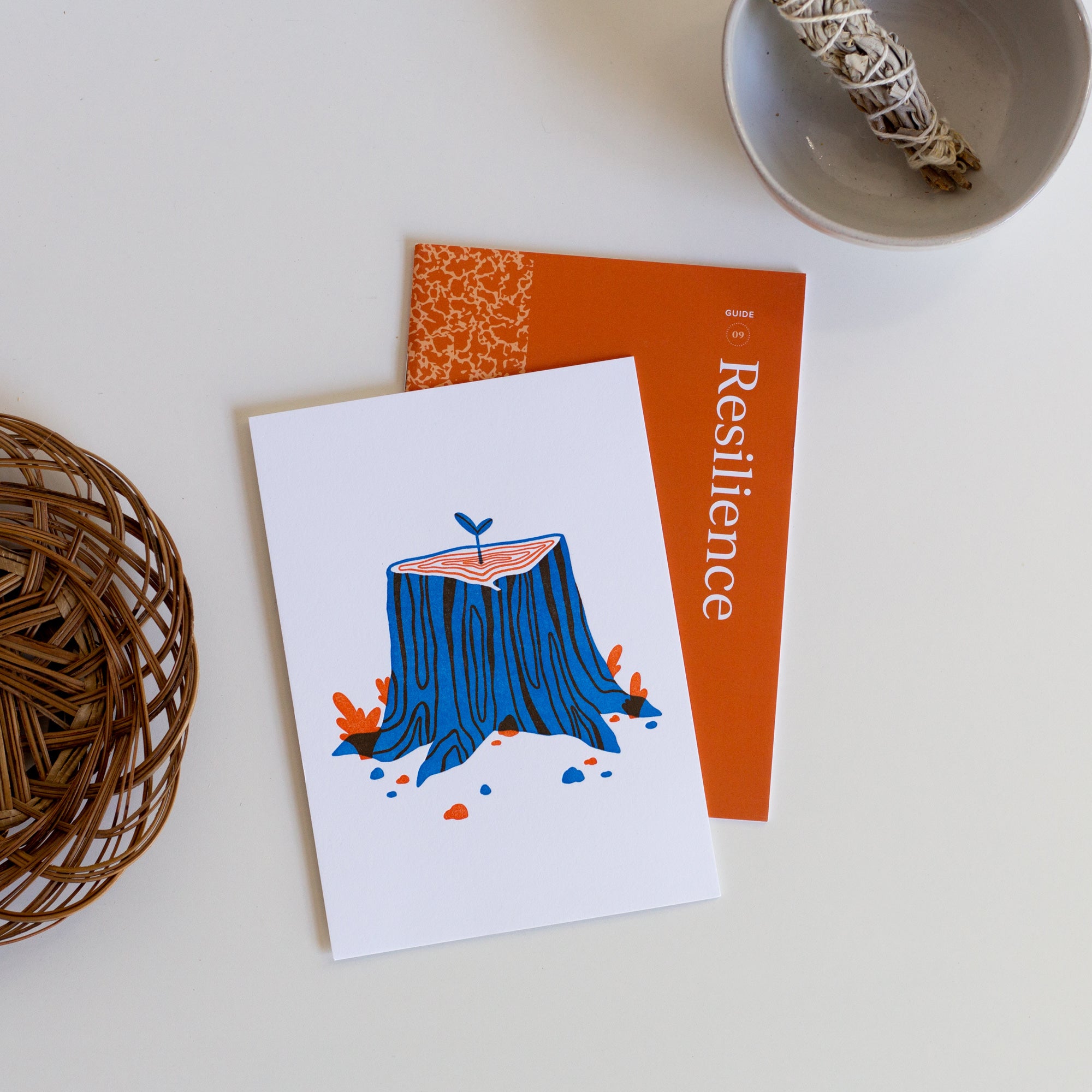
This month we partner with illustrator Cami Zea, who can be found anywhere along the West Coast of the USA. Cami is an artist, writer, and feelings feeler expressing herself through digital lettering. She says, "It takes true resilience to show up to this life- present, eyes ahead, taking it all in with your feet firmly planted. Not rushing what surfaces by the day- when circumstances are a chopping wave can you keep yourself in place and wait?” For a little more about Cami, here's a short Q&A: Where is home for you? Anywhere along the West Coast of the United States. What is your definition of a successful life? A life that was lived with great curiosity and commitment to staying present. I go to bed feeling the most successful when I am really awake within my day. I tasted my coffee, I looked into someone's eyes, I soaked in my surroundings and listened with my whole self. A life I paid great attention to is one of great success. Describe your perfect day. On my perfect day, I wake up with curls that are working for me and zero trace of a grumpy attitude. Somewhere along the way I get to see a lot of dogs. I have slow coffee, and write for hours. Every single word is inspiring!! It ends with dinner around a table of people I love. There is wine and, if I'm being honest, I probably cooked the meal and every bite was delicious! People couldn't stop talking about how buttery the mashed potatoes were. We drink many bottles and talk until we are tired. I go to bed so full of life and love and carbs. How did you get into design? I've always been a creatively driven person. I took art all of high school and my teacher (I love you, Sherry Windham!) discovered that I had great handwriting. She asked me to design all of our prom posters from freshman to senior year- but I didn't know at the time that it could be a substantial career path. Where do you find inspiration? A connecting conversation almost always draws something beautiful out. Tall trees. Books with great characters. Music. What's your dream design project? I would love to write a book full of hand drawn lettering quotes and longer form thoughts. Which designers or thinkers influence/inspire you? Alex Elle and Glennon Doyle provide deep soul stirring thoughts. I've been leaning toward art with a lot of texture and motion lately, so the work of Lolly Lolly Ceramics and Caroline Kaufman textiles have really pulled me in. My favorite lettering artists/illustrators of the moment are Lisa Congdon and Laci Jordan. What was the inspiration behind this design? My thoughts were swimming in the process of grief when I sat down and wrote this. It's so human to be put off to pain. Who wants to feel it? My instincts want to shut off to it, but we must feel it through to heal. We are worth the grit and guts it takes to heal. How does Resilience play out in your life? I wouldn't be where I was today if I didn't learn how to sit with what was difficult and heavy. Allowing myself to experience the gift of thriving after trauma and grief has required great resilience and tenacity. It has been the gift that cost a hefty price, but has also given me an artistic voice and led me back to myself year after year. At the moment, what is your favorite… Color: Black + Crisp red alwaysFood: Canelle et Vanille's banana breadSong: Eyes Are Red- Deep Sea Diver Quote: "To pay attention, this is our endless and proper work."- Mary Oliver Thanks for sharing with us, Cami!
Learn more
Antifragile.
“Wind extinguishes a candle and energizes fire.” – Nassim Nicholas Taleb In this month’s Online Member Gathering, we had a thought-provoking (and very timely) discussion about Nassim Nicholas Taleb’s book Antifragile: Things That Gain from Disorder. In it he describes a spectrum of resilience that objects, ideas, and even individuals fall on. The three markers on Taleb’s resilience spectrum are fragility, robustness, and, finally, antifragility. Fragile things (a champagne glass, a candle) are vulnerable to even the slightest force. Robust things (a rubber tire, a shield in battle) endure change, but with time and enough shock will break. Antifragile things (good ideas, evolution, and, unfortunately, wildfires) sustain and can even become stronger when challenged. Large-scale, negative forces like natural disasters, divisive politics, and a global pandemic can seem insurmountable, especially when occurring at once. This makes us, as individuals, feel vulnerable and fragile. In the current moment, each of us is being pushed to new limits, almost to the point of breakdown. However, these same forces also push us to create robust and even antifragile countermeasures: neighbors coming to one another's aid, renewed interest and involvement in our governing bodies, and novel approaches to old problems. Our ability and willingness to collectively solve problems are the building blocks of an antifragile society. If enough of us choose to respond to these challenging times through compassionate engagement, we could come out stronger than before. To our shared strength and antifragility, Mike RadparvarCo-Founder, Holstee
Learn more
Feel the feelings.
Like so many others, I was very saddened to hear of Ruth Bader Ginsburg’s passing this weekend. Justice Ginsburg beat cancer twice before it took her life on Friday. She was a force of nature and a determined advocate for women’s rights. Her passing comes at a time that is already full of challenging setbacks for many of us. In moments like this, moments when I feel an overwhelming sense of sadness and despair, I look over at a small print that my wife keeps on her desk from a past Holstee Membership Resilience kit, a collaboration with writer Courtney E. Martin and illustrator Wendy McNaughton. These last few months, I have found energy and inspiration in the words on the art print and I hope they provide the same for you now. Here is what it says: “This is your assignment. Feel all the things. Feel the hard things. The inexplicable things, the things that make you disavow humanity’s capacity for redemption. Feel all the maddening paradoxes. Feel overwhelmed, crazy. Feel uncertain. Feel angry. Feel afraid. Feel powerless. Feel frozen. And then FOCUS. Pick up your pen. Pick up your paintbrush. Pick up your damn chin. Put your two calloused hands on the turntables, in the clay, on the strings. Get behind the camera. Look for that pinprick of light. Look for the truth (yes, it is a thing—it still exists.) Focus on that light. Enlarge it. Reveal the fierce urgency of now. Reveal how shattered we are, how capable of being repaired. But don’t lament the break. Nothing new would be built if things were never broken. A wise man once said: there’s a crack in everything. That’s how the light gets in. Get after that light. This is your assignment.” To feeling the feelings and never losing hope, Dave RadparvarCo-Founder, Holstee P.S. This letterpress print is no longer available at Holstee, but Wendy has them available here. P.P.S. Also, a friendly reminder that this is the last week to save 20% on pre-orders for the Ritual Life Planner!
Learn more
Q&A with Lim Heng Swee
This month’s art is by illustrator, Lim Heng Swee. His goal as an illustrator is to "doodle a smile on the Earth’s face." Lim Heng Swee's inspiration behind his design represents the idea that the "challenges we face in life are like the never-ending waves. We can't stop them but perhaps we can learn to surf on them. Face every one of life’s challenges as a precious experience.” For a little more about Lim, here's a short Q&A! Where is home for you? Home is where I am with my loving family. What is your definition of a successful life? For me, a successful life is not about what we achieve or what we own. We can have a successful life from now on if we are able to feel happiness in the little things in life. Describe your perfect day. Every day that I’m able to be together with the people I love while doing the things I love, which is creating art. How did you get into design? I didn’t study art. I studied to become a Mechanical engineer, so I’m a self-taught artist. Where do you find inspiration? As an artist, we need to be sensitive to what we encounter in life. I always record down those elements I found interesting and touching. The creative process is like playing a game to find connections between dots. What's your dream design project? As I homeschool my 2 boys now, I wish to travel the world with them. I think travel is a great process of learning, in the meantime, I wish to have my exhibition in the city/town along our journey. That’s my dream project. Which designers or thinkers influence/inspire you? I like to share this story about a Mexican fisherman, which goes along something like this: An American investment banker was at the pier of a small coastal Mexican village when a small boat with just one fisherman docked. Inside the small boat were several large yellowfin tuna. The American complimented the Mexican on the quality of his fish and asked how long it took to catch them. The Mexican replied, “only a little while. The American then asked why didn’t he stay out longer and catch more fish? The Mexican said he had enough to support his family’s immediate needs. The American then asked, “but what do you do with the rest of your time?” The Mexican fisherman said, “I sleep late, fish a little, play with my children, take siestas with my wife, Maria, stroll into the village each evening where I sip wine, and play guitar with my amigos. I have a full and busy life.” The American scoffed, “I am a Harvard MBA and could help you. You should spend more time fishing and with the proceeds, buy a bigger boat. With the proceeds from the bigger boat, you could buy several boats, eventually you would have a fleet of fishing boats. Instead of selling your catch to a middleman you would sell directly to the processor, eventually opening your own cannery. You would control the product, processing, and distribution. You would need to leave this small coastal fishing village and move to Mexico City, then LA and eventually New York City, where you will run your expanding enterprise.” The Mexican fisherman asked, “But, how long will this all take?” To which the American replied, “15 – 20 years.” “But what then?” Asked the Mexican. The American laughed and said, “That’s the best part. When the time is right you would announce an IPO and sell your company stock to the public and become very rich, you would make millions!” “Millions – then what?” The American said, “Then you would retire. Move to a small coastal fishing village where you would sleep late, fish a little, play with your kids, take siestas with your wife, stroll to the village in the evenings where you could sip wine and play your guitar with your amigos.” Source: BeMoreWithLess, "The Story of the Mexican Fisherman" by Courtney Carver What was the inspiration behind this design? Challenges we face in life are like the never-ending waves, we can't stop them but we can learn to surf on it, take every life challenge we face as fun and precious experience. At the moment, what is your favorite… Color: Earth tone Food: A simple home-cooked meal Song: Living in the moment by Jason Mraz Quote: "You can't stop the waves, but you can learn to surf." -Jon Kabat Zinn
Learn more
Per aspera ad astra.
A couple of months ago, I was driving with my parents to Ventura, CA to visit Mike. After a few hours in traffic, we decided to switch on a recent Oprah SuperSoul Conversations podcast episode with author and spiritual teacher Eckhart Tolle. In the last 10 minutes, their conversation moved to the current state of the world. Oprah asks Tolle: "So, what is your interpretation of these troubled times we are living in?" He replies: There is a Latin saying going back 2000 years: “per aspera ad astra" which translated means “through adversity to the stars,” or, "through hardship to the stars." So whenever an obstacle rises that seems to block the path forward, in reality the obstacle has an essential function. And that is, it forces me or it forces humanity to generate more — either more strength, more energy or more consciousness." That got my interest. It reminded me of the Stoic view of adversity, a concept that really resonates with me, and we have written about before. Tolle continues: “It even operates on a physical level. If you want to make your body stronger, what do you do? You say, well, you need to exercise. But what is exercise? Exercise is … for a while you have to make life difficult for your body ... you have to lift this weight … ”Oh my god, it’s so [heavy]” … You are not in your comfort zone anymore … And so life becomes difficult for the body and then there is a demand for more strength … When life becomes difficult for human beings there is demand for more consciousness.” For Me, The Meaning of Per Aspera Ad Astra When I look at my own life, I see that my greatest periods of personal growth came after particularly challenging moments — moments where I was beyond my comfort zone. This idea of growth through adversity has come up in the Holstee Membership a number of times, particularly in the importance of Adventure and the beauty of Resilience. While it doesn’t make going through tough times any easier, this idea does give me hope that through it all, we can rise higher than where we started. To the stars, Dave RadparvarCo-Founder, Holstee [Editor's Note: While Eckhart Tolle attributes the phrase "per aspera ad astra" to 2000 years ago, it's important to note that this is not historically accurate. The exact phrase "per aspera ad astra" is of more recent origin, with documented usage dating back to the early 20th century. However, the concept of overcoming adversity to achieve greatness does have roots in classical literature. For example, Seneca the Younger wrote in his work "Hercules Furens" around 54 AD: "Non est ad astra mollis e terris via" (There is no easy way from the earth to the stars).]
Learn more
The legend of Django Reinhardt.
Django Reinhardt is known as one of the best jazz musicians of the 21st century. What’s less known is the story of his incredible resilience. I came across this story while getting lost down a Wikipedia rabbit hole one recent night and wanted to share it with you. Reinhardt was born in 1910 and grew up in a family caravan with his single mother and siblings in a nomadic Romani settlement outside of Paris. Life in the settlement wasn’t easy, so he became skilled at stealing chickens for his family. Reinhardt was also musically inclined and taught himself the violin, banjo and guitar. At the age of 12, he would travel outside of his community to Paris to put on shows. By 18, he was a favorite in Parisian dance halls and beginning to gain international fame. Then the unthinkable happened. One evening, a candle fell into flammable liquid as Reinhardt and his wife slept. Their caravan immediately went up in flames and they barely escaped. Reinhardt was hospitalized for nearly two years with bad burns across his body. Two of the fingers on his left hand were burned with silver nitrate to make what remained of his hand usable, but the doctors doubted that he would ever play guitar again. In a way the doctors were right. Reinhardt was never able to play the guitar as he did before the fire. Instead he changed his technique, creating a new style to accommodate his hand. "Instead of playing scales and arpeggios horizontally across the fretboard as was the norm, he searched out fingerings that ran vertically up and down the frets as they were easier to play with just two fingers. He created new chord forms. . . . He pushed his paralyzed fingers to grip the guitar as well, his smallest digit on the high E string, his ring finger on the B, and sometimes barring his index finger to fashion chords of four to five notes. He then slid his hand up and down the fretboard, employing these chord forms to craft a fluent vocabulary."Excerpt from “Django: The Life and Music of a Gypsy Legend” by Michael Dregni This new style sealed Reinhardt’s status as a music legend. During the first part of the 20th century, he was considered the most famous jazz musician in Europe. This isn’t the only obstacle Reinhardt overcame. His biography includes many fascinating stories (including 2 failed attempts of escaping France in World War II, once where his life spared by a jazz-loving soldier). For many people, a life filled with so many obstacles would kill the spirit, if not the body. But Reinhardt was determined to overcome his impediments and bring his own style to the music he loved so much. In the process, he created an incredible library of music (I’ve been playing his Spotify hits on repeat for the past week). His legacy is a powerful reminder that life can give us obstacles — but it will not be defined by those obstacles, only by how we respond to them. Dave RadparvarCo-Founder, Holstee
Learn more
Let it RAIN.
I recently found myself juggling a family emergency and a complex work project, all while trying my best to not completely fail in my role as a husband and father. It’s in moments like these that I have found Tara Brach’s RAIN method especially helpful. Tara is unique in that she combines eastern spiritual practices with a Ph.D. in Clinical Psychology. RAIN is the acronym of Tara’s four-step process for ‘practicing mindfulness and compassion’ when in a challenging moment and is one of the exercises featured in this month’s Resilience Guide. Here are the steps: R - Recognize what is going onAcknowledge your thoughts, feelings, and behaviors. Step outside of yourself and recognize any signs of a harsh inner voice, feelings of embarrassment and dread, or noticeable physical manifestations created by anxiety. A - Allow life to be just as it isAllow the experience to be there, just as it is. Do not attempt to alter or avoid it. When defaulting to self-judgment, let the negative emotions exist. It does not mean you are unworthy, it means you recognize painful feelings created by a stressful moment. I - Investigate with interest and careLean into your natural curiosities to discover the truth. Ask yourself, “How is this experience manifesting in my body? What is it that I think I believe? What does this vulnerable place want from me and what does it need most?” N - Nurture with self-compassionOnce you identify the wounded and hurting place inside you, offer a gesture of kindness that might address it. Ask yourself, “Does it need a message of reassurance? Of forgiveness? Of companionship?” Sincerely spark self-compassion and even if it feels awkward, it will start to soothe and strengthen the heart. Take time to explore RAIN as a stand-alone meditation or return to this exercise the next time you face a challenging moment. Mike RadparvarCo-Founder, Holstee
Learn more
Grief and gratitude.
Last week our grandfather, or Babajoon as we called him, passed away at the incredible age of 104. His death came just four months after the passing of Mamanjoon, our grandmother and his wife of 75 years. His passing also marked the loss of our last living grandparent. After the news of his death, our family received many comforting messages and words of wisdom to guide this period of grief. One video in particular was shared a few times, first by our cousin and then again by a close friend. It was an honest, heartfelt, and open conversation between Stephen Colbert and Anderson Cooper discussing life after losing loved ones. About 13 minutes in, Cooper says to Colbert: "You told an interviewer that you have learned to love the things that you most wish had not happened. You went on to say, ‘What punishments of God are not gifts?’ Do you really believe that?" Colbert took a moment and responded: "Yes. It’s a gift to exist, and with existence comes suffering. There’s no escaping that. But I didn’t learn it — that I was grateful for the thing that I most wished hadn’t happened. It’s that I realized it... I don’t want it to have happened. I want it to not have happened. But if you’re grateful for your life — and not everyone is, and I’m not always… then you have to be grateful for all of it. You can’t pick and choose what you’re grateful for. Then what do you get from loss? You get awareness of other people’s loss, which allows you to connect with that other person, which allows you to love more deeply and to understand what it’s like to be a human being…and however imperfectly, acknowledge their suffering and to connect with them and to love them in a deep way that not only accepts that all of us suffer, but also that makes you grateful for the fact that you have suffered so that you can know that about other people. And that’s what I mean. It’s about the fullness of your humanity. What’s the point of being here and being human if you can’t be the most human you can be?" Learning to find peace, growth, and even gratitude from our most painful moments — is an incredible act of Resilience. To life, love, and humanity, Mike and Dave RadparvarCo-Founders, Holstee
Learn more