

Mindful Matter

Digital Minimalism.
"They joined Facebook to stay in touch with friends across the country, and then ended up unable to maintain an uninterrupted conversation with the friend sitting across the table." — Cal Newport, Digital Minimalism I know, you know, we all know — there are better things to do with our time than peruse social media. Despite knowing this, I had to reel myself back from multiple digital distractions while writing this. Pandemic life over the past year certainly hasn’t helped. Reports show that in past months usage of Twitter, Instagram, TikTok, and other platforms have increased significantly. So, in light of this knowledge and this month’s theme, Simplicity, I invite you to visit (or revisit) author Cal Newport’s idea of digital minimalism with me. According to Cal, “the cost of social media is not so much what you are doing, but what it is pushing out of your life” — and for many of us, that is high-quality leisure activities and learning how to be alone. While always-available apps and social media have their merits, they also enable a unique form of “low quality distraction”, giving us a ready escape when we might otherwise be processing important problems, gaining insight, or practicing the lost art of simply being. Over time, this leaves us feeling impoverished. Enter Cal’s Three Principles of Digital Minimalism: Clutter is Costly — Which apps are critical and support your values?Cal draws a parallel to how hoarders can point to any single item in their collection and give a reason for why that item needs to stay in their life. The same can be said for our digital lives. Each app is working to dictate how you spend your time. Optimization Matters — How can you make technology support, rather than dictate, your schedule? For example, if you are a member of a community that uses Facebook groups, you can exercise digital minimalism by deciding to not have the app on your phone or only check the group on Sunday and Wednesday nights. Intentionality is Satisfying — What are ways that convenience is getting in the way of your intentions?It’s easy to worry that adopting digital minimalism might lead to temporary inconveniences, like not being 100% up-to-date on the latest news or updates from friends. Cal argues that this is OK because the positive overall value of being intentional and taking back control of your presence far outweighs any marginal benefits gained from sporadic updates. After revisiting digital minimalism, the question I keep returning to is: How can technology support me, rather than dictate my attention? I plan to use this month to identify the apps which are critical to my well-being and remove those that are just convenient. At the end of the month, I may add some non-critical apps back in, but at the very least I’d like to challenge myself to live like a digital minimalist for the rest of May — want to join me? For those joining the Member Gathering on the 20th, we will touch base on how it’s going and share takeaways from our experiences. To a month of less, but better... Mike RadparvarCo-Founder, Holstee & Reflection.app P.S. Digital minimalism is one of many ways we explore the theme of Simplicity with our members. Download our 25-page Digital Simplicity Guide PDF for more concepts, activities, and inspiration on living a simpler yet more meaningful life. Photo by Brad Javernick of Home Oomph
Learn more

Always invert.
Carl Gustav Jacobi was a German mathematician in the early 1800s, famous for his study of elliptical integrals. As a professor, Jacobi was known to tell his students, “Man muss immer umkehren.” Roughly translated: "One must always invert.” (Finally, my college German class put to use!) Jacobi was guiding his students toward the idea that it’s easier to understand complex equations when you work backwards from a clear result. Inverting isn’t just practical in math, but also in life. With this month’s theme of Simplicity, I have been thinking of ways to simplify my life — my commitments, my material possessions, even the digital content I consume. I’m having a difficult time cutting things back. I just don’t know what to get rid of. Taking Jacobi's advice, I decided to invert the question. Instead of asking myself what I need to get rid of, I imagined what a more simplified life would look like. What was I doing? What was I wearing? What was I reading? How was I spending my time? The question went from, “What do I need to get rid of?” to, “What do I want to keep?” Start with the end in mind, Dave RadparvarCo-Founder, Holstee P.S. Speaking of starting with the end in mind, in our Digital Welcome Guide we challenge you to write your own eulogy and to imagine how you might be remembered in order to help ground you in the values you choose to live today. It’s a powerful exercise that I often return to. In case you are curious, here is my eulogy which I wrote and shared a couple years ago.
Learn more
What do you need?
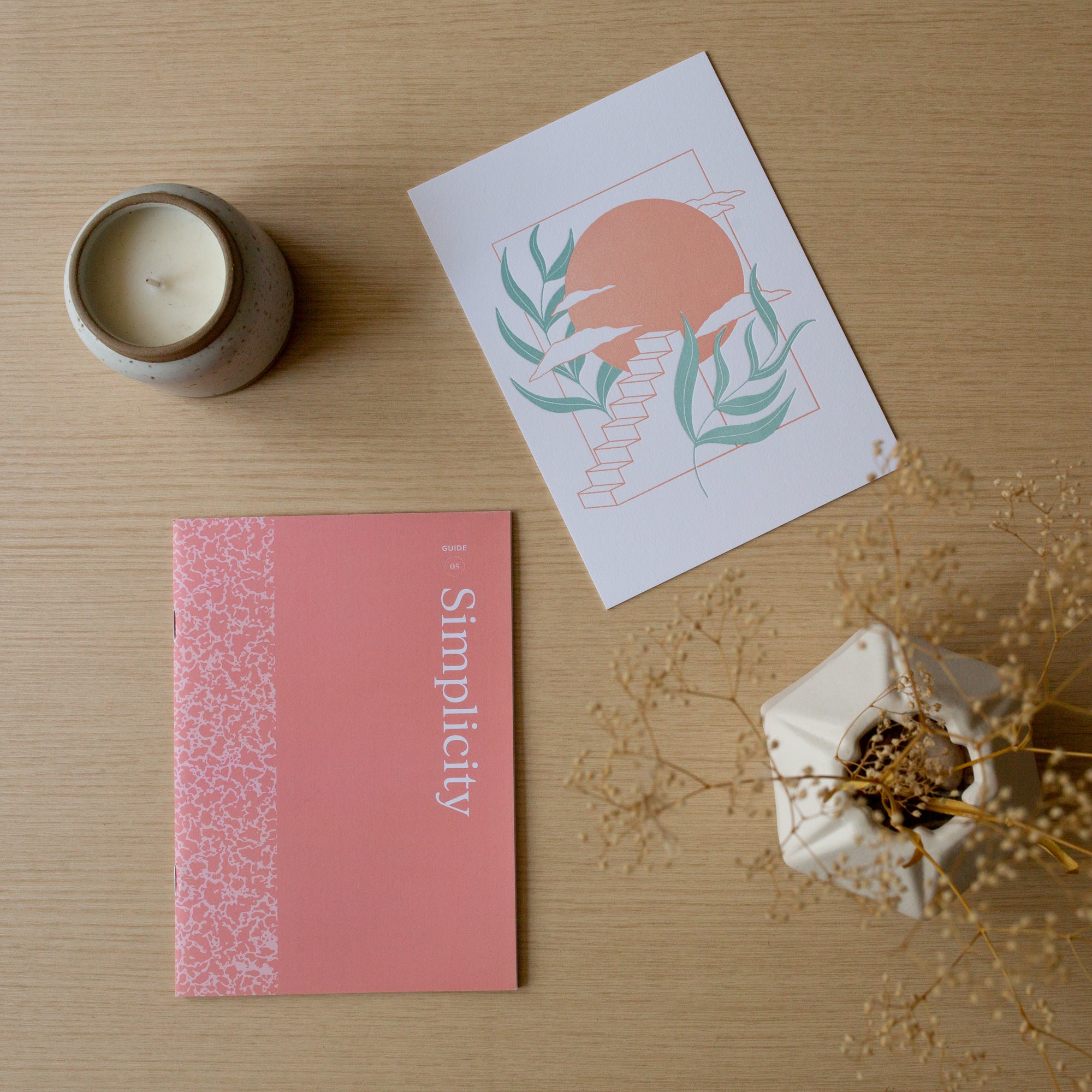
In this bold art for May’s theme of Simplicity, artist Iancu Barbărasă challenges us to reflect on what we actually need versus what we simply want. As the creative type in the print suggests, our needs are often overshadowed by our wants — so much so that it can be hard to see what our needs actually are. But where do we begin to understand what it is that we actually need? In 1943, a 35-year-old psychologist named Abraham Maslow condensed his research into a now-famous diagram: Maslow's Hierarchy of Needs. Image via The School of Life One of the reasons this diagram is so compelling is that it provides a simple and tangible answer for some of life’s biggest questions: What are we pursuing? And what do we need to achieve it? Over years of revisiting this diagram in relation to my life, I have come to appreciate that my place on the pyramid is constantly in flux as circumstance and priorities change. With our world at a meaningful turning point, it is a unique moment to revisit and distinguish what it is that we need right now. Reflecting on Maslow’s hierarchy of needs — what do you need right now? Dave RadparvarCo-Founder, Holstee P.S. We are such fans of Abraham Maslow that we created a tool and named it in his honor. Two years ago, we launched Maslow — a text-based chatbot for Holstee Members to easily access all member content, like the monthly Art, Guides, Discussion Questions, Quotes and more quickly and more easily from any phone. Give it a try!
Learn more
Making space for growth.
I was sitting on my balcony one recent morning, enjoying a cup of tea, when I looked over at our jasmine plant and realized that it hadn't yet flowered this season. The leaves had been reddish brown since the winter, but they hadn't fallen. I don’t have much of a green thumb, but something felt off. So last week I decided to prune the plant, carefully removing all the non-green leaves. The next day I came outside and there were already a dozen new sprouting leaves. The day after that, I glimpsed a handful of teeny-tiny flower buds. This whole time I was waiting for the jasmine plant to flower, I was wondering what more it needed — more fertilizer, more water, or perhaps more sun. Turns out, the only thing holding it back from growing was its past self. It made me wonder — how much of our growth relies on first trimming what no longer serves us? What do we need to release so that we can flourish in the next season? What if we were to prune all the preconceived notions of who we are? All the regrets of the past and the anxieties about the future. All the outside influences telling us who we should be. The pride, the ego, the baggage — snipping and letting these things fall away. What new season of life can we step into after we make space for our own growth? Dave RadparvarCo-Founder, Holstee P.S. Making space is something we explore every May with our members, diving into the art and science of Simplicity through our monthly kit, digital guide, curated resources, and now also with our online gatherings!
Learn more
Q&A with Iancu Barbărasă
This month’s art is by Romanian illustrator, Iancu Barbărasă. Now based full-time in London, Iancu creates art with an ideas-led approach. His work aims to inform, delight, and inspire people. He hopes his illustration serves a reminder that "We'll be much happier and our planet will be much better off when we want less and share some of what we have with those who really need it.” For a little more about Iancu, here's a short Q&A! Where is home for you? London, UK has been home for almost ten years now. I find its diversity very inspiring, even in spite of the recent political issues. I was born in Transylvania, Romania though, and it will always remain a special place for me. What is your definition of a successful life? Having a helpful, positive impact on people’s lives, starting with family, friends, colleagues and hopefully others as well. Describe your perfect day. Wake up, have breakfast, go out cycling for an hour or two, get back, shower, draw for two-three hours, quick lunch, draw or read for another couple of hours, cook dinner and enjoy the evening with my partner. How did you get into design? I’ve always liked drawing, but I'm a rational type, so I was considering architecture and design during high school. I chose design because of the wider range of projects – my university had a mixed curriculum, so I studied both product and graphic design, and some interior design as well. After graduating, I started working in advertising but I soon switched to branding, being much more interested in work that would last longer. I've been doing this for over fifteen years now. Recently I've started expanding into illustration and hand-lettering, thanks to a few of my personal projects that have drawn attention online. Where do you find inspiration? Reading a lot and being interested in a wide range of subjects. During a project, it comes first from answering the “why – what – who – how” questions: why are we doing this, what is the product or what are we trying to say, who is it for, and how should it feel. Besides that, I always try to “steal” ideas from seemingly unrelated fields, or from old masters. All work that seems original just has less obvious sources of inspiration. And of course, I follow favourite artists and designers online, but I do my best to keep their influence in check. What's your dream design project? Any project can be exciting if you’re working with great people. I'd love to work more with clients who care deeply about their impact on everyone and the environment. For example, Patagonia or the Certified B Corporation companies. Cycling or outdoors related would be just a bonus. Which designers or thinkers influence/inspire you? I greatly admire Christoph Niemann for his intelligence, kindness and versatility; Yvon Chouinard for proving that it is possible to have both a profitable and responsible business; Milton Glaser for explaining the importance of being able to create form, not just to find it; my grandad for teaching me to look at everything with a bit of imagination and a lot of goodwill. Plus I'm always learning from so many other amazing people, like Paula Scher, Michael Bierut, Katsuji Wakisaka, James Victore, Geoff McFetridge, Jean Jullien, Matt Blease, Austin Kleon, Jason Kottke, Alan Fletcher, Saul Steinberg, Herman Hesse, Tenzin Gyatso, and so on. What was the inspiration behind this design? I was searching for an impactful way to express the huge difference between what we want and what we actually need. Type size was a logical solution, but I also wanted to give it a sense of urgency and global scale. For some reason, the cover for Muse's Origin of Symmetry album came to my mind. So I tried to capture a similar uneasy atmosphere in my own design, but pushing everything to the extreme (tilted horizon, roughly hand-drawn type, long shadows etc.). At the moment, what is your favorite… Color: Red & Yellow (both better together than on their own). Food: Chestnut honey (it always reminds me of my grandparents). Song: OO by Robert Fonseca (love his latest album Yesun). Quote: “The great thing about drawing is that it forces you to pay attention, and attentiveness, in the Buddhist sense, is the one way we have to understand what is real.” —Milton Glaser
Learn more
How much more do you need?
With this month’s theme of Simplicity, we are focused on determining what’s essential — and eliminating all the rest. Before we can know what is essential, though, we need to identify what we need to feel comfortable. Our consumption-driven world constantly tells us we need more. More money, more clients, more clothes… The challenge is, if we don’t know what we’re striving for, we’ll never be content with what we have. Challenge yourself to write down what would be enough for you. For example, if constantly striving for more money is a challenge, ask yourself: At what salary would I be comfortable (regardless of what my peers earn)? At what number of clients or amount of revenue would I feel comfortable turning down a project? At what level of savings would I feel comfortable taking time off? Take an inventory of other parts of your life where you're striving for more and reflect on what would be enough. Write it down and return to it when you are feeling that endless pull for more. Because if you don’t know where you are going, you will never know when you arrive. Who knows, you may find you are already there. Simply yours, Dave RadparvarCo-Founder, Holstee Members: Check out this month’s Simplicity Guide and Curated Resources for suggestions on simplifying everything from your finances to your tech.
Learn more
Dude, you don’t even need a wetsuit.
Stop over analyzing. Life is simple. — The Holstee Manifesto I’ve wanted to try surfing ever since moving to Ventura, California. Last summer, I decided it was time to give it a go. I started by researching wetsuits and learned everything I could about the different options. I asked for recommendations from friends and anyone I met who surfed. Every person had a different suggestion, each with a compelling reason. Within a month, I went into a dozen surf shops, read the backstories of countless wetsuit brands and ordered and returned multiple wetsuits (none of which ever made it to the ocean). By mid-August, I was no closer to getting in the water. The guy at my local surf shop must have sensed my indecisiveness after my 7th visit. He said to me, “Dude, you don’t even need a wetsuit. The water is so warm right now – just jump in.” Facepalm. I had spent so much time trying to figure out the perfect wetsuit that I had lost track of what I really wanted to do. It was a great reminder that sometimes the solution to a problem is far more simple than we allow it to be. I went straight to Mondos, the local beginner beach, and paddled out for the first time. Though I didn’t get to ride a wave, it was perfect. This month’s Simplicity Kit is kinda like that guy in the surf shop — a simple yet powerful reminder to focus on what matters most. Keep it simple, Mike RadparvarCo-Founder, Holstee P.S. In California, you do need a full wetsuit for the cooler months. I finally landed on a Vissla wetsuit and am happy with it — but more than anything I am happy that I finally paddled out!
Learn more
Essentialism
“If I didn’t have this opportunity, what would I be willing to do to acquire it?” - Greg McKeown This question from Greg McKeown’s book Essentialism: The Disciplined Pursuit of Less (one of the suggested readings in this month’s Curated Resources) has become a litmus test for us when deciding which opportunities, not already in our roadmap, to take on.It’s only recently that we’ve gotten comfortable saying “no.” We’re a small team, that thrives on going deep on select projects. Our natural inclination to jump into every incoming opportunity while helpful when starting out, has turned out to be less useful today as our goals and vision for Holstee become more clear.While we’re still open to new opportunities, we’re far more discerning about the ones we’re willing to invest our team’s limited time and effort into.A similar approach can be taken to declutter the physical items in our lives by asking “if I didn’t have this already, would I still choose to purchase it today?”In this month’s Simplicity Guide we explore methods for bringing simplicity into our lives so we can focus on what really matters. Mike RadparvarCo-Founder, Holstee
Learn more