There's a kind of friendship that only ever exists in the future tense. You meet someone at a birthday party, you click over by the snacks, and you both say "we should really hang out." You mean it. They mean it. And then, somehow, you never do.
Most of us are carrying a small collection of these. Half-written texts to people we genuinely like. A mental list of "we should grab coffee" that has, in some cases, been pending for years.
It's easy to read that as a personal failing, some social muscle that other people kept and you let go slack. It almost never is. The reason making friends gets so much harder in adulthood has very little to do with you, and almost everything to do with the world quietly removing the conditions that used to make friendship happen on its own.
Here's what's going on, and the part that's genuinely hopeful.
The short version
Making friends gets hard in adulthood because the machinery that used to do it for you disappears. School, college, and early jobs put you in a room with the same people over and over, which is the one condition friendship actually needs. Take that away and you have to manufacture it on purpose, which takes more unstructured time than most adults think they have, plus a willingness to be the one who reaches out first. Most people aren't missing the desire. They're missing the structure.
You didn't make those old friends. The structure did.
Think about how your closest friendships actually started. Odds are you didn't pick those people so much as repeatedly bump into them. Same dorm floor. Same first job. Same team, same bus, same lunch table for four years running.
That's not a small detail. That's the whole thing. Proximity plus repetition, week after week, with no particular agenda, is the environment where friendship grows almost by accident. School and early adulthood hand it over for free, which is why our social networks tend to be largest in young adulthood and slowly contract after that (Franco, on the science of adult friendship).
Then come the moves, the demanding jobs where everyone's heads-down, maybe a kid, and the machinery quietly switches off. Nobody warns you. One day you look up and realize the last time you were dropped into a room of potential friends with nothing to do but hang around was a long time ago.
The friendships didn't get harder to keep because something's wrong with you. The free version just expired.
Friendship runs on a currency we stopped spending: unstructured time
A researcher named Jeffrey Hall actually tried to measure how long it takes to make a friend. His finding: somewhere around 40 to 60 hours together to go from acquaintance to casual friend, 80 to 100 to become a real friend, and more than 200 hours to become a close one (Hall, 2019).
Two hundred hours. That's not a couple of dinners. That's the kind of accumulated time most people used to rack up without trying, back when they saw someone every day for years.
There's a catch in this research: the type of time matters. Hanging out, joking around, talking about nothing in particular is the time that counts. Hours spent grinding side by side at work barely move the needle.
Which is the heart of the problem, because unstructured, no-agenda time is exactly the thing adulthood is most efficient at eliminating. Calendars fill with useful time. The pointless, lingering, nowhere-to-be time that friendship is actually built from is the first thing to go.
Somebody has to be the one who tries
Even when a promising person turns up, there's a gap most adults won't cross.
Every new friendship has an awkward middle. That stretch where you like someone but you're not close yet, where reaching out still feels like it might be too much. You have to send the text. Suggest the actual date. Risk the small, specific discomfort of being the one who seems to care slightly more.
Faced with that, most people quietly decide not to. The psychologist Marisa Franco calls one version of this "covert avoidance," when you do show up but never quite engage, staying on your phone or talking only to the one person you already know (Franco, Platonic). And we tend to assume new acquaintances like us less than they actually do, a bias researchers call the "liking gap," so we hang back to avoid a rejection that, most of the time, was never coming (Boothby et al., 2018).
It's almost always easier to assume the other person is too busy than to send a text that might go unanswered. So nobody sends it, and a friendship that wanted to happen simply doesn't.
This is more than a bummer
It would be easy to file all of this under "mildly sad fact of getting older." It deserves to be taken a little more seriously than that.
The number of people reporting no close friends at all has climbed sharply, from about 3% of Americans in 1990 to roughly 12% today (Survey Center on American Life, 2021). And the cost of that disconnection isn't only emotional. In 2023 the U.S. Surgeon General put out an advisory calling loneliness an epidemic, noting that around half of American adults report experiencing it, and that the health toll of chronic disconnection appears to be on the order of smoking up to fifteen cigarettes a day, with measurable links to higher rates of heart disease, stroke, and dementia (U.S. Surgeon General, 2023).
None of that is meant to alarm anyone, and the answer isn't to panic about your friend count. But it does reframe the stakes. Connection isn't a nice extra you get to once the important things are handled. For a social species, it's closer to one of the important things.
The good news is the fix is boring
And this is the hopeful part. If friendship is mostly a structure problem, then it's a solvable one. It doesn't require becoming more charming or interesting. It mostly requires rebuilding the conditions that used to do the work on their own.
A few things that reliably help:
Pick something repeating and just keep showing up. The magic ingredient was never the activity, it was the repetition. A weekly class, a regular pickup game, a standing walk, a recurring group that meets whether or not anyone feels like it that day. The goal in week one isn't to make a friend. It's to bank hours with the same faces until something clicks. Boring on purpose. That's the point.
Be the one who reaches out, and get comfortable being slightly too eager. Somebody has to send the text. The friends worth having are, statistically, also sitting at home assuming everyone else is too busy. Most people are quietly relieved when someone else goes first.
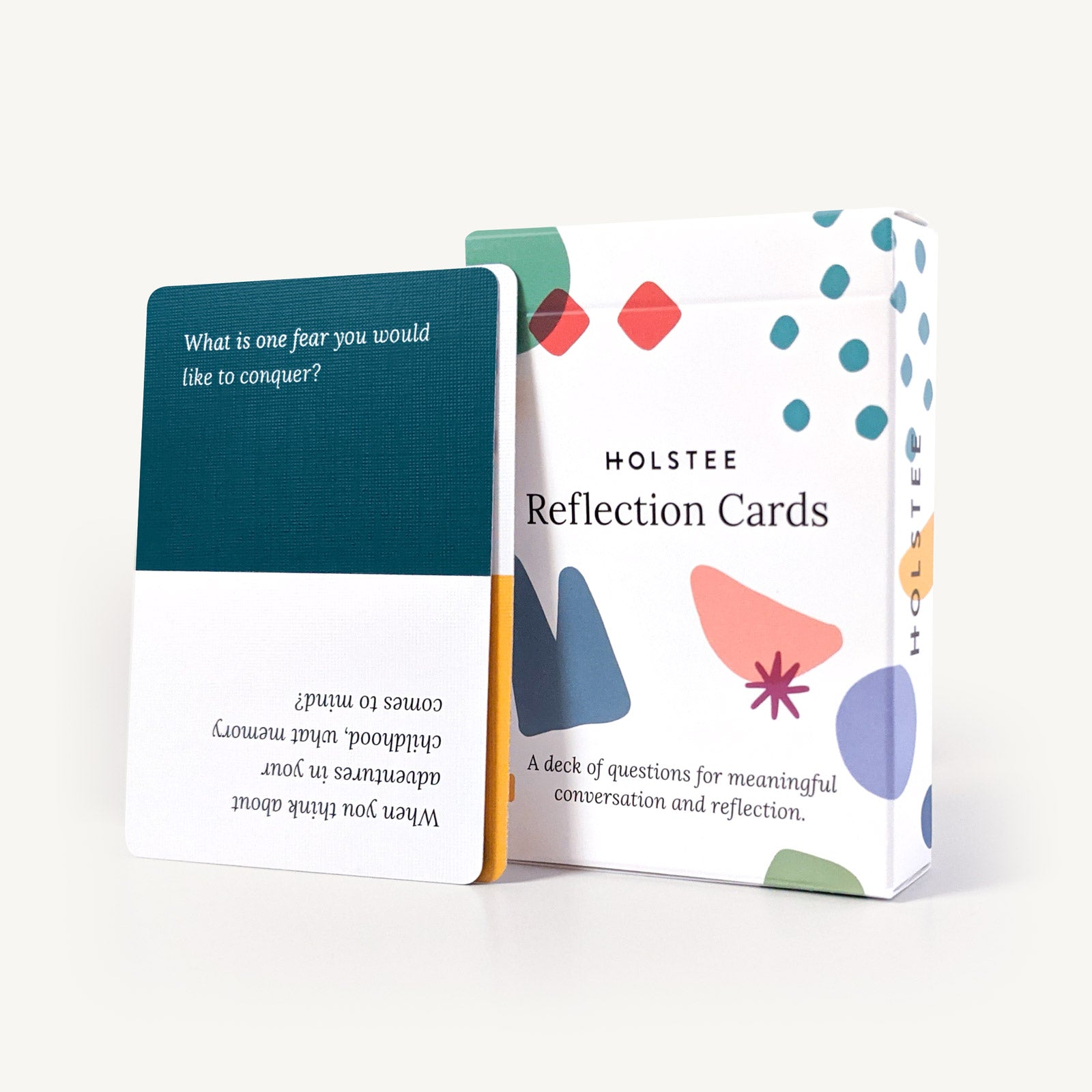
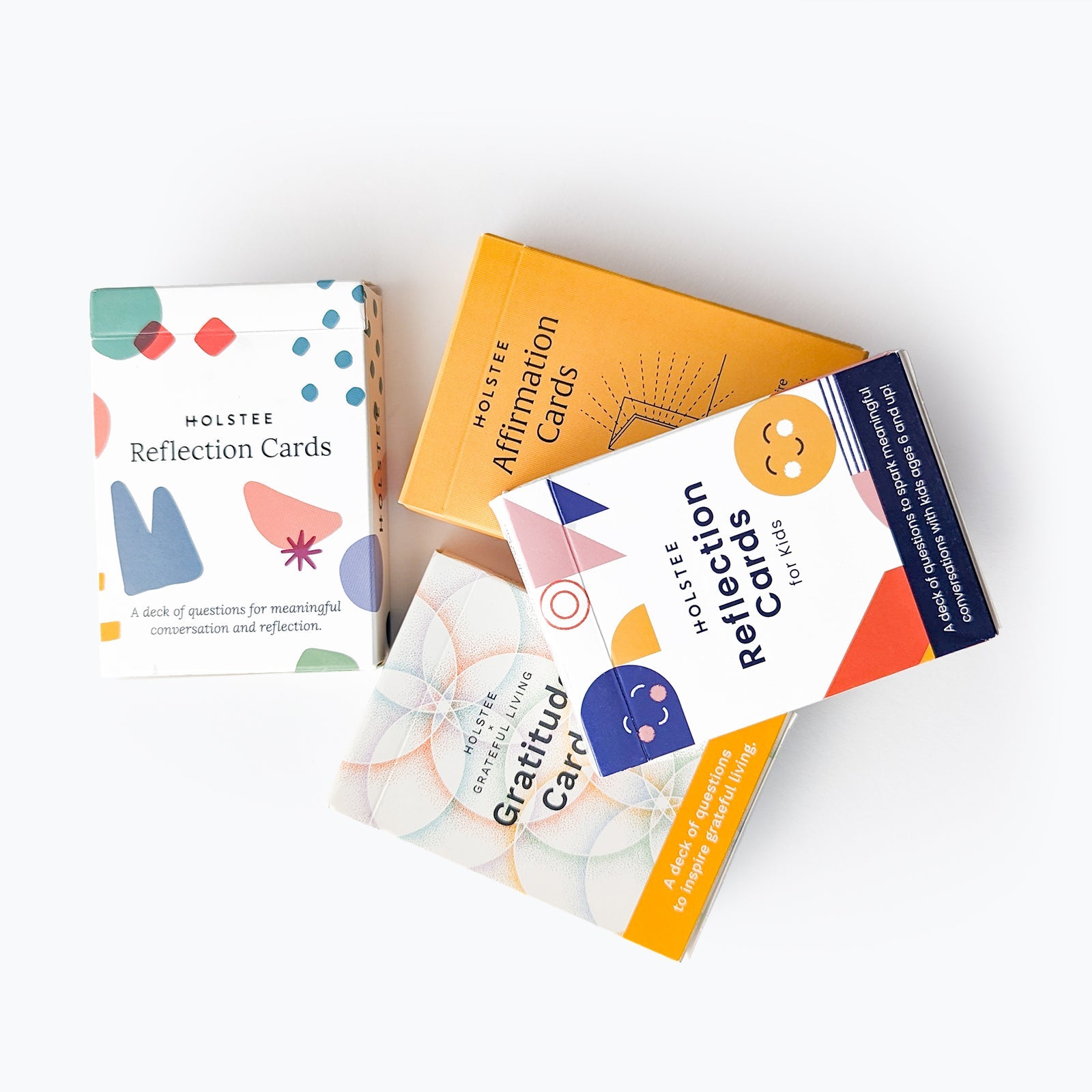
Trade small talk for real talk sooner than feels normal. Friendship doesn't deepen through more logistics about each other's weekends. It deepens the first time someone admits something true. A lot of that awkward middle shrinks when one person is a little more honest, a little earlier, than the situation strictly requires. A good set of conversation prompts can be a shortcut here, a way to skip past the weather and into the things people actually remember.
The throughline is that connection gets rebuilt the same slow way it was first built. Repeated, low-stakes, shared time with the same people, plus a little courage to go first.
That's also a big part of why we keep investing in the Holstee community. It's one attempt at putting that structure back: a group of people who show up to the same reflective space month after month, so the hours can quietly accumulate the way they used to. For anyone looking for a place to start finding your people, that's what it's for. No pressure to make it your thing. The door's just open.
The friendships waiting in the future tense usually aren't blocked by anything complicated. Most of the time, the only thing standing in the way is a text that hasn't been sent yet.
References
- Hall, J. A. (2019). How many hours does it take to make a friend? Journal of Social and Personal Relationships. Summary
- Boothby, E. J., Cooney, G., Sandstrom, G. M., & Clark, M. S. (2018). The Liking Gap in Conversations. Psychological Science. Link
- Cox, D. A. (2021). The State of American Friendship: Change, Challenges, and Loss. Survey Center on American Life. Link
- Office of the U.S. Surgeon General (2023). Our Epidemic of Loneliness and Isolation. PDF
- Franco, M. G. Platonic: How the Science of Attachment Can Help You Make and Keep Friends; APA "Speaking of Psychology"
Related reading: The Science of Belonging · How to Make Friends as an Adult · Belonging vs. Fitting In