

Mindful Matter

Q&A with Calvin Sprague
In July, we partner with illustrator Calvin Sprague. Calvin is a California-born, Texas-raised American, living and loving life in The Netherlands. For his Creativity illustration, Calvin says, “The pencil is the visual starting point of creativity for me. While ideas are floating around in my head, it is not until I put a pencil onto paper that the visual concepts will start to come to fruition." For a little more about Calvin, here's a short Q&A: Where is home for you? Texas. What is your definition of a successful life? To me, being successful is the opportunity to keep growing and learning. Working for yourself in the field of illustration has its challenges and, therefore, gives me plenty of moments to reflect and continue to keep improving my craft—failure coincides with success. How did you get into design? At the age of 13, when I started playing music with my brother, I began to learn and appreciate the visual side of music. It was innocent at first, designing flyers, posters, and cd covers. However, once I figured out that music and design are mutually coherent, the rest was history. Where do you find inspiration? Inspiration can spring up anywhere. I often find outlets from small things like cycling and taking in my surroundings, listening to music, watching movies, or hearing other people's stories. However, all creatives do experience some form of designer's block. When I have designer's block, it sometimes takes a day or two of just doing nothing to let my mind recharge. What's your dream design project? A dream design project of mine would be to develop sculptures or toys inspired by my personal work. What was the inspiration behind this design? Influenced by the Art Deco aesthetic and stain glass patterns, this was manifested by combining the two. How does Creativity play out in your life? It is a part of my life in almost everything I do! From experiencing a new culture to illustrating a detailed scene, creativity gives me energy in anything I do. At the moment, what is your favorite… Color: RedFood: TacosSong: Love by Ben Lukas Boysen Thanks for sharing with us, Calvin!
Learn more
Writer’s block.
To date, we’ve written over 150 Reflections as part of this email series. As much as I love the opportunity to share and discuss these topics, I still find it daunting every time I sit down to write one. What to say? Where to begin? To help, I have these words of wisdom from writer Anne Lamott written in large letters across the top of my writing screen: “Perfectionism is the voice of the oppressor, the enemy of the people. It will keep you cramped and insane your whole life, and it is the main obstacle between you and a shitty first draft.” This quote reminds me that I need to start somewhere — and that somewhere is likely a “shitty first draft”, as Lamott so perfectly puts it. As we explore the theme of Creativity this month, I am reminded of the importance of simply starting in order to get over a creative block. We need to recognize our resistance to the challenge and the discomfort that comes from trying something new and knowing that we might fail. Creativity requires us to face this fear of failure... and do it anyway. Because if we don’t start, we’ll never finish. To just starting somewhere, Mike RadparvarCo-Founder, Holstee
Learn more
Vuja De.
You have probably heard of Déjà vu — the feeling that you have experienced the current moment before, but what about the opposite? The concept Vuja De, originally coined by George Carlin during a comedy routine, caught the attention of author Adam Grant (who you may remember from last week's Reflections email) in his pursuit to better understand innovation and creativity. In his book, Originals, Grant says: “The starting point [of creativity] is curiosity: pondering why the default exists in the first place. We’re driven to question defaults when we experience vuja de, the opposite of déjà vu. Déjà vu occurs when we encounter something new, but it feels as if we’ve seen it before. Vuja de is the reverse—we face something familiar, but we see it with a fresh perspective that enables us to gain new insights into old problems.” Last week in our Online Member Gathering, as a group we discussed Vuja De and the ways it has helped us. One member described becoming aware of their white privilege, while another employed it to improve a relationship with a colleague, and a while back Dave shared his experience of really feeling music he had heard many times before. Another member observed that while Deja Vu tends to be passive, Vuja De requires you to be proactive and willing to expand your perspective. When was the last time you experienced Vuja De? To experience the world with fresh eyes, Mike RadparvarCo-Founder, Holstee P.S. This past Thursday, we announced the launch of our new Coaches Kit — a collection of several of our favorite products from the past few years, bundled together at a big discount for the coaches, facilitators, and gatherers in our community. Take a look — and if there’s anyone you think would appreciate it, we’d love if you could share it!
Learn more
3 Journal Prompts to Unleash Your Creativity
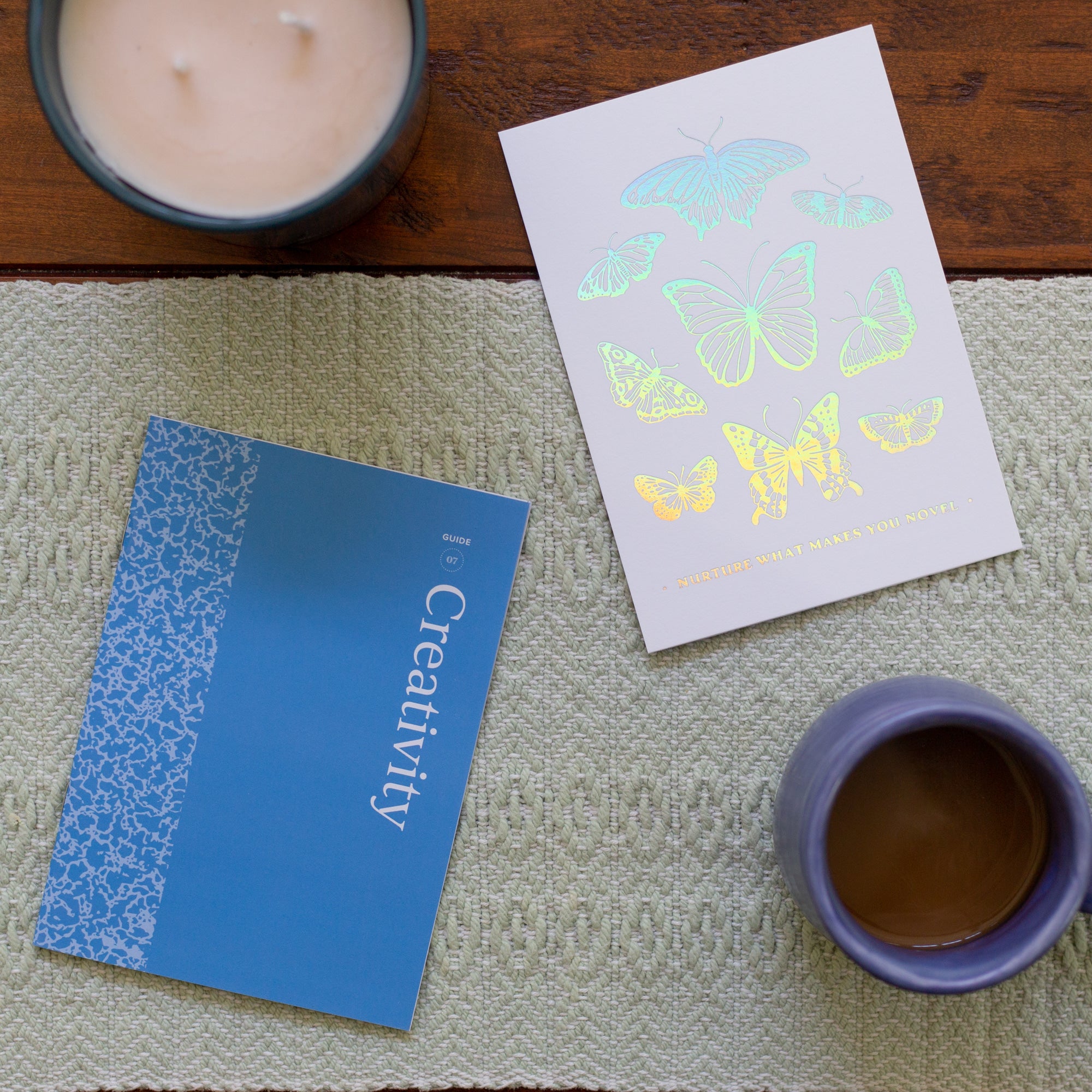
In a world with endless information at our fingertips, it can feel challenging to be original — to do things that are truly different, to be one-of-a-kind. In this month’s Creativity Guide, we share the research of Adam Grant, author of Originals: How Non-Conformists Move the World. Grant writes that the people who champion originality are the ones who propel the world forward. But originals are not so different from conformists, he argues. They feel the same fears and doubts, but instead of succumbing to these thought patterns, they explore and take action on them. Below are three ways Grant suggests we can increase our own originality, each with a corresponding prompt from this month’s guide for you to reflect on (I’ve added links so you can journal your answers in Reflection.app (our new journaling platform), if you’d like!). 1. Question the default. Ask why things are done the way they are, and see what happens when you take the road less travelled. In what ways have you challenged the default option or chosen a different route? Journal your response → 2. Broaden your interests. With a wide range of interests, you have more places to find inspiration and make connections to build new paths. What are three of your interests and how do you explore them? Journal your response → 3. Procrastinate on purpose. Grant says, “Once a task is finished, we stop thinking about it. But when it is interrupted and left undone, it stays active in our minds.” While it may feel counterintuitive, this ‘incubation period’ is typically when our subconscious connects the dots, allowing entirely new ideas to take shape. What projects are you working on that could benefit from this form of purposeful procrastination? Journal your response → To embracing your inner original and unlocking creativity in your life, Mike RadparvarCo-Founder, Holstee
Learn more
The Torrance Test.
“The creative adult is the child who survived.” — Ursula Leguin Ellis Paul Torrance, a pioneering psychologist in the 1960s, dedicated himself to unpacking how children and adults engage with creativity. He designed a non-conventional IQ test to measure a person’s creativity through a squiggle prompt on a piece of paper. Higher scores were awarded for answers that included rich imagery, implied narrative, or humor or fantasy. In this month’s Creativity Guide, we included a similar activity. We shared two mini-canvases with abstract squiggles and challenged members to come up with a one-of-a-kind picture, using their imaginations. Here is what the activity page looked like: Members have been sharing their creations in our private members community. It has been so fun to see the creative ways different people bring these simple squiggles to life: What would you create? Download the Creativity Guide or pick up a Creativity Kit to give it a try. Mike RadparvarCo-Founder, Holstee P.S. Attention Art Lovers! We just launched a new Art Membership option. It gives you access to all of the resources available in the Digital Membership plus we will send the monthly archival quality letterpress-printed art to you every month. It starts at just $10/Month. Learn more and sign up today!
Learn more
More bad ideas.
This past weekend, I brought my notebook and a pen to a nearby cafe with the intention of drawing some simple sketches. It’s not something I do often, but it’s something I’ve wanted to do more of. I opened my notebook and felt the familiar fear that comes from looking at a blank page. But this time, I remembered a line from this month’s Creativity Guide. “Generate more bad ideas. Sometimes it’s about the quantity, not quality. It’s proven that simply generating more ideas (even if it means producing less than great work) creates a pathway to ideas that ultimately stick.” It reminded me that the first time is rarely perfect — in fact, the best results often come after many imperfect attempts. Inspired by this thought, I touched my pen to the page and I wrote in all caps at the top: “IMPERFECT SKETCHES” I decided to reframe my sketching experience by removing the results-oriented expectation. Once I did that, I was able to relax and start moving my hand without judgment, ultimately doodling different perspectives of a simple chair. By altering our approach, we can reduce the pressure that sometimes comes up during the creative process. Not only can this lead to better outcomes, but it can also make the whole thing way more fun. Dave RadparvarCo-Founder, Holstee P.S. The past few weeks I’ve been sharing some of my creative struggles — like resistance and fear of the blank page — along with a few techniques that help me power through them. For more tips and inspiration, check out our Curated Resources for Creativity.
Learn more
My creative writing process.
"Perfectionism is the voice of the oppressor, the enemy of the people. It will keep you cramped and insane your whole life, and it is the main obstacle between you and a shitty first draft." - Anne Lamott Last week, I shared about powering through my resistance to the creative process. Once I manage that, I typically hit a second obstacle: the intimidating weight of the first stroke. I become terrified of putting pen to paper and the risk of destroying what is an otherwise pristine and unadulterated page. I have gotten better at facing this challenge since I began “morning pages” — a practice of writing at least three pages of longhand, stream-of-consciousness thinking every morning, popularized by Julia Cameron’s “The Artist’s Way.” Through my morning pages, I’ve learned to write even if I have nothing to say. I literally write things like: “Good morning, morning pages day 10. I really have nothing to say today. I slept well, but still feeling a bit tired and am sitting here watching the steam float up from my tea.” Bored by my own writing, I sometimes catch myself daydreaming. But the moment I catch myself, I immediately write about it: “I just caught myself daydreaming about…” It's strange to catch yourself lost in thought about something trivial, then magnify that thought by writing about it. But it’s also an incredible way to release these kinds of thoughts onto a page and out of your head. Similar to meditation, writing gives us a lens into our monkey-minds and perspective into the power and unpredictability of our thoughts. I just keep writing and writing, getting all the surface-level clutter out, removing the blockages between my thoughts and my words. Eventually ideas start flowing more naturally and I begin to write a bit quicker — I stop overthinking and I just get it all out. Knowing that there’s plenty of time for editing and analytical thinking later, I focus on keeping that stream from my heart, to my mind, to my fingers, open and flowing. Dave RadparvarCo-Founder, Holstee P.S. Looking for more creative inspiration? Check out this month’s Creativity Kit:
Learn more
Fight the resistance.
When it comes to creating, I struggle with the same feeling of resistance I shared in our three-part series on finding creative inspiration. It’s a concept I learned from Steven Pressfield’s “The War of Art” (recap shared in this month’s Creativity Curated Resources for members). Resistance is the mind’s aversion to a task and the distractions it creates in order to avoid the task altogether. These distractions can show up in different ways for everyone. For me, resistance takes the form of an infinite flow of “urgent” tasks broadcast to the forefront of my mind. The moment I open a blank page is the exact moment I realize that I need to do something else… put in the laundry, clip my nails, see if the mail arrived, or vacuum that cobweb in the corner of the ceiling. The lengths my mind will go to avoid a blank page is pretty incredible. Through practice, I have gotten a lot better at realizing the unexpected ways resistance tries to hijack my creative time. I now do my best to label it for what it is, schedule the distracting to-do for later, and power through with my work. It’s not always easy, but it's a constant practice. How does creative resistance take shape in your life? What ways have you found to power through it? Dave RadparvarCo-Founder, Holstee
Learn more
In The Studio With Kevin Lucbert
Each month, we are privileged to work with artists from all over the world. Their unique styles and points of view make for an especially diverse sense of inspiration in the art that arrives in our monthly Holstee Membership. From Los Angeles, California to Barcelona, Spain and everywhere in between, each piece of art is a true collector's piece. This month’s Creativity Art is by designer and illustrator Kevin Lucbert a French artist fascinated with the unknown. His signature ‘blue line’ aesthetic has been featured in the New York Times and in art exhibitions around the world. We got to work with him to help us bring our theme of Creativity to life! For a little more about what inspired this artwork, his process, and his life, here's a short Q&A: Where is home for you? Berlin, Paris and Bretagne,France. I have great childhood memories of my time spent in this beautiful region. My mother’s family comes from the small city of Pont-Aven, an enchanting place that inspired Paul Gauguin and many other artists. What is your definition of a successful life? Drawing each day, enjoying each moment of the creative process, and being able to make a living from f it. Describe your perfect day. My perfect day usually starts at 6am - sometimes earlier - when my two-year-old daughter wakes everyone up. Only moments later, I am sitting in my studio drawing, drinking good coffee, and enjoying the spring in Berlin after the long cold winter. How did you get into design? I spent most of my childhood reading comics. Classics like Tintin, Asterix, Franquin, Harold Foster but also artists less “traditional” like Moebius, Druillet, Hugo Pratt (Corto Maltese) were among my favorites. I then became naturally interested in drawing my own ideas and stories. Where do you find inspiration? Everywhere. Music, books, comics, films, graffiti on the street. I just finished reading the autobiography of the psychiatrist and psychoanalyst Carl Gustav Jung: “My Life” (1875-1961). His ideas about dreams and the subconscious life are mind blowing. During his life, he also created many beautiful drawings and mandalas. Which designers or thinkers influence/inspire you? Right now it is mostly the psychoanalyst Carl Gustav Jung. I recently discovered the intriguing yet virtuoso drawings of Austin Osman Spare. I also get ideas by reading books from writers with a strong imagination like H.P. Lovecraft, Edgar Allan Poe, or Philip K. Dick. I like watching David Lynch’s movies because he creates such beautiful and strange atmospheres, on the edge of dream and reality. I also like to look at the work of artists like M.C. Escher, Alfred Kubin, Caspar David Friedrich, James Ensor, Saul Steinberg, and David Hockney. I admire children’s book artists like Tomy Ungerer and comic book artists like François Schuiten and Benoît Peeters. Their wonderful comic book “La Tour” strongly influenced me as a child. What was the inspiration behind this design? A dreamgate. A step into the unknown. The Unexpected emerging in a banal environment. At the moment, what is your favorite … Color: Blue Food: Salmon Song: “Get Ready” Rare Earth (1969) Quote: “It never happened, yet it is still true! What magic art is this?” Robin Goodfellow, in Sandman #19: "A Midsummer Night's Dream" by Neil Gaiman
Learn more