A short read on how repetition shapes you — and what to do with it.
"Neurons that fire together, wire together" is a phrase from neuropsychologist Donald Hebb. It means that repeated thoughts and actions strengthen the neural pathways that produce them, making those patterns easier and more automatic over time. Repetition is the wiring.
What does "neurons that fire together, wire together" mean?
It means your brain wires itself through repetition. Each time two neurons activate together, the connection between them strengthens slightly. Repeat the pattern enough times and the brain treats it as the default — the next time the trigger appears, the same neurons fire together more readily. The phrase is a plain-English shorthand for what neuroscientists call Hebbian learning.
The everyday version: whatever you do often, you get better at — including things you didn't mean to practice. Worry, harsh self-talk, and rumination wire together the same way gratitude, attention, and care do. The brain doesn't grade the pattern; it just reinforces what gets repeated.
Where the phrase comes from: Donald Hebb and Hebbian learning
"Neurons that fire together, wire together." — Donald Hebb
Neuropsychologist Donald Hebb first proposed the underlying idea in his 1949 book The Organization of Behavior. Hebb was trying to explain how learning could happen at the cellular level — not as a vague metaphor, but as a physical change in the brain. His proposal, now called Hebb's postulate, was that when one neuron repeatedly helps fire another, the connection between them physically strengthens. Cells that activate together start to bind together.
The catchy four-word version of the postulate — "neurons that fire together, wire together" — was actually coined later, by neuroscientist Carla Shatz in 1992. It's the formulation that stuck because it captures Hebb's whole idea in a sentence a non-specialist can remember. Both phrasings now appear in the literature; in popular use, Hebb gets the credit because the underlying theory is his.
The phrase people sometimes mix up
If you've seen it as "wire together, fire together" or "cells that fire together, wire together," you're not misremembering — both variants circulate. Wire together, fire together is the inverted form (sometimes used to describe the consequence rather than the mechanism). Cells that fire together, wire together is closer to Hebb's original cellular framing. The standard version is "neurons that fire together, wire together," and that's the one to search if you're chasing a citation.
Hebbian theory and modern neuroplasticity
Hebb's postulate was a precursor to the broader story we now call neuroplasticity: the brain's lifelong capacity to change its structure and function in response to experience. For decades after Hebb, the dominant view was that the adult brain was largely fixed. Research from the late 1990s onward — on stroke recovery, learning new skills in adulthood, mindfulness practice, even London cab drivers' enlarged hippocampi — kept showing that the brain stays plastic.
The mechanism Hebb proposed turned out to be one of several that drive that plasticity. Repeated co-activation strengthens connections (long-term potentiation); disuse weakens them (long-term depression). The picture isn't quite as clean as four words make it sound, but the four-word version captures the practical truth: your brain becomes what it practices.
Why it matters for daily life: how repetition shapes you
This is why the practice of gratitude — the regular journaling and the habitual moments of reflection — can be so powerful. It creates and strengthens pathways in the brain for acknowledging what you have to be grateful for. The more you do it, the more ingrained it becomes, and the easier it gets for the brain to find gratitude on its own. A small repeated input compounds into a default state.
The same logic runs the other way for less helpful patterns. If your default is to scan for what's wrong, what's missing, or what someone else has — what psychologists call social comparison — that's also wiring. The path to changing it isn't to "try harder to think positively" — it's to give the brain something specific to repeat, on a small enough scale that you can actually do it daily.
A simple practice: noticing the wires you're laying
One small daily practice is enough to start shifting which neurons fire together. The format matters less than the consistency.
- One sentence, every morning or evening. Name a single specific thing you're grateful for. Specific beats abstract — "the way the kitchen light hit the counter this morning" wires more than "my health."
- Pair it with an existing routine. Brushing teeth, first sip of coffee, walking to the subway. The existing habit is the trigger; the new pattern attaches to it.
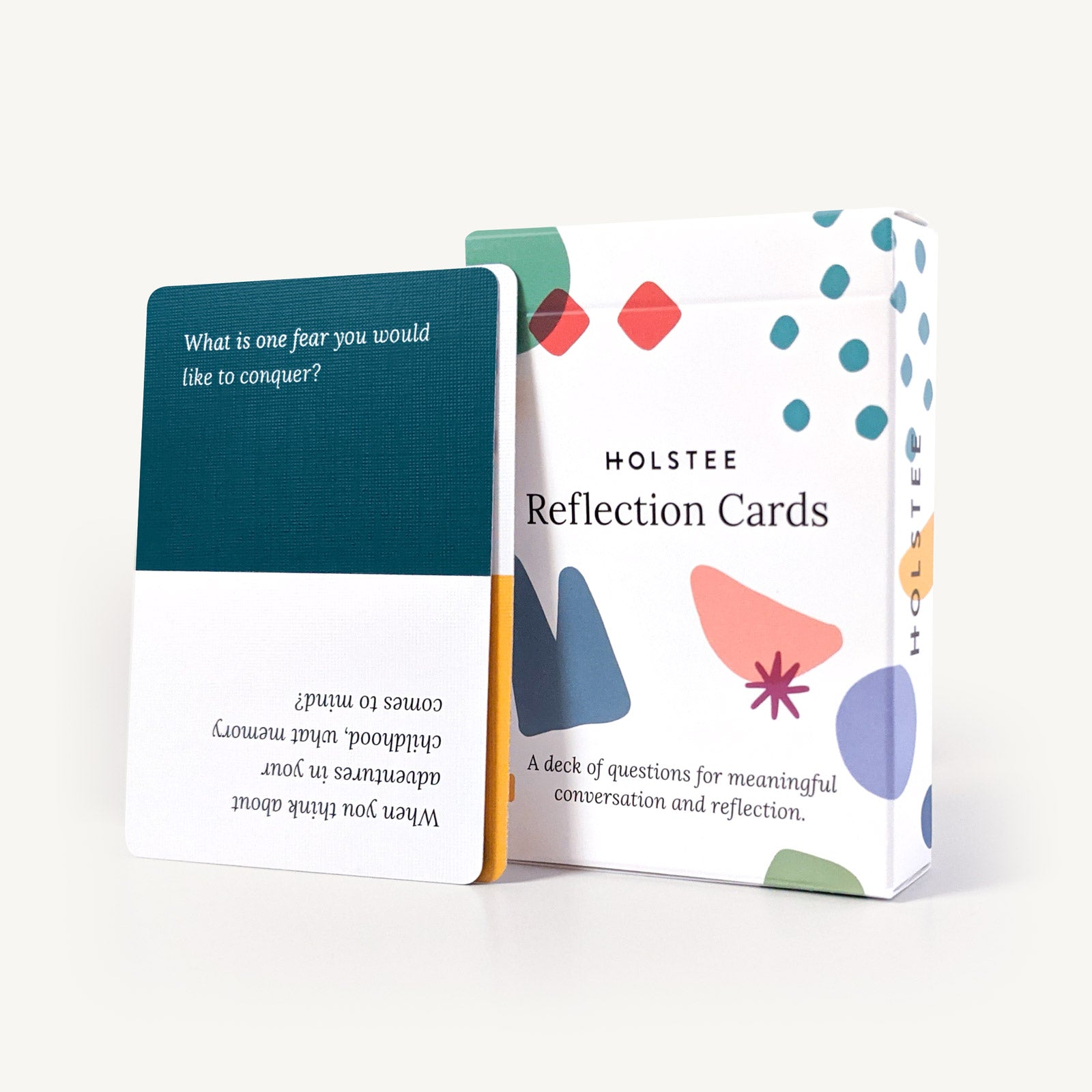
- Use a prompt when you're stuck. "Who made my life easier today?" "What surprised me?" "What did I almost miss?" Prompts cut the friction of staring at a blank page. Our Reflection Cards exist for exactly this — a deck of prompts you draw from when you need a starting point.
- Keep it small. Five minutes daily beats an hour weekly. Repetition is the wiring; intensity isn't.
If you want a deeper read on why willpower-based approaches to changing patterns often backfire — and what to do instead — this piece on habits covers it. The Stoics had a version of the same idea two millennia before Hebb did; our Stoicism 101 primer goes into the practice side of that.
So get those neurons firing! You'll be grateful you did 😉.

Dave Radparvar
Co-Founder, Holstee
P.S. If you want a starting point for your own daily noticing practice, our Reflection Cards are designed to be exactly that — a small repeated input you can pull from each day. And if you're looking for a community to keep the practice going, our membership is built around shared reflection.
P.P.S. If this is the kind of idea you find yourself thinking about, Enjoying the Little Things is a natural next read — it's the practice side of the same wiring.