🌱 Enjoying this? It's a taste of The Flourishing Life, our year-long Holstee membership. Every month we explore a new theme like this one together, with guided practices, reflection prompts, and live conversations. Unlock full access →
In the early days of Holstee, my co-founders and I lived and worked out of a small apartment in the East Village. We didn't have a budget for marketing, or really for much of anything, so when we wanted to meet people, we fed them. We'd squeeze a dozen near-strangers into a room barely big enough for the table, ask everyone to bring a dish and take their shoes off, and put a few real questions out where the small talk usually goes. Some of the closest friendships of my life started at those dinners.
That's the thing about kinship. It rarely shows up on its own. You have to make a little room for it, set a table, ask a better question. Kinship is an old word for something we don't have a good modern name for: the feeling of being genuinely known by another person, and choosing to know them back. Not networked, not followed. Known.
What kinship really means
Think about the last time someone really saw you. Not the version you bring to work or wear at the grocery store, but the actual you, with the messy thoughts and the quiet fears and the unreasonable enthusiasms. That feeling of being seen and getting to stay anyway is what kinship is made of.
Most of us are quietly starved for it. We have more contacts than any humans in history and still struggle to name who we'd call at 2am. What's missing is depth: the difference between being liked and being known, between collecting people and actually tending to a few of them over time.
Kinship isn't about having hundreds of friends or being everyone's favorite person. It's about finding your people and letting them find you, the ones who treat your quirks as features rather than bugs and stick around for the long version of your story. That work of turning strangers into friends is slower than adding a contact, and it's most of what a good life is made of.
Why connection keeps us well
Connection does more than make life nicer. People with strong social ties have roughly a 50% greater likelihood of survival than people with weaker ones, a bigger effect on your health than quitting smoking. Good relationships don't just make life better. They make it longer.
Which makes the modern loneliness problem strange and a little sad. We are more connected by technology than any people who have ever lived, and lonelier at the same time. If that's where you are right now, you are very much not the only one, and you're not stuck there either. We wrote once about the opposite of loneliness, and it has less to do with crowds than you'd think.
It helps to remember that loneliness itself isn't a character flaw. Vivek Murthy, the former U.S. Surgeon General, describes it as a biological signal, like hunger or thirst, telling you something essential is missing. Seasons of it are normal. A move, a breakup, a new job, a loss, any of these can loosen your ties for a while. The signal isn't there to shame you. It's there to point you back toward each other.
And the way back is smaller than you'd expect. Murthy's own advice is almost comically simple: fifteen minutes a day of real attention with someone you care about, no phones. Reach out first. Say the thing. It tends to matter more than you imagine it will.
The many kinds of love
Part of why connection feels confusing is that we use one tired word, love, for a dozen different things. The ancient Greeks were more precise, and their vocabulary still earns its keep.
Aristotle sorted friendship into three kinds. Friendships of pleasure, built on the fun you have together. Friendships of utility, built on what you each get out of it. And friendships of virtue, built on genuinely wanting the best for the other person with no strings attached. He called that last one philia and thought it was the highest form, and also the rarest, because it asks the most of us. Much of what makes those rare ones last is no mystery; we gathered some of it in the natural laws of friendship.
The Greeks went further and named seven loves in all. Storge, the easy affection of family. Eros, romantic desire. Philia, deep friendship. Agape, selfless love extended to anyone. Pragma, the patient love that endures in long partnerships. Ludus, the playful, flirtatious kind. And philautia, the love you turn toward yourself. Most real relationships are a moving blend of several, shifting over the years. You don't need the vocabulary to feel any of it, but naming it helps. It's easier to tend a friendship of virtue once you can tell it apart from a friendship of convenience.
How to build connection that lasts
If kinship is the goal, a few ordinary muscles get you there. None of them are complicated. All of them take practice.
Listen like you mean it. Most of us listen for the gap where we can say our own piece. Active listening is the reverse: you give someone your whole attention and let understanding them be the point. It sounds small. It's the rarest thing in most conversations.
Let yourself be seen. Brené Brown spent years studying why we hide the parts of ourselves we think are unlovable, and found that the hiding is exactly what keeps us from getting close. Vulnerability feels like weakness from the inside and reads as courage from the outside. Trust gets built in those moments, not around them.
Learn how the other person receives love. Gary Chapman's five love languages (words of affirmation, acts of service, gifts, quality time, and touch) are an imperfect framework, and Chapman himself would tell you they aren't the whole picture. But they point at something true: people feel cared for in different ways, and it's worth learning which one actually lands for the people you love.
Show up. Most of the time it's unglamorous work: the airport pickup, the text on the hard day, the standing invitation that doesn't need a reason. Kinship is built mostly out of small, repeated acts of being there.
Rekindling a connection you've let slip
Almost everyone has a name that comes to mind here. An old friend whose laugh you miss, a relative you keep meaning to call, someone who mattered and then quietly drifted. The good news is that reconnecting is usually far less awkward than the story you've built about it.
It works as a ladder, easiest rung first. Send the text: something as low-stakes as "hey, you came to mind today, just wanted to say hello." You will almost certainly make their day. If that goes well, offer a real time to talk, not a vague "we should catch up" but an actual "are you free Sunday afternoon?" And when you can, get in the same room. A coffee or a walk does something a thread of messages never will.
The hardest part is the first message, and it's hard only because we imagine it will be. It rarely is.
Set a table
Which brings me back to that East Village apartment. The food was never really the point. The design was: a small room, a reason to show up, and a few good questions that gave people permission to skip the small talk and actually meet.
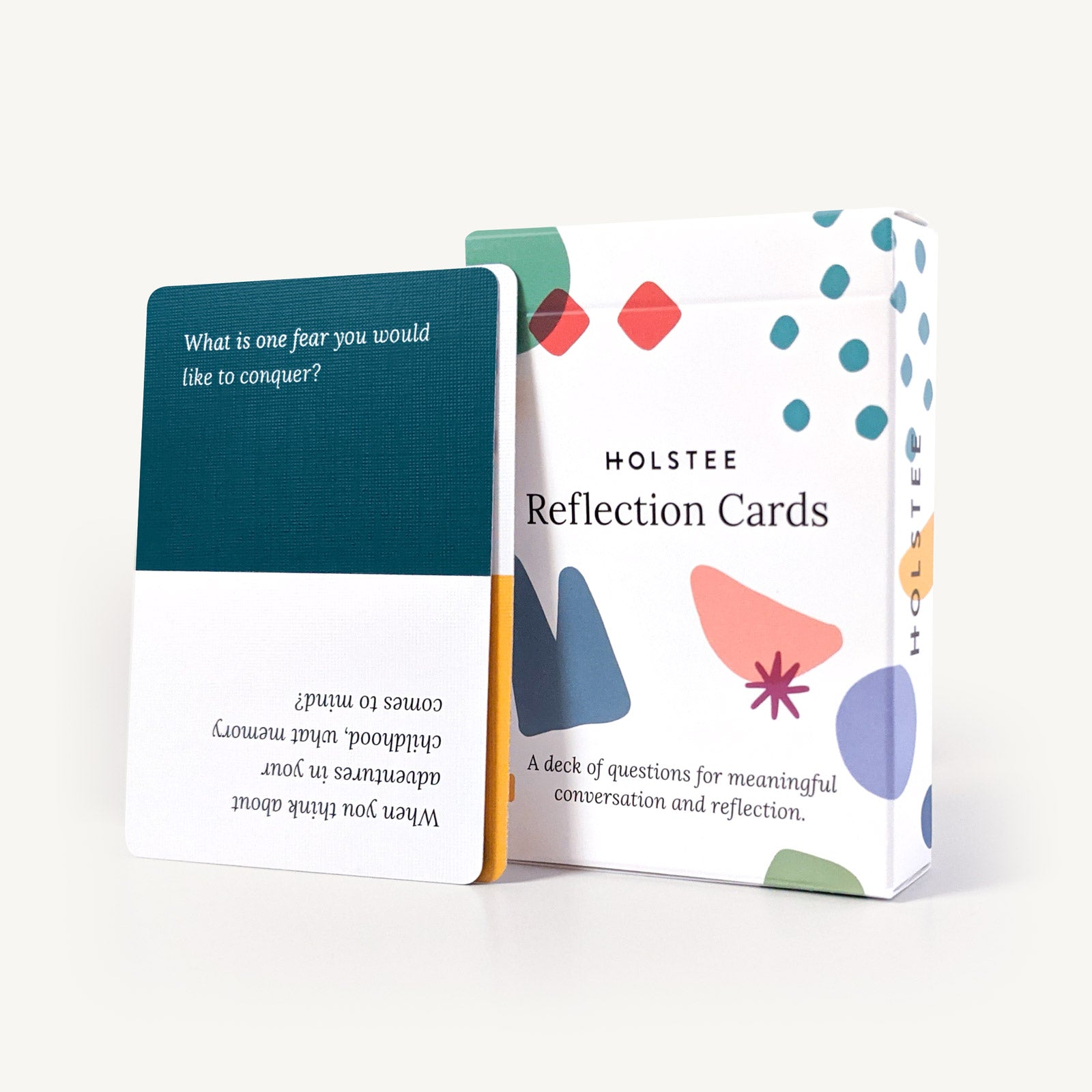
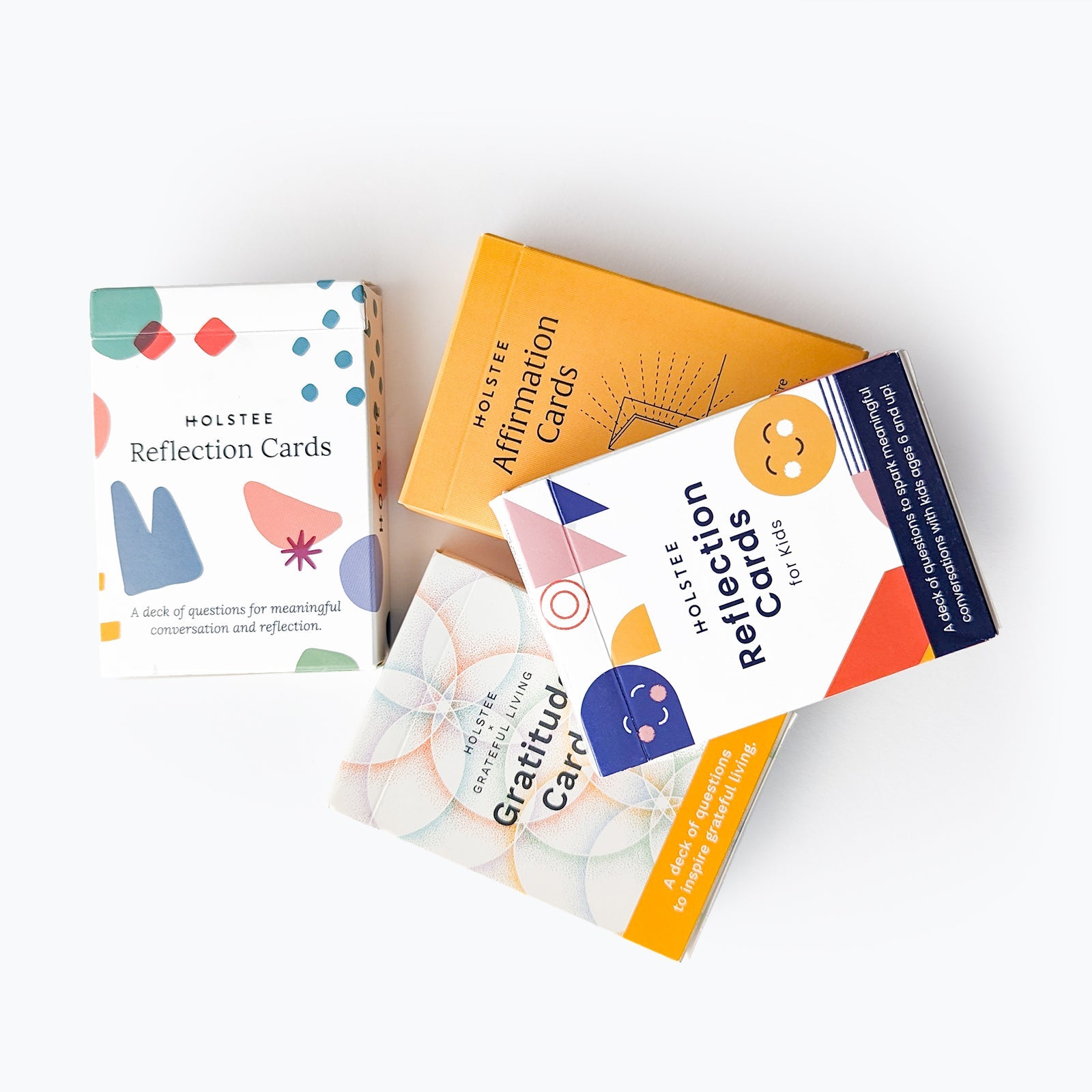
You can recreate it with almost no effort. Host the dinner. Ask everyone to bring a dish and a story. Put one real question on the table, something better than "so what do you do," like "what's had your attention lately?" and watch what happens. If you want a running start, we keep a list of good conversation starters for exactly this. The questions we asked at those early dinners eventually became our Reflection Cards, which still exist to turn a room full of acquaintances into something warmer.
You don't need a big house or a free weekend. Kinship gets built at tables, on walks, over coffee. The invitation is most of the work.
Going deeper, together
Reading about connection is one thing. Practicing it alongside other people who are also trying is another, and it tends to stick better.
Kinship is one of twelve themes in The Flourishing Life, our year-long Holstee membership, alongside Intention, Gratitude, Compassion, and the rest. Over a year the community moves through all twelve together, and you can join any time and focus on whatever you need most right now. Each theme brings a small curriculum, fellow members working through it alongside you, and live conversations to make it real. It's not for everyone, but if you've read this far, it might be for you.
Frequently asked questions
What is kinship?
Kinship is a deep sense of connection and belonging with another person, the feeling of being genuinely known and choosing to know someone in return. It goes beyond acquaintance or contact. Kinship is the bond you feel with the people who see the real you and stay, whether they're family, old friends, or someone you've only just met.
What is the difference between kinship and friendship?
Friendship is one expression of kinship, but kinship is broader. It describes the felt sense of belonging that can exist with a friend, a family member, a partner, or even a stranger you feel inexplicably close to. You can have many friends and still long for kinship, because kinship is about depth and being known, not about the number of people you know.
What are the seven types of love?
The ancient Greeks named seven: storge (familial affection), eros (romantic love), philia (deep friendship), agape (selfless, universal love), pragma (enduring, long-standing love), ludus (playful love), and philautia (self-love). Most real relationships blend several of these at once and shift between them over time.
Why do we feel lonely even when we're surrounded by people?
Loneliness is about the quality of connection, not the quantity of people around us. You can be surrounded by others and still miss the deep sense of being seen and known. Loneliness works like a biological signal, similar to hunger, telling us that something essential is missing and inviting us to reconnect more meaningfully.
How do you build deeper friendships as an adult?
Adult friendships deepen through repeated, intentional effort: listening with full attention, allowing yourself to be vulnerable, showing up in small consistent ways, and creating reasons to spend real time together. Depth comes from presence and follow-through over time, not from any single grand gesture.
How do you reconnect with an old friend?
Start small and let it build. Send a short, low-pressure message such as "you came to mind today, just wanted to say hello." If it goes well, offer a specific time to talk rather than a vague "let's catch up," and when you can, meet in person. The first message feels harder than it is; most people are genuinely glad to hear from you.
Michael Radparvar
Co-Founder, Holstee