🌱 Enjoying this? It's a taste of The Flourishing Life, our year-long Holstee membership. Every month we explore a new theme like this one together, with guided practices, reflection prompts, and live conversations. Unlock full access →
There's a poem by Cathy Ross that has stuck with me for years. It imagines what would happen if the moon came out only once a month:
If the moon came out only once a month
people would appreciate it more. They'd mark it
in their datebooks, take a walk by moonlight, notice
how their bedroom window framed its silver smile.
And if the moon came out just once a year,
it would be a holiday, with tinsel streamers
tied to lampposts, stores closing early
so no one has to work on lunar eve [...]
And if the moon rose but once a century,
ascending luminous and lush on a long-awaited night,
all humans on the planet would gather
in huddled, whispering groups
to stare in awe [...] Years later,
they would tell their children, "Yes, I saw it once.
Maybe you will live to see it too."
But the moon is always with us,
an old familiar face, like the mantel clock,
so no one pays it much attention.
Tonight
why not go outside and gaze up in wonder,
as if you'd never seen it before,
as if it were a miracle,
as if you had been waiting
all your life.
(Cathy Ross, "If the Moon Came Out Only Once a Month")
That's the whole problem with gratitude in one image. The good things are right there. We've just stopped seeing them.
What gratitude actually is
Gratitude has a softness to it that makes it easy to wave off, like a nice idea you'll get to once the real work is done. The research tells a different story. Robert Emmons, who has studied it for decades, calls gratitude one of the few things that can measurably change a person's life: better health, stronger relationships, more steadiness in hard times.
He defines it in two simple parts. First, noticing the good that's already in your life. Second, recognizing that much of that good came from outside you, from other people, from luck, from the plain fact of being alive. That second part is what separates gratitude from mere satisfaction. Satisfaction says I have enough. Gratitude says I was given much of this, and stays a little amazed by it.
Why we stop noticing
The noticing is hard, and it isn't a character flaw. It's wiring. Psychologists call it the hedonic treadmill. We adapt to whatever we get. The raise, the bigger place, the thing we were sure would finally do it, all of it gives a brief lift and then quietly becomes the new normal. Gretchen Rubin puts it plainly: we get the boost, we get used to it, and we start scanning for the next thing.
The treadmill is why you can have a life your younger self would have wept for and still feel a low hum of not-enough. Gratitude is one of the few things that reliably interrupts it. It drags your attention off the next rung and back onto the one you're standing on. We once called this gratitude as an antidote to perfection, and that's close to right.
Stop. Look. Go.
The Benedictine monk Brother David Steindl-Rast has spent a lifetime on a single, slightly subversive idea: most of us have the order backwards. We assume that once we're happy, we'll be grateful. He thinks it runs the other way. Be grateful first, and the happiness tends to follow. (We wrote about his "want to be happy, be grateful" talk a while back; it holds up.)
His method is something you already learned as a kid crossing the street. Stop. Look. Go. Stop long enough to interrupt the autopilot. Look for what the moment is actually offering, the warmth of the coffee, the kindness of a stranger, the fact of a working body. Then go, and let it move you to do something, even if that something is just saying thank you. It's almost embarrassingly simple, which is exactly why it works. It's small enough to actually do.
Steindl-Rast went on to found Grateful Living, the nonprofit that has carried the grateful-living movement for more than twenty-five years. We're lucky to call them friends; we built our Gratitude Cards together with them, a deck of questions designed to turn this idea into a daily practice.
Get specific
If there's one upgrade to make to the standard practice, it's this: get specific. "I'm grateful for my family" is true, and also so broad it barely lands. Emmons found that the detail is where the feeling lives.
Compare the two. "I'm grateful for my family," against "I'm grateful that my sister called me every evening during the worst week of the year, even when she had nothing in particular to say." The second one you can feel. Specificity turns gratitude from a category into a memory, and memories are what stay with you.
The doorway to awe
Gratitude has a bigger cousin worth chasing too: awe. Dacher Keltner, who studies it, defines awe as the feeling of being near something vast that exceeds your understanding. He found we stumble into it in eight ordinary places: nature, music, art, big ideas, moral beauty, the rush of being in a crowd, the sacred, and the plain mystery of being alive and someday not.
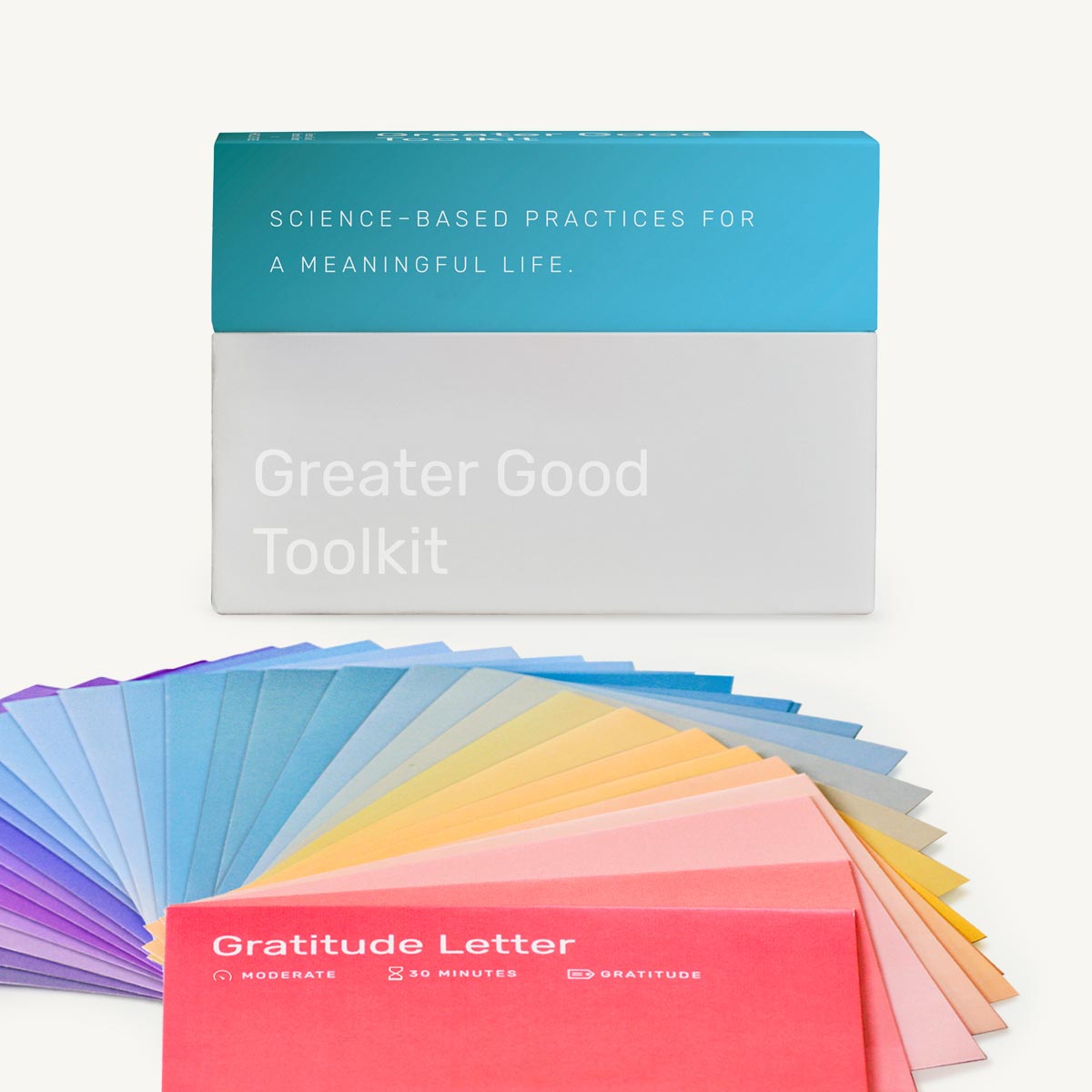
Keltner runs the Greater Good Science Center at UC Berkeley, which translates the research on what actually makes life meaningful into something usable. We've worked with them for years, and turned that science into two decks of practices you can hold in your hand: the Greater Good Toolkit and a version for kids.
Awe does something useful. It makes you feel small in the best way, less wrapped up in yourself, more aware of being part of something. You don't need a mountaintop for it. A sunrise will do. So will a long look at the moon, as if you'd never seen it before.
Making it a habit
None of this works as a one-time insight. It works as a practice, repeated until it changes what you notice by default. A few that hold up:
Keep it nightly. Maya Angelou treated gratitude as an end-of-day ritual, a moment before sleep to name one small gift the day handed you. The reliability matters more than the length.
Write it down, specifically. Three things, with real detail, beats a long vague list every time.
Say it out loud. The biggest jump in most gratitude practices comes when you stop journaling about people and start telling them. Some of the warmest versions of this happen around a table.
The point isn't relentless positivity or pretending hard things aren't hard. Gratitude doesn't ask you to believe the hardship was good, only to notice that something, even in a hard stretch, is still worth being thankful for. We've gathered more of this in our five principles for grateful living.
Going deeper, together
Reading about gratitude is one thing. Practicing it alongside other people who are also trying is another, and it tends to stick better.
Gratitude is one of twelve themes in The Flourishing Life, our year-long Holstee membership, alongside Intention, Kinship, Compassion, and the rest. Over a year the community moves through all twelve together, and you can join any time and focus on whatever you need most right now. Each theme brings a small curriculum, fellow members working through it alongside you, and live conversations to make it real. It's not for everyone, but if you've read this far, it might be for you.
Frequently asked questions
What is gratitude?
Gratitude is the practice of noticing the good already present in your life and recognizing that much of it comes from outside yourself, from other people, from circumstance, from being alive at all. It's less a fleeting feeling than a way of paying attention, a habit of receiving what's already here rather than scanning for what's missing.
What is the hedonic treadmill?
The hedonic treadmill, or hedonic adaptation, is our tendency to quickly adjust to new circumstances and return to a baseline level of happiness. A raise, a new home, or a long-wanted achievement gives a brief lift before becoming the new normal. It's why lasting contentment rarely comes from acquiring more, and why gratitude, which redirects attention to the present, is one of the few reliable ways to step off it.
How do you practice gratitude daily?
Build in small, regular moments to notice. Many people keep a nightly ritual of naming a few specific things they're grateful for, with detail rather than broad categories. Even more powerful is expressing it directly to the people involved. Consistency matters more than length; a few seconds of genuine noticing each day compounds.
What is the "Stop. Look. Go." method?
Coined by Brother David Steindl-Rast, "Stop. Look. Go." is a simple gratitude practice modeled on crossing the street. Stop to interrupt your autopilot, Look for what the moment is actually offering, then Go and let it prompt an action, even if that action is just saying thank you. The idea is that gratitude can come first and happiness follows, rather than the other way around.
Does gratitude really improve your health?
Research by Robert Emmons and others links a regular gratitude practice to better physical health, stronger relationships, higher self-esteem, more empathy, and greater resilience during hard times. It isn't a cure-all, but few simple practices have as much evidence behind them.
How is gratitude different from positive thinking?
Positive thinking often asks you to reframe or downplay difficulty. Gratitude doesn't require pretending hard things aren't hard. It simply trains you to also notice what remains good, true, or worth appreciating, even in a difficult season. It's grounded in what's actually present rather than in forced optimism.
Michael Radparvar
Co-Founder, Holstee