Mindful Matter



We have everything we need to start.
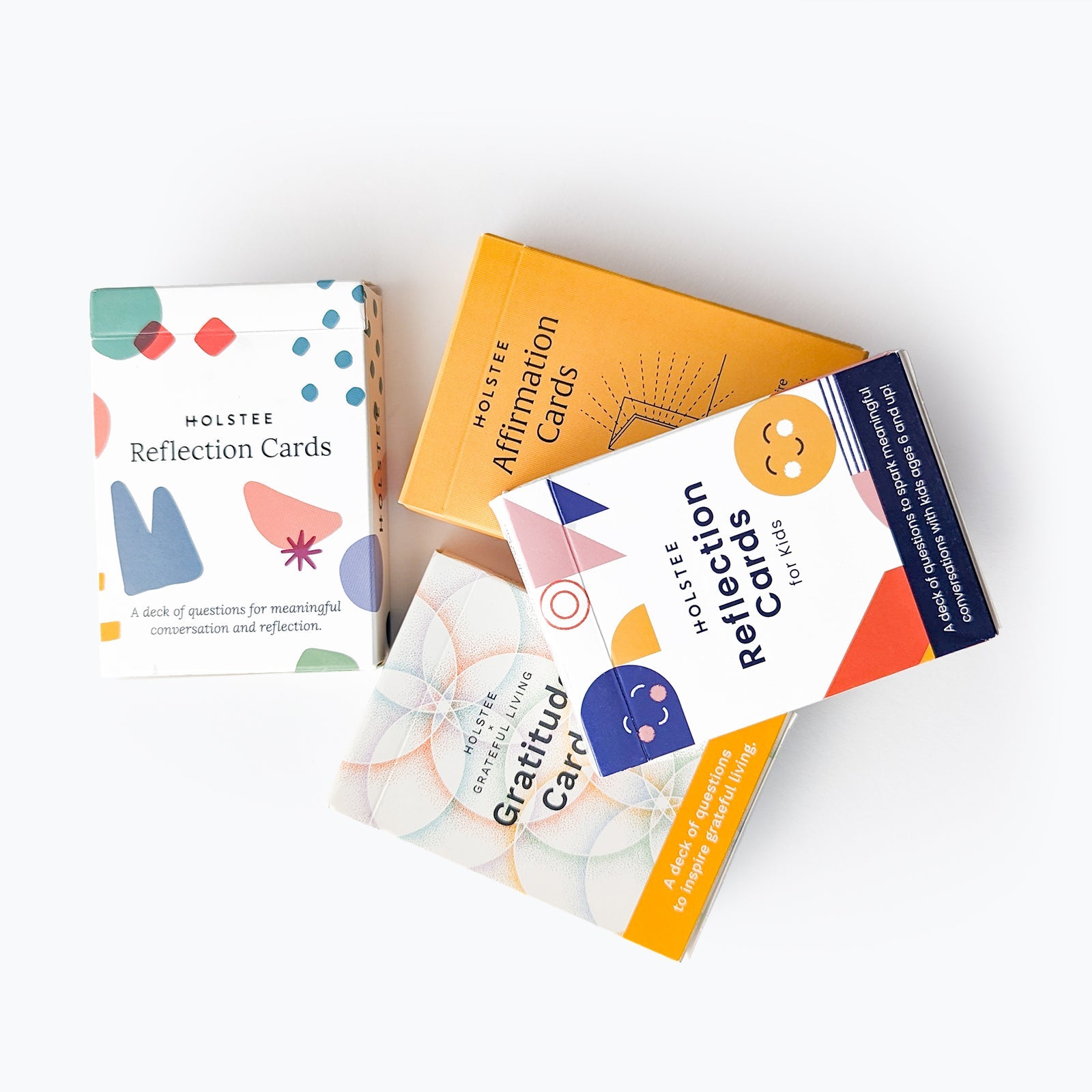
I was just rewatching one of my favorite TED Talks from the renowned social psychologist, author, and professor Sherry Turkle. About six minutes in, Turkle brings up a recurring conversation she has: “When I ask people "What's wrong with having a conversation?" People say, "I'll tell you what's wrong with having a conversation. It takes place in real time and you can't control what you're going to say." So that's the bottom line. Texting, email, posting, all of these things let us present the self as we want to be. We get to edit, and that means we get to delete, and that means we get to retouch, the face, the voice, the flesh, the body —not too little, not too much, just right.” In other words, the digital age has put us in a situation where we are constantly polishing our communication. Now, it can feel intimidating or even thoughtless to share in an authentic, in-the-moment, vulnerable way. We are shrinking who we are to fit a text box — a figurative and literal character-limit — and at the same time, removing the chance for genuine face-to-face interaction. This is a problem. The bonds we build in our relationships with others bring meaning, purpose, and a deep sense of kinship into our lives. Beyond that, they can help us better understand ourselves. Turkle continues: “...We use conversations with each other to learn how to have conversations with ourselves. So a flight from conversation can really matter because it can compromise our capacity for self-reflection.” The challenge is, it can be hard to have those deep, meaningful conversations, especially in an age of so much screen time. It’s hard to make the time, it’s hard to open up, and it’s hard to know what to ask. We are hoping our new Reflection Cards (now on Kickstarter!) help spark more of those dialogues. Today, more than ever, we need to find time to foster deep human connection, and one of the most enjoyable ways to do that is by simply listening and sharing the stories that make us who we are. As Turkle concludes in her talk: “We have everything we need to start. We have each other.” To the magical moments of connection ahead, Dave RadparvarCo-Founder, Holstee P.S. In our Reflections post titled: 'A great conversation.' a few months back — Mike recalled a wonderful interview by Krista Tippett with John O’Donohue. If you missed it and others — consider signing up to get 30 days of the best past Reflections. Sign up here →
Learn more

Fail, learn, and improve quickly.
“The key is to fail, learn, and improve quickly. If you’re constantly learning and improving, your evolutionary process will be ascending. Do it poorly, it will be descending. So I believe evolving is life’s greatest accomplishment and its greatest award.” ― Ray Dalio For several weeks now, I have been keeping a notebook of mistakes — or as I am starting to view them, life lessons. In each of these entries, I identify the outcome, the root cause and what I would do differently if faced with the same situation in the future. The log is a combination of professional and personal missteps, which I would benefit from not repeating. This process was inspired by the book Principles by Ray Dalio. Business books rarely make it into my queue, but this one stuck out to me. Ray has lived a remarkably reflective life while building an incredibly strong business, and he attributes this success to principles he’s learned along the way. In the book, he goes into great depth on his own principles but also encourages readers to challenge them and write their own, based on their unique experiences. One of his principles particularly resonated with me: "Pain + Reflection = Progress" It’s way too easy to sweep challenging moments under the rug, rather than acknowledge them, understand how they came to be, and learn how to navigate them in the future. When viewed in this way, painful moments become opportunities, or as he calls them, "potential improvements that are screaming at you.” Most people, myself included, don’t really enjoy shining a light on our own weaknesses. But after just a few weeks of this practice, I am beginning to find myself feeling incredibly fulfilled and better prepared for future potential missteps. Give it a try: 1. Write down one challenge you had last week.2. What did you learn from going through it?3. How would you approach it differently if it happened all over again today? Checking in regularly, asking tough questions, and growing with the answers is a big reason we think the Holstee Membership is so important. It’s not easy to make time to reflect on our thoughts and experiences — but it brings so much more meaning, clarity, and perspective to life. Wishing you many moments of growth, Mike RadparvarCo-Founder, Holstee P.S. Speaking of reflecting, in just one week we will be launching our newest product, the Holstee Reflection Cards, on Kickstarter! Learn more and sign up to be notified for early-bird pricing →
Learn more
The road will reveal itself.
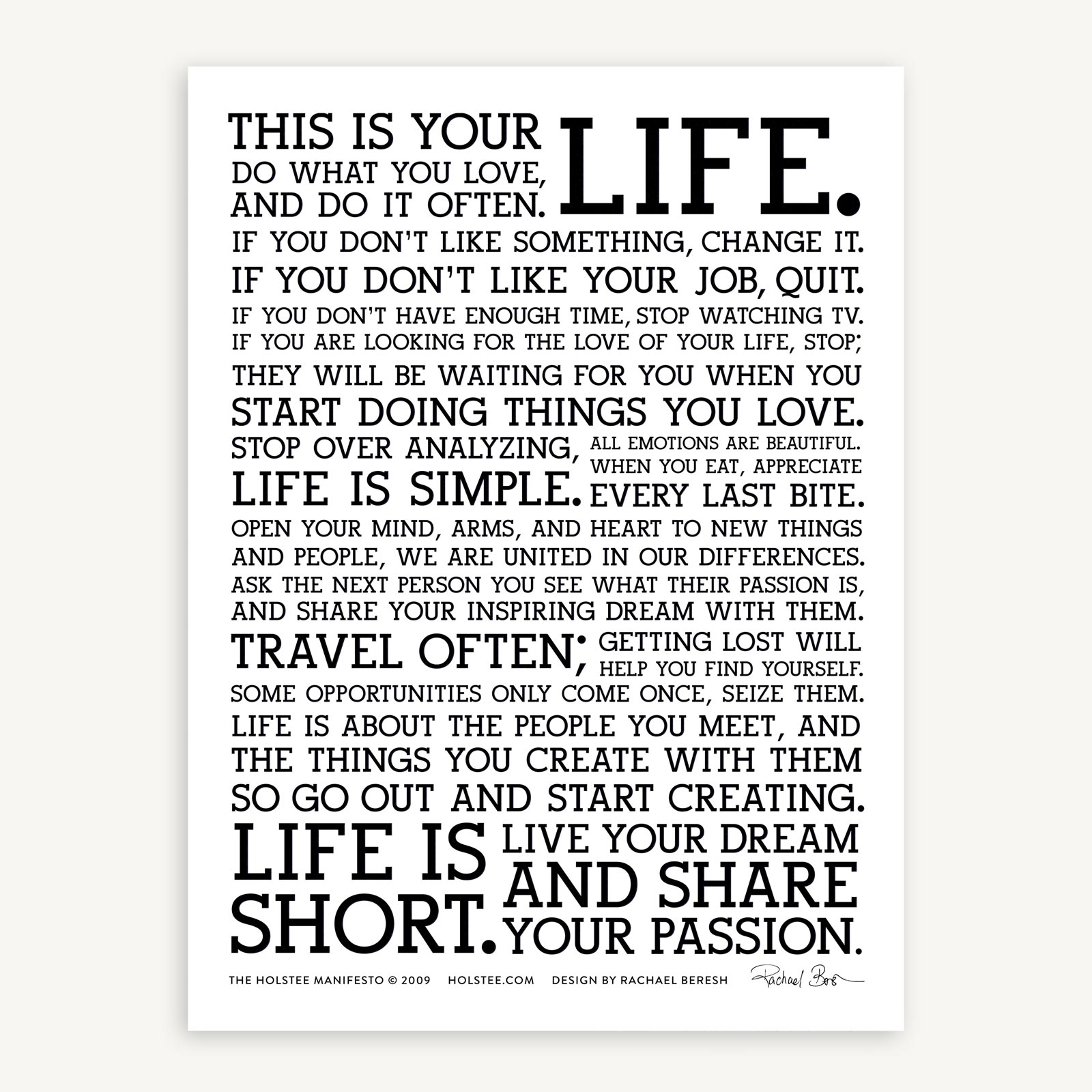
Lately, I’ve been trying to be less dependent on my phone for navigating around Amsterdam, my home for the past year. While I still can’t tell you exactly how to get to an address, I’ve noticed that when I get on my bike and start pedaling, familiar landmarks start to pop up and one turn at a time, the road reveals itself. I was recently listening to a Tim Ferriss podcast interview with Brandon Stanton, the creator of Humans of New York, and in it, Brandon shared a similar story about his creative path. Several years ago, Brandon was deep in an office job and found himself yearning to do something simply for the joy of it. He decided to start taking photos on the weekends and quickly became completely absorbed in it. He took thousands of photos and eventually realized that he liked his portraits of people the most. He started going to new cities and taking even more photos, particularly of strangers. At a certain point, he decided to move to New York for the practical reason that there are just so many more people to photograph. If 10 people on the street say no when you ask to take their picture, there are 100 right behind them that might say yes. One day, soon after he moved to the city, Brandon came across a women dressed all in green — green clothes, green hair, green shoes. He asked to take a photo of her, and in the process he casually asked, “So, do you do a different color every day?” She answered: “No. I used to go through different stages, but then I found that I was happiest when I was green. So I’ve been green for 15 years." Her response had an impact on Brandon — so much so that when he went to post the photo on social media, he decided to also share what she had told him. The response to that post was far more than he had ever received. The green lady’s response had uncovered a new road. Brandon realized that after months of asking strangers to take their photos, perhaps it wasn’t the photos themselves that were the most impactful. Perhaps it was the personal stories of the humans behind them. The rest, of course, is history. Brandon’s Humans of New York Facebook page now has more than 18 million followers. He has produced an incredible documentary series and written a #1 New York Times bestselling book. Brandon has also used his platform to bring attention to worthwhile causes like public school education and pediatric cancer research, helping raise and donate over $2.5 million for charitable causes. His work touches millions of people each year. What I love about this story of creative growth isn't the decisions that were made — but rather, Brandon’s journey of committing to one step at a time, only to have the next steps reveal themselves. This month's Creativity Guide reminds us that sometimes, you just need to take that first step. The guide starts with a warm-up exercise to help you put pen to paper and simply start creating. To the first step, Dave RadparvarCo-Founder, Holstee P.S. We have a new limited-edition Manifesto launching on Wednesday — here is a first look!
Learn more
A mental model for creative thinking.
Five years ago my brother-in-law, Arian, decided to go all in and follow his passion for videography, driving from Boston to Los Angeles to live his dream. In the years that followed, he consistently stretched his creative boundaries and produced an impressive volume of work. A few years in, his persistence and dedication began to get real attention and festivals like Burning Man and Coachella started requesting that he come and document their events. Today, the world’s most notable brands and icons seek him out. I spent last weekend with him and asked about his creative process. “I think I am different from most people. I only have about three to four hours of solid focus time in me each day. So if I am not doing something that requires a high level of creative thinking, I need to let my mind just float and drift.” It turns out Arian’s three to four hour limit on focused work time is not that unusual — but his level of self-awareness and proactivity is. A 2016 survey of office workers found that the average amount of “productive” work time barely hits three hours in a normal workday. Beyond these three hours, though, most time was spent browsing the web, chatting with co-workers and getting food. After Arian and I spoke, I realized that he unknowingly optimizes his day for Convergent and Divergent Thinking, terms coined by psychologist Joy Paul Guilford. Divergent Thinking is free-flowing and non-linear. It’s blue sky thinking. It doesn’t need to be rational or feasible, and oftentimes it doesn’t take place at a desk. It might be triggered by activities like going for a walk, cooking, taking a shower or simply stepping away from your screen. Convergent Thinking, on the other hand, is structured and methodical. It can include analyzing ideas and planning how to implement them. Its triggers include making lists, considering outcomes and constructing a timeline. Both are incredibly important for creative work — but it’s easy to get so wrapped up in one that we forget to make time for the other. A good first step is to simply become aware of our limited stocks of convergent and divergent time each day and structure our days accordingly. We explore this concept as well as the growth mindset, flow and more in this month’s Creativity Guide. To finding your balance, Mike RadparvarCo-Founder, Holstee P.S. This is also a really useful framework for team meetings. We often make this distinction for our creative brainstorms, starting off with a bit of Divergent Thinking — new ideas that have been prepared in advance and shared. Then we switch to Convergent Thinking and drill down into the best possible option for our desired outcome. It’s a method we returned to more than once while developing our Holstee Reflection Cards, which we are preparing to launch later this summer.
Learn more