Mindful Matter



The plane, and the train, and the road.
“Books are the plane, and the train, and the road. They are the destination, and the journey. They are home.” ― Anna Quindlen One of my favorite things to do during the summer is dive into a good book — a doorway to a new world, an adventure in time, a mirror to my own mind. Last year I shared my summer reading list, and in response I got some incredible recommendations from all of you. Here are some of the books I read over the past year that really stood out: Letters to a Young Poet by Rainer Maria RilkePoetic wisdom and encouragement. I found myself re-reading passages to let the words fully blossom. (Thank you Ruth for the recommendation.) Invisible Man: A Novel by Ralph EllisonEllison’s writing has rhythm that transported me. It shines a light on personal identity, politics and the conscious and unconscious biases that contribute to systemic racism — issues that are as relevant today as when the book was written in 1952. If you haven’t read this classic yet, bump it up in your queue. The Last Black Unicorn by Tiffany HaddishAfter reading this book, only one name comes to mind for the word Resilience: Tiffany Haddish. This book is raw. Hilarious. Inappropriate. Wild. Inspiring. Sad. Encouraging. And above all, unapologetically human. I recommend listening to the audiobook to really appreciate Tiffany’s comedic delivery, which is itself an incredible art. (Thanks for the recommendation Jess.) Brave New World by Aldous HuxleyTurns out I love sci-fi. This classic dystopian science fiction novel explores race, genetic modification, the purpose of life, religion, relationships, governance, capitalism, and so much in between. I couldn’t put it down. It’s also mind-blowing to me that this book was written in the 1930s! Becoming Wise: An Inquiry into the Mystery and Art of Living by Krista TippettKrista Tippett is like that wise, calm friend that you can always count on for a compassionate conversation over a warm cup of tea. Becoming Wise explores what it means to live well through interviews that remind us of the beauty, strength, passion, and resilience we have as humans. (Thanks again Ruth :-) The Untethered Soul: The Journey Beyond Yourself by Michael A. SingerListening to this book was a journey inward. In it, Singer shares thoughts and ideas that I have always felt but could never quite put to words. This book unlocked something inside me. (Thanks Tina for the recommendation.) Sapiens: A Brief History of Humankind by Yuval Noah HarariThis book ambitiously covers history from the perspective of humans and all their creations — religion, currency, wars, commerce, slavery, environmental impact, and the future of the species. It was mind-blowing to see how each chapter related to the others. It's also a book I'd like to revisit — there was too much thought-provoking content to capture in a single read. A Man Called Ove by Fredrik BackmanI just finished this book last night. For nearly half of it, I was choked up with a ball of tears stuck in my throat. For the other half, I couldn't hold back a smile or laugh. This is a beautiful story of love, loss, aging, and unlikely friendships. It’s also a perfect reminder of the unexpected impact we can have through the seemingly small roles we play in each others' lives. (Thanks Claudia and Carol for this recommendation — so glad I finally read this!) Have you read any of these books? Are there others you would recommend? Share what books you are reading and loving with the Holstee Community — join the conversation here. And if you’re not yet, help contribute to our work and get access to monthly guides, art, and the private community by becoming a supporting Holstee Member: Holstee.com/membership See you on the inside! Dave RadparvarCo-Founder, Holstee
Learn more
A Season of Adventure: 5 Learnings From This Month’s Guide
Jennifer Lioy, Creative and Community Lead at Holstee
Learn more
The proof is in the poems.
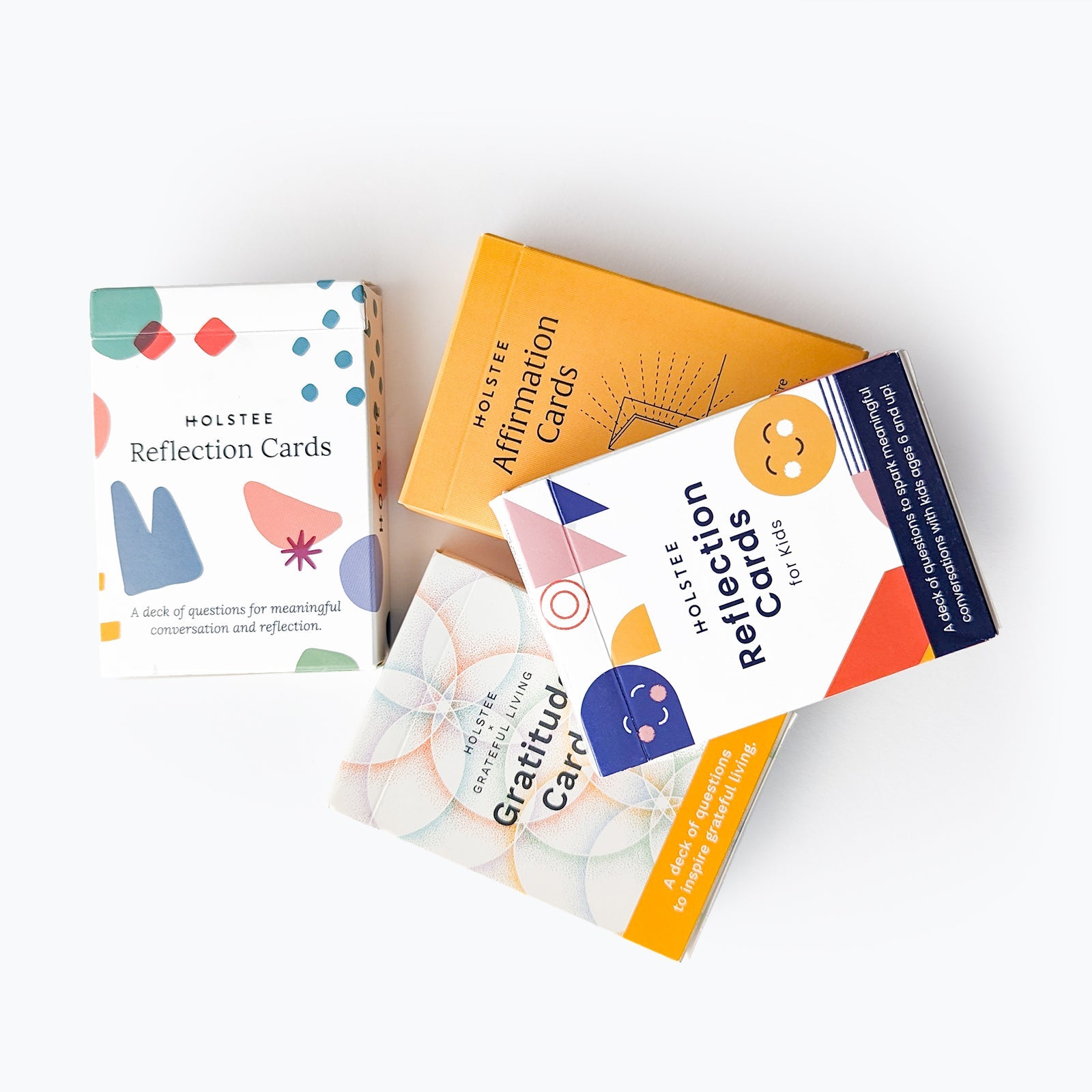
Last weekend, I got in some great family time. A particularly powerful moment was when my grandmother Mammanjoon (MJ for short) held Mala, our new daughter, in her arms for the first time. Immediately, she recited a poem she had written for Mala in her native Farsi. It's said that the people of Shiraz, Iran — where our family’s lineage dates back several hundred years — cherish creativity, curiosity, and celebration. MJ’s actions remind us of this legacy each day. She wrote poems for each of her nine grandchildren and eight great-grandchildren, and she can easily recite any number of Rumi and Hafez poems she’s committed to memory over the 92 years of her life. She pulls late nights with the family playing logic games like Rummikub and Hokm, a Persian card game. She regularly practices new crochet patterns, tries new recipes, and is curious about new technologies. When I look back, it seems there’s no challenge MJ’s been afraid to take on. And despite her age, her memory is as sharp as mine — on my best days. When I asked MJ the number one thing that keeps her mind so sharp, she told me that it’s doing things that engage and challenge her. Her response almost perfectly echoes the latest research into neurodegeneration, highlighted in this month’s Adventure Guide: “People who have led more cognitively stimulating lives — through formal education, complex paid occupations, and/or cognitively engaging hobbies — have a reduced risk of developing dementia ... Cognitive engagement provides cognitive reserve that delays the onset of cognitive impairment.”– CCNA Researchers Nicole D. Anderson, PhD, Angela K. Troyer, PhD, and Kelly Murphy, PhD Whether it’s memorizing poems or learning a new stitch — by living a ‘cognitively stimulating’ life, it would appear that Mammanjoon has built up a ‘cognitive reserve’ — basically a bank of neurons that can be drawn on for years to come. By building our cognitive reserve, researchers suggest that we can actually delay symptoms of old age. And on a personal level, it might be the reason why Mammanjoon continues to school Dave in Rummikub and delight her new great-granddaughter with poetry. To life, love, and learning, Mike RadparvarCo-Founder, Holstee P.S. Fun fact: MJ created many of the first prototypes for our first product, the Holstee t-shirt (holster pocket + t-shirt = Holstee). In many ways, she is the reason Holstee exists today! Speaking of new products... if you haven’t heard yet, we are preparing for a Kickstarter launch later this summer! Learn more about our newest product, Holstee Reflection Cards →
Learn more
An adventure into parts unknown.
“If I'm an advocate for anything, it's to move. As far as you can, as much as you can. Across the ocean, or simply across the river. The extent to which you can walk in someone else's shoes or at least eat their food, it's a plus for everybody. Open your mind, get up off the couch, move." ― Anthony Bourdain My parents and much of my family moved to the U.S. in 1979. They were seeking asylum — fleeing Iran during the revolution to avoid religious persecution. My parents, newlyweds, came with two pieces of luggage each, leaving their home, their families, their friends and nearly all of their possessions to start a new life. Like most of my family members who left during that time, they haven't returned, always waiting for a safe moment to visit again. Cooking, eating, and sharing conversations over meals became a way for my family to stay connected, as well as an opportunity to make friends in their new home. It was after one of these long, delicious Persian meals that I was first introduced to Anthony Bourdain. My aunt had watched the Parts Unknown episode focused on Iran, and she played it for the family to see. Watching this episode was an eye-opener for me. I was reminded that beyond the cultural heritage, delicious dishes, and Persian hospitality that surrounded me growing up, there are places, people, and foods from Iran that are still completely foreign because I’ve never had the chance to travel there in person. Watching it was also a relief. Anthony, with his infinite humanity, demonstrated that even in places seen as dangerous or foreign, there are caring people who open their homes and kitchens with a loving smile. It’s a reminder that sometimes it takes going beyond our comfort zone to see how connected the world can be. As we explore the theme of Adventure this June, we want to take a moment to remember a man who shared so many incredible adventures with us. Anthony and his zest for both cuisine and kinship will be forever missed. And his legacy will remain as we find our own ways to explore parts unknown. Dave RadparvarCo-Founder, Holstee
Learn more
Parenting wisdom from the community.
In last week’s Reflection (Reduce the noise, focus on the essentials, and keep it simple.) I shared how I have been paring down and simplifying my life so I could make space for becoming a father. At the end of the email I asked you, the Holstee community, to share your lessons and words of parenting wisdom — the response was incredible. And what timing. Our baby girl was born this week and it’s been one of the most meaningful, magical experiences of my life. My heart has swelled in ways I didn’t know was possible. The transition from last month's theme of Simplicity to June's theme of Adventure was particularly pronounced for me this year. It was a great reminder of how much the former can be an enabler for the latter. The wisdom of this community runs deep so I’d like to reflect back what you so generously had to offer me, categorized into a few buckets below. Keep yourself healthy “All the baby needs is happy, healthy parents. If you are centered and strong, your child will be as well!” -Heather “Sleep when the baby sleeps” - Melissa “Make sure that you and your wife have each others back when either of you makes what may be an unpleasant decision.” - CJ “Your daughter will test your strength and push you to your limits of sanity. It will start easily enough and will quickly progress to full on chaos. You will lose your mind. When this happens allow yourself to step away and reset, until you can return to your normal state of mind.” - Dave E. Be in the moment “SAVOR EVERY MOMENT.” - Yvonne “Especially in the first months in the life of your little girl you can set the base of a deeply emotional relationship. I cuddled and hugged as much as I could with my daughter” - Carsten “Just enjoy the moments and embrace a beginners mind.” - CJ "Don't wish anything away. No matter what phase you are in, it will change. And it all goes by quickly. So do whatever you can to appreciate the now of whatever stage you're in." - Mike S. “When you are with your family BE with your family. Learn to be flexible. Listen to your child. If they feel heard, really heard, everything from there is doable.” - Lani “Put down the parenting books and pick up the baby.” - Gina "Parenting tiny humans is like living life in fast forward and slow motion all at the same time. Enjoy the show!" - Leslie B “We asked everyone to stay away for two weeks so that we could bond and find our new rhythm. Its difficult to put into words how special it was.” - Ben Trust your intuition “Keep it simple, do what your instincts tell you.” - Max “You can't mess it up. You will be the exact parent your child needs.” - Melissa “We're all wrong at least 50% of the time, and it turns out, being wrong isn't so bad, especially in parenting. With each "wrong" choice, you are teaching incredible resilience, flexibility, and forgiveness. And the world always needs more of all three of those things.” - Elaine “Don't feel that you need to listen to other's parenting advice. Take what you want. Smile and say no thank you to the rest.” - Heather On guiding your child “Enjoy them love them and know that you can influence not own and control them.” - Jane “Teach them character and integrity by example. Say yes whenever you can and when you say no, mean it.” - Barbara “Let her learn the value of a dollar and the satisfaction and personal pride that comes from working to earn something. As she saves for the things that she wants, she will learn to delay gratification. She is being born into a world of uncertainty. Create family rituals and routines that become sacred to your family. She is growing up in a world of disconnected people. Let her find her voice and know that her thoughts matter. Remember that ultimately, she has her own journey.” - Debbie And one more to look forward to ;-) “The best thing about children is they are a gateway to being a grandparent” - Jane Cecilia also resurfaced two poems on parenting for me I have always loved: On Children by Kahlil Gibran and Children Learn What They Live by Dorothy Law Nolte - you can read both at the end of this note. Thank you again for sharing your wisdom and hard-learned lessons with me. I am honored to be able to pass them along. And thanks to Allaina for the great suggestion to share these responses! With gratitude and love, Michael, Setareh and Mala On Children by Kahlil Gibran Your children are not your children. They are the sons and daughters of Life's longing for itself. They come through you but not from you,And though they are with you yet they belong not to you. You may give them your love but not your thoughts,For they have their own thoughts. You may house their bodies but not their souls,For their souls dwell in the house of tomorrow,which you cannot visit, not even in your dreams. You may strive to be like them,but seek not to make them like you. For life goes not backward nor tarries with yesterday. You are the bows from which your children as living arrows are sent forth. The archer sees the mark upon the path of the infinite, and He bends you with His might that His arrows may go swift and far. Let your bending in the archer's hand be for gladness;For even as He loves the arrow that flies,so He loves also the bow that is stable. Children Learn What They Live by Dorothy Law Nolte If a child lives with criticism,he learns to condemn. If a child lives with hostility,he learns to fight. If a child lives with fear,he learns to be apprehensive. If a child lives with pity,he learns to feel sorry for himself. If a child lives with ridicule,he learns to be shy. If a child lives with jealousy,he learns what envy is. If a child lives with shame,he learns to feel guilty. If a child lives with encouragement,he learns to be confident. If a child lives with tolerance,he learns to be patient. If a child lives with praise,he learns to be appreciative. If a child lives with acceptance,he learns to love. If a child lives with approval,he learns to like himself. If a child lives with recognition,he learns that it is good to have a goal. If a child lives with sharing,he learns about generosity. If a child lives with honesty and fairness,he learns what truth and justice are. If a child lives with security,he learns to have faith in himself and in those about him. If a child lives with friendliness,he learns that the world is a nice place in which to live. If you live with serenity,your child will live with peace of mind. With what is your child living?
Learn more