Mindful Matter

Adventure: How Curiosity and Courage Open Up Life
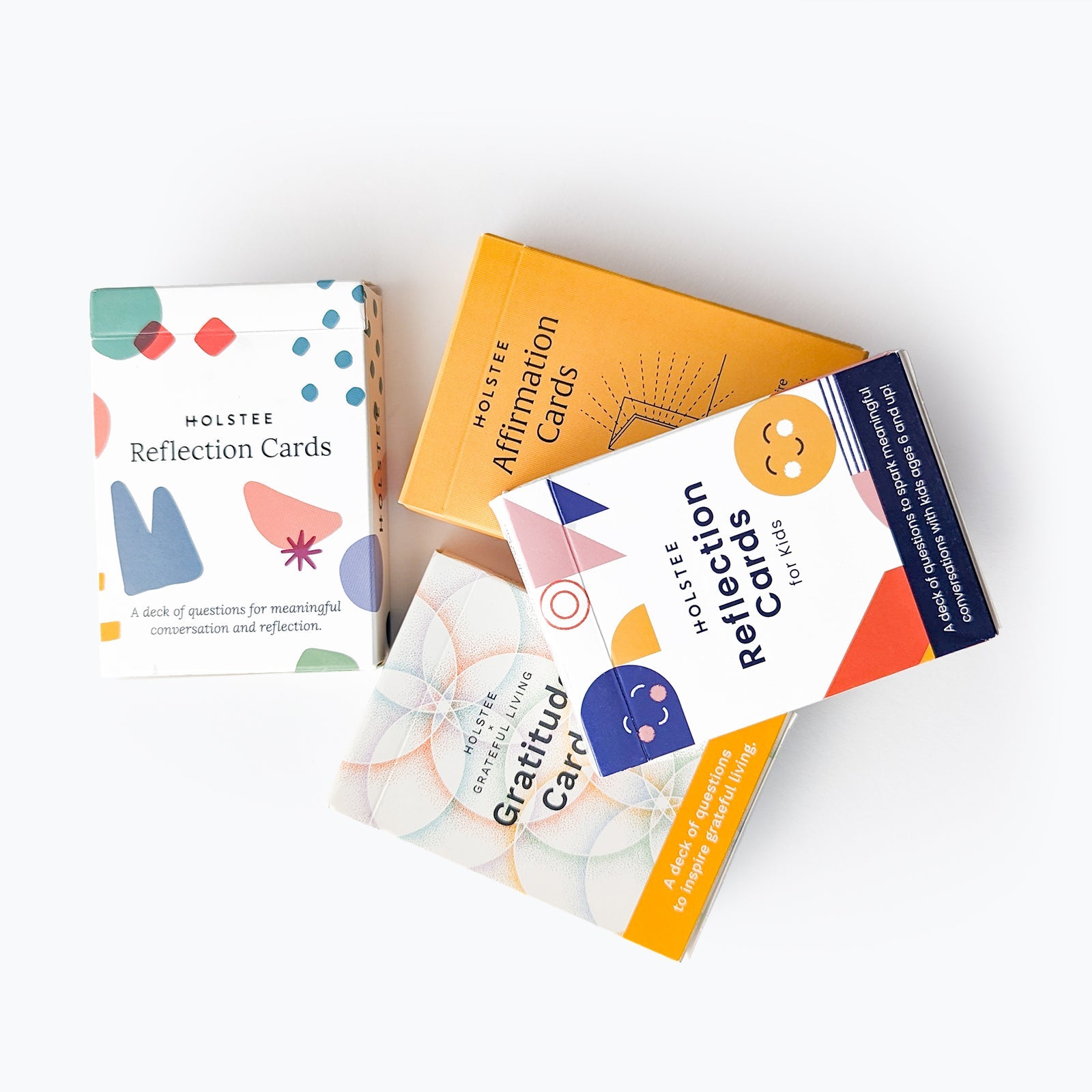
🌱 Enjoying this? It's a taste of The Flourishing Life, our year-long Holstee membership. Every month we explore a new theme like this one together, with guided practices, reflection prompts, and live conversations. Unlock full access → We tell ourselves a flattering story about playing it safe. We call our routines wisdom and our avoidance prudence. For a long time I did too, right up until I made a big, uncertain leap of my own and realized the careful version of my life had quietly become the riskiest one. That's the heart of adventure, and it has almost nothing to do with plane tickets or extreme sports. The word comes from the Latin for "about to happen." Adventure is really just the practice of staying open to what wants to emerge, and being willing to step toward it before you're certain. Adventure is curiosity plus bravery The cleanest definition I've found comes from the VIA Institute on Character, and it's a simple equation. Adventure sits at the intersection of two things: the curiosity to wonder what's over there, and the bravery to actually go and look. You need both. Curiosity without bravery is just daydreaming, the trip you research for years and never take. Bravery without curiosity is recklessness, motion for its own sake. Where they meet, where wondering turns into willingness, is where an ordinary day becomes an adventure. The real risk is playing it too safe We all know the myth of Icarus, who flew too close to the sun and fell. We've used it for centuries as a warning against flying too high. Seth Godin points out that we've forgotten the other half of the warning. Daedalus told his son not to fly too low either, because the sea's damp would weigh the wings down just as surely. Most of us are in far more danger of flying too low. We optimize for comfort and then wonder why we feel restless and small. Godin's reframe is bracing: in a world like ours, playing it safe has quietly become the riskiest game. The comfort zone feels like shelter, but spend too long in it and it becomes the thing you need an adventure to escape. The adventures that don't need a passport Here's the part that surprised me most. The bravest things most of us ever do don't happen on a mountain. They happen in a conversation. There's a kind of quiet adventure that no one sees and nothing forces. The belief you've started to suspect isn't true. The part of yourself you keep not looking at. The apology you owe. The thing you keep almost saying to someone who matters. These don't make for good photographs, and they're easy to defer forever, because no flight is leaving without you. The door has no handle on the outside. The only thing that opens it is your willingness to put your hand on it. If you're looking for an adventure to begin, you can skip the question of what would be impressive. Ask the two quieter ones instead. What have I been carrying that I haven't faced? And what have I been afraid to say, and to whom? Our Reflection Cards are full of questions like these, if you want company in asking them. Sometimes the adventure that matters most is the inward one. A richer life, not just a happier one For most of its history, psychology offered two measures of a good life: was it happy, and was it meaningful. The psychologist Shigehiro Oishi has spent recent years arguing for a third measure he calls psychological richness, a life of varied, interesting, perspective-changing experiences. What I love about his framing is that richness has its own logic. A life optimized for happiness alone can curdle into complacency. A life optimized for meaning alone can narrow into rigidity. Richness is the textured life, harder to summarize and harder to regret. Oishi found that some people will reliably choose interesting over easy, even when it costs them comfort, and they don't always score higher on happiness. They just say they wouldn't trade the life they're living. Every time you say yes to something unfamiliar, you're voting for that kind of richness. We've felt this firsthand chasing a more wonder-full life. Make stress and failure your allies Adventure asks you to be uncomfortable, which means it asks you to handle some fear and some stress. The good news is that both are more useful than we treat them. Bravery, it turns out, isn't the absence of fear. It's a sequence: acknowledge the fear, decide to act anyway, then take the step. On stress, the health psychologist Kelly McGonigal makes a compelling case that the feeling isn't a malfunction. Stress shows up when something you care about is at stake, and that same energy can be aimed forward instead of fought. Failure works similarly. Astro Teller, who runs Google's moonshot lab, talks about celebrating failure because so many failures are really redirections. The researcher Amy Edmondson sharpens it: the failures worth celebrating are the "intelligent" ones, the smart risks taken at the edge of what's known, where the outcome genuinely couldn't be known in advance. Those aren't the price of doing something foolish. They're the price of doing something new. The journey is the point The Greek poet Cavafy said it best, in his poem "Ithaka", written as advice for any voyage: As you set out for Ithaka hope your road is a long one, full of adventure, full of discovery... Keep Ithaka always in your mind. Arriving there is what you're destined for. But don't hurry the journey at all. Better if it lasts for years... Ithaka gave you the marvelous journey. Without her you wouldn't have set out. The destination gets you moving. The journey is what actually makes you. That's as true of a quiet adventure as a literal one. Going deeper, together Reading about adventure is one thing. Practicing it alongside other people who are also trying is another, and it tends to stick better. Adventure is one of twelve themes in The Flourishing Life, our year-long Holstee membership, alongside Intention, Kinship, Gratitude, and the rest. Over a year the community moves through all twelve together, and you can join any time and focus on whatever you need most right now. Each theme brings a small curriculum, fellow members working through it alongside you, and live conversations to make it real. It's not for everyone, but if you've read this far, it might be for you. Frequently asked questions What is adventure? Adventure is the practice of staying open to the unknown and being willing to step toward it. The word comes from the Latin for "about to happen." It isn't limited to travel or extreme sports; an adventure can be any experience that asks for curiosity and courage, including inner and interpersonal ones. What is the difference between courage and fearlessness? Fearlessness is the absence of fear; courage is feeling the fear and acting anyway. Genuine bravery doesn't require you to stop being afraid. It follows a simple path: acknowledge the fear, decide to act, and take the step despite it. Do I have to travel to have an adventure? No. Some of the most meaningful adventures are "quiet" ones that require no passport: having a hard conversation, facing a truth you've avoided, making an apology, or trying something you might fail at. These ask for the same courage a cliff edge does, the willingness to move when the ground feels uncertain. What is psychological richness? Psychological richness, a concept from psychologist Shigehiro Oishi, is a third dimension of a good life alongside happiness and meaning. It describes a life full of varied, interesting, and perspective-changing experiences. Richness often involves difficulty, and people living richly don't always report being happier, but they tend to say they wouldn't trade their lives. Why is staying in my comfort zone risky? Comfort feels safe, but over-optimizing for it tends to breed restlessness, stagnation, and regret. As Seth Godin argues, in a fast-changing world, playing it too safe can be the most dangerous choice. New and challenging experiences also build "cognitive reserve," mental flexibility that keeps you adaptable over time. How can I become more adventurous? Start small and build the muscle. Get curious by asking more questions, then practice bravery by taking one uncomfortable step, reflecting on it, and stacking small successes. Reframing stress as energy and failure as information makes the next step easier. Adventurousness grows through direct experience more than through pep talks. Michael Radparvar Co-Founder, Holstee
Learn more
Simplicity: How to Reduce the Noise and Keep What Matters
🌱 Enjoying this? It's a taste of The Flourishing Life, our year-long Holstee membership. Every month we explore a new theme like this one together, with guided practices, reflection prompts, and live conversations. Unlock full access → For years my calendar was a monument to things I'd said yes to and didn't want. A coffee here, a call there, a favor I'd half-volunteered for, each one reasonable on its own, all of them together leaving no room to breathe. I kept treating it as a scheduling problem. It was really a courage problem. I didn't yet know how to say no. Simplicity is the practice of fixing that, not just on the calendar but in the closet, the inbox, and the mind. It isn't about owning less for its own sake. It's about clearing away the noise so the few things that actually matter have room to be heard. Simplicity isn't deprivation The word conjures a bare white room and a person who owns four shirts. That's a caricature. You don't have to become a minimalist monk. You just have to become the editor of your own life, choosing on purpose what gets your time, money, and attention, and letting the rest go. We've been sold the opposite story: that more options mean more freedom, that busy means important. The research disagrees. The psychologist Barry Schwartz found that too much choice actually makes us less satisfied and more anxious, the grocery store jam aisle as a small daily portrait of modern paralysis. The abundance most of us are missing isn't more stuff. It's the spaciousness that shows up when the clutter is gone. We made a short version of this same case a while back. Edit your commitments Start with your time, because it's the thing you can never get back. Derek Sivers offers a brutal, useful filter: if it isn't a "hell yeah," it's a no. Most of what fills our weeks lives in the lukewarm middle, and that middle is exactly what crowds out the things we'd genuinely love. Greg McKeown, who wrote Essentialism, calls the skill we're all missing the "graceful no," a way to decline that's firm without being unkind. And Leo Babauta names the deeper trap: the feeling that you must always do more, which he frames as a kind of greed. His antidote is generosity, giving your full presence to one thing instead of a thin slice of attention to ten. The goalposts of "more" always move. Presence is the way off the field. Edit your stuff Possessions are the visible version of the same problem. Marie Kondo turned tidying into a near-spiritual practice with a single question: does this spark joy? The reframe that makes it work is subtle. You're not choosing what to throw away. You're choosing what to keep, and thanking the rest on its way out. One small practice has stuck with me more than any closet purge. The designer Tina Roth Eisenberg keeps a "Did Not Buy" list: every time she's tempted by something nonessential, she writes it down instead of buying it. Months later the list is a quiet record of all the things she was sure she needed and never missed. It turns restraint into something that feels like collecting rather than depriving. Edit your attention The last frontier, and the hardest, is your attention, because the noise there is engineered to be sticky. Start by retiring the myth of multitasking. A Stanford study found that heavy multitaskers were measurably worse at filtering distraction and switching tasks, not better. The brain doesn't run parallel; it just switches fast and pays a tax each time. Cal Newport offers the cleanest fix, which he calls digital minimalism: decide what you actually value, keep only the tools that clearly serve it, and, in his words, "happily miss out on everything else." It's the graceful no, pointed at your screen. A worthwhile exercise: write down five of your values, then look at the apps you open most and ask, honestly, which ones earn their place. Make a clearing Underneath the tactics is an older idea. Zen calls it beginner's mind, the willingness to meet even familiar things, your commute, your kitchen, a person you love, as if for the first time. Much of our complexity is just accumulated assumption, and a lot of peace comes from setting it down. The teaching on non-attachment isn't that you stop caring. It's that you stop clinging, and let the changing things change. The poet Martha Postlethwaite captured the whole practice better than any framework, in a poem called "Clearing": Do not try to save the whole world or do anything grandiose. Instead, create a clearing in the dense forest of your life and wait there patiently, until the song that is your life falls into your own cupped hands and you recognize and greet it. That's what simplicity is for. Not less for the sake of less, but a clearing, so the song of your life has somewhere to land. If you want a tool for hearing it, our Reflection Cards are good company in the quiet. Going deeper, together Reading about simplicity is one thing. Practicing it alongside other people who are also trying is another, and it tends to stick better. Simplicity is one of twelve themes in The Flourishing Life, our year-long Holstee membership, alongside Intention, Kinship, Gratitude, and the rest. Over a year the community moves through all twelve together, and you can join any time and focus on whatever you need most right now. Each theme brings a small curriculum, fellow members working through it alongside you, and live conversations to make it real. It's not for everyone, but if you've read this far, it might be for you. Frequently asked questions What is simplicity? Simplicity is the practice of consciously editing your life, deciding what truly deserves your time, energy, and attention, and letting go of the rest. It applies not just to physical possessions but to commitments, attention, and mindset. It's less about owning little than about making deliberate room for what matters most. Is simplicity the same as minimalism? They overlap but aren't identical. Minimalism often focuses on owning fewer things, while simplicity is broader, covering how you spend your time, where you place your attention, and how you make decisions. You can live simply without a stark, minimalist aesthetic; the goal is clarity and intention, not a particular look. How do I simplify my life without giving up everything? Start small and in one area. Edit your commitments by saying no to anything that isn't a clear yes, declutter one category of possessions at a time, and trim the digital tools that don't serve your values. Simplicity is about subtraction in service of what you care about, not deprivation for its own sake. Why does having more choices make me less happy? Psychologist Barry Schwartz found that an abundance of options can increase anxiety and decrease satisfaction, a phenomenon often called the paradox of choice. More options mean more effort to decide and more second-guessing afterward. Reducing trivial choices frees up mental energy for the decisions that actually matter. What is digital minimalism? Coined by Cal Newport, digital minimalism is the practice of using technology intentionally: keeping only the digital tools that clearly support your values and letting go of the rest. Rather than reacting to every app and notification, you decide in advance what deserves your attention and "happily miss out on everything else." How does decluttering help mentally, not just physically? Clearing physical clutter tends to reduce the low-level stress of visual noise and decision fatigue, freeing attention for what matters. The act of deciding what to keep also clarifies your values. Many people find that an external clearing, in their space, calendar, or devices, creates a corresponding sense of internal calm and focus. Michael Radparvar Co-Founder, Holstee
Learn more
Compassion: How to Be Kinder to Others and Yourself
🌱 Enjoying this? It's a taste of The Flourishing Life, our year-long Holstee membership. Every month we explore a new theme like this one together, with guided practices, reflection prompts, and live conversations. Unlock full access → I can be endlessly patient with other people and a tyrant to myself. A friend misses a deadline and I tell them not to worry, it happens, life is full. I miss the same deadline and the voice in my head reaches for words I would never say out loud to anyone I cared about. For a long time I thought that double standard was just discipline. It was mostly cruelty wearing discipline's clothes. Compassion is the practice of closing that gap. The word comes from the Latin for "to suffer with," and that's the heart of it: the willingness to be present with pain, your own or someone else's, and to respond with kindness rather than judgment. What compassion actually is Compassion gets confused with a few softer things. It isn't pity, which looks down. It isn't fixing, which rushes to make the discomfort go away, usually more for our sake than theirs. And it isn't drowning in someone else's pain until you're no use to anyone. Real compassion is two things held together: feeling with someone, and the motivation to help. Think about the last time someone was truly there for you in a hard moment. Odds are they didn't solve anything. They just sat with you and somehow made it lighter. That presence is the whole skill. We've written before about accepting kindness, which turns out to be its own kind of practice. Be kinder to yourself first Here's the part most of us skip. Dr. Kristin Neff, who has spent her career studying this, found that self-compassion does what we wrongly expect self-criticism to do. People who treat themselves kindly through failure are less anxious, less depressed, and, counterintuitively, more motivated to improve. The inner drill sergeant isn't keeping you sharp. It's wearing you down. Neff describes self-compassion as three moves. Self-kindness instead of harsh judgment when you fall short. Common humanity instead of isolation, remembering that struggling and failing is something every human does, not a private defect of yours. And mindfulness instead of over-identifying, holding your hard feelings without becoming them. A practice she teaches has stuck with me. When the inner critic starts up, notice that there are actually three voices in there: the Critic, the one being criticized, and a third, quieter one, a kind observer. Most of us never let that third voice speak. Try writing down what it would say. Usually it sounds like what you'd tell a good friend, which is exactly the point. If saying kind things to yourself feels strange at first, our Affirmation Cards are a small scaffold for the habit. Widening the circle Once you can extend warmth inward, it gets easier to extend it outward, even to strangers, even to people you'll never meet. That isn't sentimental. Dr. Emma Seppälä at Stanford's compassion research center, who recently joined us as a guest speaker in The Flourishing Life, has shown that our instinct for compassion can actually be trained, often through a simple loving-kindness meditation: quietly wishing well, first to someone you love, then to yourself, then outward to people you barely know. The positive psychologist Chris Peterson spent a career boiling the research on what makes life good down to three words: "Other people matter. Period." Compassion is just the everyday technology for acting like that's true. It shows up small, in a kindness offered with eyes open, in the choice to stay soft during a conflict instead of bracing for one. Compassion is also how you speak Some of the most practical compassion lives in language, in how we handle the moments when we're hurt or at odds. Marshall Rosenberg built a whole method around it called Nonviolent Communication, which we wrote a fuller introduction to here. Its four steps are worth memorizing: Observe without judgment. "The project was two days late," not "you always miss deadlines." Name the feeling. "I feel anxious," not "I feel like you don't care," which is a thought wearing a feeling's clothes. Identify the need underneath. Most anger is an unmet need for connection, respect, or security in disguise. "I feel anxious because I really value being able to count on a plan." Make a request, not a demand. "Would you be willing to give me a day's notice if things change?" leaves room for a yes. It feels mechanical written out. In practice it does something quietly radical: it lets you be honest about your hurt without turning the other person into a villain. A note on paying attention Underneath all of this is something even simpler. Compassion begins with attention, the willingness to actually notice another person, or yourself, instead of rushing past. Mary Oliver put it better than any framework could, in her poem "Praying": It doesn't have to be the blue iris, it could be weeds in a vacant lot, or a few small stones; just pay attention, then patch a few words together and don't try to make them elaborate, this isn't a contest but the doorway into thanks, and a silence in which another voice may speak. That doorway is where compassion starts. Pay attention. The rest follows. Going deeper, together Reading about compassion is one thing. Practicing it alongside other people who are also trying is another, and it tends to stick better. Compassion is one of twelve themes in The Flourishing Life, our year-long Holstee membership, alongside Intention, Kinship, Gratitude, and the rest. Over a year the community moves through all twelve together, and you can join any time and focus on whatever you need most right now. Each theme brings a small curriculum, fellow members working through it alongside you, and live conversations to make it real. It's not for everyone, but if you've read this far, it might be for you. Frequently asked questions What is compassion? Compassion is the ability to understand and share in another person's suffering, combined with the desire to help relieve it. The word comes from the Latin for "to suffer with." It requires both feeling and action, and it can be directed toward others or toward yourself. What is the difference between empathy and compassion? Empathy is feeling what another person feels. Compassion adds a second ingredient: the motivation to help. Empathy alone can leave you overwhelmed or stuck in someone else's pain, while compassion channels that shared feeling into supportive action, which is part of why it tends to be more sustainable. What is self-compassion? Self-compassion is treating yourself with the same kindness you'd offer a good friend who was struggling. Researcher Kristin Neff describes it as three elements: self-kindness instead of harsh judgment, recognizing your struggles as part of common humanity rather than isolation, and holding difficult emotions mindfully instead of being consumed by them. Is self-compassion just an excuse to let yourself off the hook? No. Research consistently finds the opposite: people who practice self-compassion are more motivated to improve, not less, because they're less afraid of failure. Harsh self-criticism tends to drive anxiety and avoidance, while self-compassion creates the safety needed to learn from mistakes and try again. How can I be more compassionate in difficult conversations? Nonviolent Communication offers a simple framework: state a specific observation without judgment, name how you feel, identify the underlying need, and make a clear request rather than a demand. This lets you express hurt honestly without blaming the other person, which keeps the conversation open instead of defensive. Can compassion be learned? Yes. Studies show compassion is trainable, much like a muscle. Practices such as loving-kindness meditation, which involves directing goodwill toward yourself and others, have been shown to measurably increase compassionate feelings and behavior over time. Michael Radparvar Co-Founder, Holstee
Learn more
Wellness: How to Thrive, Not Just Get Through the Day
🌱 Enjoying this? It's a taste of The Flourishing Life, our year-long Holstee membership. Every month we explore a new theme like this one together, with guided practices, reflection prompts, and live conversations. Unlock full access → You know the kind of day I mean. You weren't doing anything heroic, a few meetings, some errands, the usual, and by evening you're wrung out, shoulders up somewhere near your ears, too tired to sleep and too wired to rest. You tell yourself that tomorrow you'll exercise, eat better, get to bed early. Then tomorrow does the same thing to you. For a long time I treated that as a discipline problem, like I just needed a stricter morning routine and more willpower. It turned out to be a listening problem. Wellness has less to do with imposing a system on yourself than with learning to hear what your body and mind are actually asking for. Wellness isn't a finish line Most of what gets sold as wellness is really optimization: the perfect routine, the cleanest diet, the most disciplined schedule. It treats your body like a project to be managed and you like the manager who keeps falling short. Real wellness is messier and kinder than that. It's honoring your need for rest in a world that rewards hustle. It's finding ways to move that feel like play instead of punishment. It's noticing the difference between "I'm tired and need rest" and "I'm restless and need stimulation," which sound alike from the inside until you practice telling them apart. You never arrive at wellness and check it off. You just get a little better at the daily conversation. We've made a version of this same case before, and it still holds. The six dimensions of a well life One reason wellness feels slippery is that we collapse it into one thing, usually fitness, when it's really at least six. A whole life leans on its mind, body, soul, work, play, and love, and when you neglect one, the others start to wobble. Mind. Staying curious, learning, using your attention on purpose. Being a beginner at something as an adult is good for you, ego included. Body. Sleep, movement, food, the basics, tuned to what your body actually needs rather than what a program tells you it should. Soul. A sense of awe and connection to something larger than your to-do list. Work. Drawing some real fulfillment from what you spend your days on, even if a wholesale change isn't on the table. Play. Time for the things that spark joy for no productive reason at all. Love. Nourishing, and being nourished by, the people in your life. You don't fill all six equally every day. The skill is noticing which one is running low and needs your attention this week. Start with the body When most of us finally notice the body, it's because something has gone wrong: pain, exhaustion, a knot between the shoulders. A lot of wellness is just moving that check-in earlier, before the warning light. The fastest lever is the one you're using right now, your breath. James Nestor, who wrote a whole book on it, calls the nose "nature's air filter" and makes a strong case that most of us would feel better breathing through it more. When sleep won't come, a slow 4-7-8 breath, a long exhale through the mouth, does more to settle the nervous system than another hour of lying there doing the math on how little rest you're about to get. (If the not-sleeping part sounds familiar, we went deep on it in why you're so tired.) Don't forget to play Play is the dimension adults quietly delete first, and it costs us more than we think. Dr. Stuart Brown has studied play for decades and argues it isn't the opposite of work, it's part of what keeps us creative and sane. He also found that play looks different for different people. Some of us play through movement, some through games and competition, some through making things, some through collecting, exploring, telling stories, or just being silly. If "go have fun" has never quite worked for you, it may be that you've been borrowing someone else's idea of fun. Find your own kind and protect a little time for it. Small practices that compound You don't overhaul a life. You run small experiments and keep the ones that work. A few worth trying: Morning pages. Julia Cameron calls three pages of unedited longhand writing first thing in the morning "windshield wipers for the soul." You're not writing for anyone, including future you. You're just clearing the glass. A weekly check-in. Once a week, ask what challenged you and what you want to do differently next week. Our Reflection Cards are built for exactly this kind of honest conversation with yourself. Practice patience on purpose. Let someone go ahead of you in line. Leave the phone in your pocket at the red light. Patience is a skill, and these are the reps. The form of care you need changes week to week, so it's worth asking. The point isn't to do all of it. It's to keep listening, and to be gentle with yourself when a week gets away from you. That gentleness is part of the practice, not a break from it. Going deeper, together Reading about wellness is one thing. Practicing it alongside other people who are also trying is another, and it tends to stick better. Wellness is one of twelve themes in The Flourishing Life, our year-long Holstee membership, alongside Intention, Kinship, Gratitude, and the rest. Over a year the community moves through all twelve together, and you can join any time and focus on whatever you need most right now. Each theme brings a small curriculum, fellow members working through it alongside you, and live conversations to make it real. It's not for everyone, but if you've read this far, it might be for you. Frequently asked questions What is wellness? Wellness is the ongoing practice of caring for your whole self across several dimensions of life, not just physical fitness. It's less a fixed state you achieve than a daily process of noticing what you need and responding to it. True wellness is about thriving rather than simply getting by. What are the six dimensions of wellness? A common framework breaks wellness into six interconnected dimensions: mind (curiosity and mental engagement), body (sleep, movement, and nourishment), soul (awe and connection), work (fulfillment in what you do), play (joy for its own sake), and love (nourishing relationships). Neglecting one tends to throw the others off balance. How do I improve my wellness without a perfect routine? Start by noticing which dimension feels most depleted right now, then run one small experiment to support it rather than overhauling everything at once. Small, repeatable practices like a few minutes of slow breathing, a weekly check-in, or protecting time for play tend to compound far better than an ambitious routine you can't sustain. Why am I exhausted even when I get enough sleep? Tiredness isn't always about hours in bed. It can stem from chronic stress, an under-supported nervous system, lack of restorative downtime, or neglecting non-physical dimensions of wellness like play and connection. Simple practices such as nose breathing, a wind-down routine, and slowing your exhale before bed can meaningfully improve how rested you feel. Is wellness the same as self-care? Self-care is one piece of wellness, the practices that restore you, but wellness is broader. It includes how you work, learn, play, connect, and find meaning, not just how you rest and recharge. Self-care tends to be the moment-to-moment maintenance; wellness is the whole-life picture. How do I know which area of my life needs attention? Body awareness is the key skill. Check in regularly, through a body scan, journaling, or a simple weekly review, and notice where you feel depleted, numb, or out of balance. Over time you get better at distinguishing what you actually need, like rest versus stimulation or solitude versus connection. Michael Radparvar Co-Founder, Holstee
Learn more
Gratitude: How to Notice What's Already There
🌱 Enjoying this? It's a taste of The Flourishing Life, our year-long Holstee membership. Every month we explore a new theme like this one together, with guided practices, reflection prompts, and live conversations. Unlock full access → There's a poem by Cathy Ross that has stuck with me for years. It imagines what would happen if the moon came out only once a month: If the moon came out only once a month people would appreciate it more. They'd mark it in their datebooks, take a walk by moonlight, notice how their bedroom window framed its silver smile. And if the moon came out just once a year, it would be a holiday, with tinsel streamers tied to lampposts, stores closing early so no one has to work on lunar eve [...] And if the moon rose but once a century, ascending luminous and lush on a long-awaited night, all humans on the planet would gather in huddled, whispering groups to stare in awe [...] Years later, they would tell their children, "Yes, I saw it once. Maybe you will live to see it too." But the moon is always with us, an old familiar face, like the mantel clock, so no one pays it much attention. Tonight why not go outside and gaze up in wonder, as if you'd never seen it before, as if it were a miracle, as if you had been waiting all your life. (Cathy Ross, "If the Moon Came Out Only Once a Month") That's the whole problem with gratitude in one image. The good things are right there. We've just stopped seeing them. What gratitude actually is Gratitude has a softness to it that makes it easy to wave off, like a nice idea you'll get to once the real work is done. The research tells a different story. Robert Emmons, who has studied it for decades, calls gratitude one of the few things that can measurably change a person's life: better health, stronger relationships, more steadiness in hard times. He defines it in two simple parts. First, noticing the good that's already in your life. Second, recognizing that much of that good came from outside you, from other people, from luck, from the plain fact of being alive. That second part is what separates gratitude from mere satisfaction. Satisfaction says I have enough. Gratitude says I was given much of this, and stays a little amazed by it. Why we stop noticing The noticing is hard, and it isn't a character flaw. It's wiring. Psychologists call it the hedonic treadmill. We adapt to whatever we get. The raise, the bigger place, the thing we were sure would finally do it, all of it gives a brief lift and then quietly becomes the new normal. Gretchen Rubin puts it plainly: we get the boost, we get used to it, and we start scanning for the next thing. The treadmill is why you can have a life your younger self would have wept for and still feel a low hum of not-enough. Gratitude is one of the few things that reliably interrupts it. It drags your attention off the next rung and back onto the one you're standing on. We once called this gratitude as an antidote to perfection, and that's close to right. Stop. Look. Go. The Benedictine monk Brother David Steindl-Rast has spent a lifetime on a single, slightly subversive idea: most of us have the order backwards. We assume that once we're happy, we'll be grateful. He thinks it runs the other way. Be grateful first, and the happiness tends to follow. (We wrote about his "want to be happy, be grateful" talk a while back; it holds up.) His method is something you already learned as a kid crossing the street. Stop. Look. Go. Stop long enough to interrupt the autopilot. Look for what the moment is actually offering, the warmth of the coffee, the kindness of a stranger, the fact of a working body. Then go, and let it move you to do something, even if that something is just saying thank you. It's almost embarrassingly simple, which is exactly why it works. It's small enough to actually do. Steindl-Rast went on to found Grateful Living, the nonprofit that has carried the grateful-living movement for more than twenty-five years. We're lucky to call them friends; we built our Gratitude Cards together with them, a deck of questions designed to turn this idea into a daily practice. Get specific If there's one upgrade to make to the standard practice, it's this: get specific. "I'm grateful for my family" is true, and also so broad it barely lands. Emmons found that the detail is where the feeling lives. Compare the two. "I'm grateful for my family," against "I'm grateful that my sister called me every evening during the worst week of the year, even when she had nothing in particular to say." The second one you can feel. Specificity turns gratitude from a category into a memory, and memories are what stay with you. The doorway to awe Gratitude has a bigger cousin worth chasing too: awe. Dacher Keltner, who studies it, defines awe as the feeling of being near something vast that exceeds your understanding. He found we stumble into it in eight ordinary places: nature, music, art, big ideas, moral beauty, the rush of being in a crowd, the sacred, and the plain mystery of being alive and someday not. Keltner runs the Greater Good Science Center at UC Berkeley, which translates the research on what actually makes life meaningful into something usable. We've worked with them for years, and turned that science into two decks of practices you can hold in your hand: the Greater Good Toolkit and a version for kids. Awe does something useful. It makes you feel small in the best way, less wrapped up in yourself, more aware of being part of something. You don't need a mountaintop for it. A sunrise will do. So will a long look at the moon, as if you'd never seen it before. Making it a habit None of this works as a one-time insight. It works as a practice, repeated until it changes what you notice by default. A few that hold up: Keep it nightly. Maya Angelou treated gratitude as an end-of-day ritual, a moment before sleep to name one small gift the day handed you. The reliability matters more than the length. Write it down, specifically. Three things, with real detail, beats a long vague list every time. Say it out loud. The biggest jump in most gratitude practices comes when you stop journaling about people and start telling them. Some of the warmest versions of this happen around a table. The point isn't relentless positivity or pretending hard things aren't hard. Gratitude doesn't ask you to believe the hardship was good, only to notice that something, even in a hard stretch, is still worth being thankful for. We've gathered more of this in our five principles for grateful living. Going deeper, together Reading about gratitude is one thing. Practicing it alongside other people who are also trying is another, and it tends to stick better. Gratitude is one of twelve themes in The Flourishing Life, our year-long Holstee membership, alongside Intention, Kinship, Compassion, and the rest. Over a year the community moves through all twelve together, and you can join any time and focus on whatever you need most right now. Each theme brings a small curriculum, fellow members working through it alongside you, and live conversations to make it real. It's not for everyone, but if you've read this far, it might be for you. Frequently asked questions What is gratitude? Gratitude is the practice of noticing the good already present in your life and recognizing that much of it comes from outside yourself, from other people, from circumstance, from being alive at all. It's less a fleeting feeling than a way of paying attention, a habit of receiving what's already here rather than scanning for what's missing. What is the hedonic treadmill? The hedonic treadmill, or hedonic adaptation, is our tendency to quickly adjust to new circumstances and return to a baseline level of happiness. A raise, a new home, or a long-wanted achievement gives a brief lift before becoming the new normal. It's why lasting contentment rarely comes from acquiring more, and why gratitude, which redirects attention to the present, is one of the few reliable ways to step off it. How do you practice gratitude daily? Build in small, regular moments to notice. Many people keep a nightly ritual of naming a few specific things they're grateful for, with detail rather than broad categories. Even more powerful is expressing it directly to the people involved. Consistency matters more than length; a few seconds of genuine noticing each day compounds. What is the "Stop. Look. Go." method? Coined by Brother David Steindl-Rast, "Stop. Look. Go." is a simple gratitude practice modeled on crossing the street. Stop to interrupt your autopilot, Look for what the moment is actually offering, then Go and let it prompt an action, even if that action is just saying thank you. The idea is that gratitude can come first and happiness follows, rather than the other way around. Does gratitude really improve your health? Research by Robert Emmons and others links a regular gratitude practice to better physical health, stronger relationships, higher self-esteem, more empathy, and greater resilience during hard times. It isn't a cure-all, but few simple practices have as much evidence behind them. How is gratitude different from positive thinking? Positive thinking often asks you to reframe or downplay difficulty. Gratitude doesn't require pretending hard things aren't hard. It simply trains you to also notice what remains good, true, or worth appreciating, even in a difficult season. It's grounded in what's actually present rather than in forced optimism. Michael Radparvar Co-Founder, Holstee
Learn more
Kinship: How to Build Connections That Actually Hold
🌱 Enjoying this? It's a taste of The Flourishing Life, our year-long Holstee membership. Every month we explore a new theme like this one together, with guided practices, reflection prompts, and live conversations. Unlock full access → In the early days of Holstee, my co-founders and I lived and worked out of a small apartment in the East Village. We didn't have a budget for marketing, or really for much of anything, so when we wanted to meet people, we fed them. We'd squeeze a dozen near-strangers into a room barely big enough for the table, ask everyone to bring a dish and take their shoes off, and put a few real questions out where the small talk usually goes. Some of the closest friendships of my life started at those dinners. That's the thing about kinship. It rarely shows up on its own. You have to make a little room for it, set a table, ask a better question. Kinship is an old word for something we don't have a good modern name for: the feeling of being genuinely known by another person, and choosing to know them back. Not networked, not followed. Known. What kinship really means Think about the last time someone really saw you. Not the version you bring to work or wear at the grocery store, but the actual you, with the messy thoughts and the quiet fears and the unreasonable enthusiasms. That feeling of being seen and getting to stay anyway is what kinship is made of. Most of us are quietly starved for it. We have more contacts than any humans in history and still struggle to name who we'd call at 2am. What's missing is depth: the difference between being liked and being known, between collecting people and actually tending to a few of them over time. Kinship isn't about having hundreds of friends or being everyone's favorite person. It's about finding your people and letting them find you, the ones who treat your quirks as features rather than bugs and stick around for the long version of your story. That work of turning strangers into friends is slower than adding a contact, and it's most of what a good life is made of. Why connection keeps us well Connection does more than make life nicer. People with strong social ties have roughly a 50% greater likelihood of survival than people with weaker ones, a bigger effect on your health than quitting smoking. Good relationships don't just make life better. They make it longer. Which makes the modern loneliness problem strange and a little sad. We are more connected by technology than any people who have ever lived, and lonelier at the same time. If that's where you are right now, you are very much not the only one, and you're not stuck there either. We wrote once about the opposite of loneliness, and it has less to do with crowds than you'd think. It helps to remember that loneliness itself isn't a character flaw. Vivek Murthy, the former U.S. Surgeon General, describes it as a biological signal, like hunger or thirst, telling you something essential is missing. Seasons of it are normal. A move, a breakup, a new job, a loss, any of these can loosen your ties for a while. The signal isn't there to shame you. It's there to point you back toward each other. And the way back is smaller than you'd expect. Murthy's own advice is almost comically simple: fifteen minutes a day of real attention with someone you care about, no phones. Reach out first. Say the thing. It tends to matter more than you imagine it will. The many kinds of love Part of why connection feels confusing is that we use one tired word, love, for a dozen different things. The ancient Greeks were more precise, and their vocabulary still earns its keep. Aristotle sorted friendship into three kinds. Friendships of pleasure, built on the fun you have together. Friendships of utility, built on what you each get out of it. And friendships of virtue, built on genuinely wanting the best for the other person with no strings attached. He called that last one philia and thought it was the highest form, and also the rarest, because it asks the most of us. Much of what makes those rare ones last is no mystery; we gathered some of it in the natural laws of friendship. The Greeks went further and named seven loves in all. Storge, the easy affection of family. Eros, romantic desire. Philia, deep friendship. Agape, selfless love extended to anyone. Pragma, the patient love that endures in long partnerships. Ludus, the playful, flirtatious kind. And philautia, the love you turn toward yourself. Most real relationships are a moving blend of several, shifting over the years. You don't need the vocabulary to feel any of it, but naming it helps. It's easier to tend a friendship of virtue once you can tell it apart from a friendship of convenience. How to build connection that lasts If kinship is the goal, a few ordinary muscles get you there. None of them are complicated. All of them take practice. Listen like you mean it. Most of us listen for the gap where we can say our own piece. Active listening is the reverse: you give someone your whole attention and let understanding them be the point. It sounds small. It's the rarest thing in most conversations. Let yourself be seen. Brené Brown spent years studying why we hide the parts of ourselves we think are unlovable, and found that the hiding is exactly what keeps us from getting close. Vulnerability feels like weakness from the inside and reads as courage from the outside. Trust gets built in those moments, not around them. Learn how the other person receives love. Gary Chapman's five love languages (words of affirmation, acts of service, gifts, quality time, and touch) are an imperfect framework, and Chapman himself would tell you they aren't the whole picture. But they point at something true: people feel cared for in different ways, and it's worth learning which one actually lands for the people you love. Show up. Most of the time it's unglamorous work: the airport pickup, the text on the hard day, the standing invitation that doesn't need a reason. Kinship is built mostly out of small, repeated acts of being there. Rekindling a connection you've let slip Almost everyone has a name that comes to mind here. An old friend whose laugh you miss, a relative you keep meaning to call, someone who mattered and then quietly drifted. The good news is that reconnecting is usually far less awkward than the story you've built about it. It works as a ladder, easiest rung first. Send the text: something as low-stakes as "hey, you came to mind today, just wanted to say hello." You will almost certainly make their day. If that goes well, offer a real time to talk, not a vague "we should catch up" but an actual "are you free Sunday afternoon?" And when you can, get in the same room. A coffee or a walk does something a thread of messages never will. The hardest part is the first message, and it's hard only because we imagine it will be. It rarely is. Set a table Which brings me back to that East Village apartment. The food was never really the point. The design was: a small room, a reason to show up, and a few good questions that gave people permission to skip the small talk and actually meet. You can recreate it with almost no effort. Host the dinner. Ask everyone to bring a dish and a story. Put one real question on the table, something better than "so what do you do," like "what's had your attention lately?" and watch what happens. If you want a running start, we keep a list of good conversation starters for exactly this. The questions we asked at those early dinners eventually became our Reflection Cards, which still exist to turn a room full of acquaintances into something warmer. You don't need a big house or a free weekend. Kinship gets built at tables, on walks, over coffee. The invitation is most of the work. Going deeper, together Reading about connection is one thing. Practicing it alongside other people who are also trying is another, and it tends to stick better. Kinship is one of twelve themes in The Flourishing Life, our year-long Holstee membership, alongside Intention, Gratitude, Compassion, and the rest. Over a year the community moves through all twelve together, and you can join any time and focus on whatever you need most right now. Each theme brings a small curriculum, fellow members working through it alongside you, and live conversations to make it real. It's not for everyone, but if you've read this far, it might be for you. Frequently asked questions What is kinship? Kinship is a deep sense of connection and belonging with another person, the feeling of being genuinely known and choosing to know someone in return. It goes beyond acquaintance or contact. Kinship is the bond you feel with the people who see the real you and stay, whether they're family, old friends, or someone you've only just met. What is the difference between kinship and friendship? Friendship is one expression of kinship, but kinship is broader. It describes the felt sense of belonging that can exist with a friend, a family member, a partner, or even a stranger you feel inexplicably close to. You can have many friends and still long for kinship, because kinship is about depth and being known, not about the number of people you know. What are the seven types of love? The ancient Greeks named seven: storge (familial affection), eros (romantic love), philia (deep friendship), agape (selfless, universal love), pragma (enduring, long-standing love), ludus (playful love), and philautia (self-love). Most real relationships blend several of these at once and shift between them over time. Why do we feel lonely even when we're surrounded by people? Loneliness is about the quality of connection, not the quantity of people around us. You can be surrounded by others and still miss the deep sense of being seen and known. Loneliness works like a biological signal, similar to hunger, telling us that something essential is missing and inviting us to reconnect more meaningfully. How do you build deeper friendships as an adult? Adult friendships deepen through repeated, intentional effort: listening with full attention, allowing yourself to be vulnerable, showing up in small consistent ways, and creating reasons to spend real time together. Depth comes from presence and follow-through over time, not from any single grand gesture. How do you reconnect with an old friend? Start small and let it build. Send a short, low-pressure message such as "you came to mind today, just wanted to say hello." If it goes well, offer a specific time to talk rather than a vague "let's catch up," and when you can, meet in person. The first message feels harder than it is; most people are genuinely glad to hear from you. Michael Radparvar Co-Founder, Holstee
Learn more
How to Live with Intention: Setting Intentions You'll Actually Keep
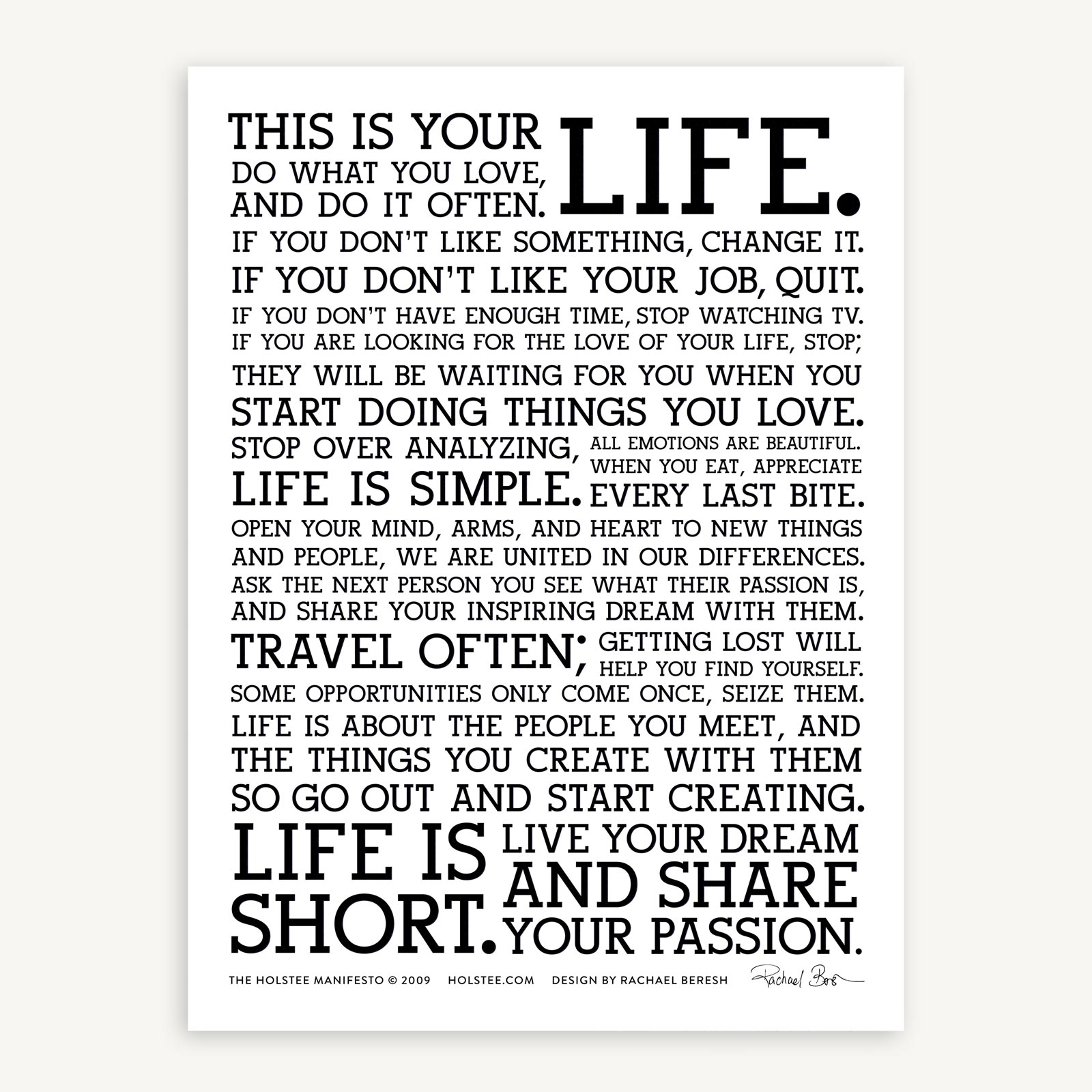
🌱 Enjoying this? It's a taste of The Flourishing Life, our year-long Holstee membership. Every month we explore a new theme like this one together, with guided practices, reflection prompts, and live conversations. Unlock full access → Every January, I used to write a list of resolutions. By February most of them had quietly dissolved, not because I didn't want what they promised, but because they never quite made it past the page. The year I stopped writing resolutions and started setting an intention was the year that started to actually change. To live with intention is to act from a clear sense of who you want to become, not just what you want to accomplish. Goals point to finish lines; intentions shape how you show up on the way, and on days when there's no finish line in sight at all. What it means to live with intention We tend to talk about intention as a softer cousin of ambition, a wishful framing for things we haven't gotten around to doing yet. That's not what we mean here. Intention is closer to a north star. It's the answer to a quiet question we don't ask ourselves often enough: who am I becoming, and is that the person I actually want to be? Research keeps confirming what most of us suspect. Studies of New Year's resolutions consistently find that roughly 90% are abandoned within a few months. The usual explanations (discipline, motivation, time) only tell part of the story. More often, the missing piece is clarity. We set goals we kind of want, attached to outcomes we kind of believe in. When the friction shows up, and it always shows up, there isn't enough underneath them to hold. An intention sits underneath your goals. It's the why behind the what. When you can't muster motivation, when the calendar fills up, when life gets messy, an intention is what you can still return to. It's also a quieter, more durable measure of a good day: not "did I hit a target," but "did I live in line with the person I'm trying to become?" That shift, from outcome to identity, is small and large at once. It's the difference between living on purpose and going through the motions. If you've ever read a Holstee Manifesto, that's the territory we're in. Less "achieve this thing by Q3," more "live this way, today, and again tomorrow." Intention vs. goal: why you need both This is the question that comes up most often, and it's worth being precise about. A goal is an outcome, something you want to accomplish, usually by a date, usually outside yourself. Run a marathon. Save $10,000. Publish the book. An intention is a state: how you want to be, internally, on the way to and through whatever you're doing. Be present. Stay curious. Move with kindness. The two work best together. A goal without an intention can become hollow. You cross the finish line and feel nothing, or you bend yourself out of shape chasing something you no longer want. An intention without a goal can drift, beautiful in the abstract, untethered to anything you'd actually do this Tuesday morning. We wrote a short piece on the difference between a goal and an intention a few years ago that's worth the two-minute read if you want this one sharper. The short version: combine them, and you get both the journey and the destination. Pick one without the other, and something important goes missing. How to set an intention that lasts The practice itself is simple. Most people overcomplicate it because the word feels heavy. I certainly did. For years I confused "setting an intention" with making a vague resolution and hoping it stuck. The first year I actually worked through the exercise below, the difference was immediate. Start with a goal you actually want, large or small. Now do a small, slightly strange exercise: imagine you've achieved it. Close your eyes if you can. Get into the scene. What does that future moment feel like? Not what you've done, but what you are in that moment. Joyful? Connected? At peace? Steady? Free? That feeling is your intention. Name it in one word, or one short phrase. Then reframe it as something you can claim right now, today, not as a future state but as a present one. I am present. I am at peace. I am steady. This is where intention quietly turns into practice. You can start now. You don't need the marathon, the savings, the book to feel any of those things. You can choose to be at peace this morning, in the middle of an ordinary commute, with nothing solved. The goal still matters; it gives the practice a direction. But the practice doesn't have to wait for the goal. Goals that actually serve you If intention is the why, goals are the how, and how you frame them changes whether they'll hold up. A few framings that have helped us, drawn from the research and from our own missteps: Approach over avoidance. An avoidance goal describes what you're trying to escape (I will avoid junk food). An approach goal describes what you're moving toward (I will eat more seasonal vegetables). Health psychologist Kelly McGonigal has written about this for years: approach goals are more enjoyable to pursue, easier to measure, and more durable than the negative-space versions. If your goal is "I want to be on my phone less," reframe to "I want to spend an evening a week reading." Process over outcome. An outcome goal is the finish line (run a marathon). A process goal is the practice that gets you there (run three times a week). The outcome is rarely fully in your control. The process always is. Show up for the process, and the outcome takes care of itself most of the time. Specific enough to act on. "Be healthier" is not a goal. "Walk for 20 minutes after lunch on weekdays" is a goal. The specificity is what makes it possible to either do it or not, and you need that signal to learn from. None of this is new. SMART goals were named in 1981. What's changed is that we're now drowning in self-improvement advice, and most of it is louder than it is useful. The basics still work. Building the habits that carry it Intention sets the direction. Goals describe the destination. But it's habits that actually carry you there, day by day, when motivation is gone and the new-year energy has long since faded. James Clear's Atomic Habits made a useful framework popular: every habit follows a loop of cue → craving → response → reward. Most habit failure happens at one of those four steps. You build a good habit by making the cue obvious, the craving attractive, the response easy, and the reward satisfying. You break a bad one by doing the inverse. Two of his tactics get most of the mileage: The two-minute rule. When you're starting a new habit, scale it down until it takes under two minutes. Want to read more? Put one page in front of you. Want to meditate? One minute. The point is not to do the full habit. The point is to make showing up so easy that resistance has nothing to grab onto. Once showing up is routine, expansion takes care of itself. Habit stacking. Anchor a new habit to one you already do. After I pour my coffee, I will write down three things I'm grateful for. After I brush my teeth, I will read one page. Existing habits give you cues you don't have to remember; stacking lets you ride on infrastructure you've already built. Plenty of people have written about how to make new habits stick; the meta-lesson is the same across all of it. Make it small enough to start. Make starting easy enough that you can't talk yourself out of it. Trust that the size will grow on its own. Returning to your intention An intention is not a one-time decision. It's a small daily return. The reason intentions tend to outlast resolutions isn't that they're somehow more powerful. It's that they're built to be returned to. A resolution is a verdict, passed once. An intention is a practice, taken up again every morning. You don't fail at an intention; you just notice you've drifted, and choose it again. This is also why most useful intentions are short. Long sentences are hard to hold in mind during a busy Tuesday. I am present. I am open. I am steady. Three to five words, repeated until they shape what you notice. Our Reflection Cards were built around this: a small daily ritual of one good question, designed to bring you back to your own measure of a good life. Use them, use a journal, use the back of a receipt; the medium matters less than the return. And revisit. Intentions are not chiseled in stone. The one you set in January may shift by July, and that's not a failure of commitment. It's evidence that you're paying attention. Don't be afraid to update. Going deeper, together Reading about intention is one thing. Living it, alongside other people who are also trying, is another. Most of what makes a practice stick is community: a quiet form of accountability, a shared vocabulary, regular returns to the same questions. Intention is one of twelve themes in The Flourishing Life, our year-long Holstee membership, alongside Kinship, Gratitude, Compassion, and the rest. Over a year the community moves through all twelve together, and you can join any time and focus on whatever you need most right now. Each theme brings a small curriculum, fellow members working through it alongside you, and live conversations to make it real. It's not for everyone, but if you've read this far, it might be for you. Frequently asked questions What does it mean to live with intention? Living with intention means acting from a clear sense of who you want to become, not just what you want to accomplish. It's the practice of orienting your daily choices around values and identity, so that the small decisions add up to a life that looks like the one you actually want. What is the difference between an intention and a goal? A goal is an outcome, something you want to achieve, often by a date and often measurable. An intention is a state: how you want to be, internally, while you're getting there. Goals point to finish lines; intentions describe how you walk the path. The two work best together. How do you set an intention you'll actually keep? Start with a goal you genuinely want. Imagine yourself having achieved it, and notice the feeling: peace, joy, connection, steadiness. That feeling is your intention. Name it as a short, present-tense phrase you can claim today (I am steady. I am open.) and return to it regularly. What is an example of a daily intention? Daily intentions are short and present-tense: I am patient. I am here. I notice what's good. Some people hold the same intention for a year; others set a new one each morning. The form matters less than the habit of returning to it before the day's noise begins. How is an intention different from an affirmation? An affirmation is usually a statement of belief: "I am worthy," "I am loved." An intention is closer to a direction: "I am present today," "I am moving with kindness this week." The two overlap, and an intention often takes the same grammatical shape as an affirmation. The difference is mostly in how you use it: an intention guides what you do; an affirmation reinforces what you already are. Why do New Year's resolutions fail so often? Studies consistently find that roughly 90% of resolutions are abandoned within a few months. The most common reason isn't willpower, it's clarity. Resolutions tend to be vague outcomes ("get healthier," "be more present") with no underlying intention, no specific process, and no easy daily ritual to return to. Adding any one of those moves the odds dramatically. Michael Radparvar Co-Founder, Holstee
Learn more
Why You're So Tired (Even When You Sleep Enough)
To paraphrase John Mulaney, there are two types of people in this world: people who like to get to the airport "three hours early" and those who like to arrive at the last possible moment, and these people find each other and get married. For too much of my adult life, I have pushed myself to be an early bird AND a night owl, all in the name of sweet, sweet productivity. My wife on the other hand is a sleep champion (at least her Oura ring tells her so all the time). I thought I was built differently. I was actually just running on a massive sleep deficit. About two years ago, I started to become much more intentional with my sleep hygiene by minimizing screentime, using an eye mask (the sleeper hit), and tracking my sleep. All three helped in their own ways. Though I was recently reminded that fatigue isn't just about how much you sleep. It's also about what accumulates in your brain during the day and whether your daily habits are actually letting sleep clear it. The reminder came through this video by Johnny Harris sent to me by Dave. It's 20 minutes, well produced and in my opinion well worth the watch. If you'd rather read, or just want to skim to the part that's most relevant to you, what follows are my notes from it. Your brain is running 300,000-year-old hardware Here's the framing Johnny uses: the human brain hasn't meaningfully changed in about 300,000 years. Our ancestors needed that brain to make a handful of high-stakes choices per day, where to find food, whether to approach or flee, who to trust. The rest of the time was largely quiet. Estimates suggest modern humans make approximately 35,000 decisions per day. What to wear. Whether to answer that message now or later. What to have for lunch. Whether to accept the calendar invite. How to word the reply. Which tab to open. These feel small, and individually they are. But your prefrontal cortex, the region responsible for decision-making and executive function, doesn't distinguish between "should I flee this predator?" and "should I reply-all?" It fires either way. And that firing has a cost. The glutamate problem Every decision your prefrontal cortex makes releases glutamate, the brain's primary excitatory neurotransmitter. In the right amounts, glutamate is essential: it's how neurons communicate and how signals move across the brain. But under sustained cognitive load, it accumulates faster than the brain can clear it. Johnny points to what he calls brand-new research from the Paris Brain Institute. He's upfront that it's still being worked out exactly how the mechanism functions, but the core finding is straightforward: a full day of demanding mental work leaves a measurable buildup of glutamate in the prefrontal cortex by day's end. It isn't just that you feel tired. Something has physically built up in the part of your brain you've been leaning on all day. This is why you can be completely spent by 3pm without having done anything you'd call physically demanding. The fatigue isn't in your muscles. It's in your prefrontal cortex, and it showed up there one small decision at a time. The caffeine trap Most of us respond to afternoon brain fog with another coffee. It helps, for a while. Caffeine works by blocking adenosine receptors. Adenosine is a byproduct that accumulates throughout the day, and it's your brain's natural "you're getting tired" signal. Caffeine blocks that signal, buying you a few more hours of alertness. The problem: caffeine doesn't clear adenosine, it only blocks the receptors. The adenosine keeps accumulating the whole time. When the caffeine wears off, all of that built-up adenosine floods in at once. The 2pm coffee that got you through the afternoon is part of the reason you're still awake at midnight. The nighttime half Which brings us to sleep, and to why so many of us aren't getting the kind that actually clears the day's accumulated residue. Sleep, particularly deep sleep and REM sleep, is when the brain does most of its metabolic cleanup work. Glutamate clears. Adenosine clears. The prefrontal cortex resets. But many of us are either cutting sleep short, or degrading its quality through evening habits that work directly against the process. Johnny walks through his own typical evening in the video, and it's uncomfortable to watch because it's so recognizable. He gets home late, still has work to do, and pours a coffee to push through it even though his body wants to be in bed. Then some Netflix to wind down, which is its own stream of small decisions, which episode, whether to keep going. He's not asleep until 2am. Each of those choices eats into the sleep that follows. Chronotypes add a structural layer. Your chronotype, your genetically-influenced tendency toward mornings or evenings, determines when your body naturally wants to sleep and wake. Night owls who conform to a standard 9-to-5 aren't sleeping too few hours by choice; they're sleeping at the wrong time for their biology. The result is chronic, low-grade sleep deprivation that no amount of personal resolve fixes. Blue light from screens suppresses melatonin, the chemical that shifts your brain from wakefulness toward sleep. As Johnny puts it, a bright screen at night fools your brain into thinking it's still daytime, so it holds back the melatonin you need. You're lying in bed, but your brain doesn't know it yet. Five things that actually help 1. Reduce daily decisions at the source The most effective intervention is eliminating decisions before they happen. Meal prep on Sundays so lunch isn't a daily question. Set out tomorrow's clothes tonight. Create defaults for recurring low-stakes choices. Steve Jobs famously wore the same outfit every day, not for style reasons, but to eliminate one more daily deliberation. The logic holds even if you don't take it that far: every trivial decision you remove in advance is prefrontal cortex capacity preserved for decisions that actually matter. 2. Time your caffeine Johnny's tip is to hold off on coffee until mid-morning, somewhere between 9 and 11am. The logic is about when the crash lands. Caffeine wears off after a few hours, so a cup first thing means the slump hits mid-afternoon, while a mid-morning cup carries you to the end of the workday before it fades. 3. Try a coffee nap This is Johnny's favorite trick, the one he calls one of the greatest things in the world. Drink a quick coffee, then lie down for about 15 minutes. A nap is when your body clears out adenosine, so by the time you wake the adenosine is gone and the caffeine arrives with nothing left to block, a kind of multiplier effect. It's also worth noting Johnny's point that cultures with a regular afternoon siesta show better brain functioning and, by one study he cites, a 37% lower risk of dying from heart disease. 4. Protect the wind-down hour The hour before bed isn't just "not working" time. It's active neurological preparation. Dimmer lights signal to your body that the day is ending. Putting screens away removes both the blue light and the ongoing decision overhead that keeps your prefrontal cortex running when it needs to stand down. This isn't deprivation; it's giving your brain what it needs to do its job. 5. Know your chronotype If you're consistently sharp at night and groggy in the morning, that is not a discipline problem. It's biology. Work backward from when you need to be at your best, protect your sleep window, and adjust what you can in your schedule rather than fighting your own nervous system. What intentional living has to do with any of this There's a thread running through all five of these that I keep coming back to: every trivial decision you eliminate is energy preserved for a decision that matters. Your capacity for thoughtful, reflective decision-making, about your relationships, your work, your values, the direction of your life, is finite. It depletes with every decision you make, no matter how small. The only way to protect it is to design your environment in advance so that low-stakes choices are already handled, and your best thinking is available for the things you'd say actually define you. This is part of what we mean by intentional living at Holstee. Not minimalism as an aesthetic, or rigidity for its own sake, but the practical recognition that how you spend your cognitive energy over the course of a day shapes who you become over the course of a year. It's also why Reflection Cards exist, to offer a ready-made question for the moments when you want to pause, step off autopilot, and think about what actually matters. One prompt, one moment, without the overhead of figuring out where to start. If you want a regular structure for that kind of practice, The Flourishing Life is our membership built around doing this work consistently, weekly reflection prompts, a community of people pursuing the same thing, and a curriculum designed to help you spend more of your energy on what you care about most. Make it a good one. — Michael RadparvarCo-Founder, Holstee & Reflection.app P.S. If you want to figure out your chronotype, searching "chronotype quiz" surfaces a few reliable options. Takes about five minutes, and the result might explain more than you'd expect. Keep exploring: Wellness: How to Thrive, Not Just Get Through the Day, part of our Flourishing Life series.
Learn more
Free Nervous System Resources: Videos, Books & Tools Guide
Your nervous system is the invisible backdrop to every moment of your life: how you focus at work, how you argue with a partner, how you recover from a panic attack or anxiety attack, how you fall asleep, how you come back to yourself after feeling anxious. When you learn its language, everyday life starts to feel a little less random, and a lot more workable. This guide gathers zero-cost resources from nervous system expert Jonny Miller, who partnered with us on Calm Cards, to help you build “nervous system literacy” — the skills to notice what is happening inside you and gently respond, not just react. Stay as you are, bring your curiosity, and move at your own pace. TL;DR Summary Nervous system literacy is your ability to understand what your body is trying to tell you — and respond with care instead of harshness. Start with the Nervous System Quotient (NSQ) self-assessment, then explore the resources that speak most to where you are right now. Nervous system literacy helps you recognize patterns of stress, shutdown, and resilience in everyday life. The free NSQ assessment gives you a personalized snapshot and practical next steps. Curated videos, essays, podcasts, and books from Jonny Miller offer structured ways to deepen this work over time. You can pair these resources with Calm Cards to turn insights into embodied practice. Table of Contents Start with the Nervous System Quotient (NSQ) Four videos to build a foundation Four essays to deepen your understanding Nervous-system-friendly listening on the go Six books to go deeper when you’re ready How to use these resources with Calm Cards Frequently Asked Questions Start with the Nervous System Quotient (NSQ) If you only do one thing, begin here. The Nervous System Quotient (NSQ) is a free self-assessment that gives you a snapshot of how your nervous system is functioning right now, along with personalized suggestions for where to focus next. It helps you see patterns: where you feel resourced, and where you tend to shut down, speed up, or disconnect. At the end, you receive tailored protocols for each area, so you’re not just learning concepts — you’re getting next steps you can try in real life. You can take the NSQ assessment for free here: http://assessment.nsmastery.com/ Four videos to build a foundation Think of these four videos as your introductory course in “how your inner wiring really works.” You can watch them in order, or choose the one that feels most relevant today. Video 1: Nervous System Mastery 101 (Start Here) A friendly overview of your nervous system, why it matters for stress, mood, and relationships, and what “nervous system mastery” actually means in day-to-day life. Video 2: The Truth About How Your Nervous System Operates A deeper look at the patterns underneath your reactions, including how your body decides when you’re safe and when to prepare for threat. Video 3: Interoception 101 for Beginners (Start Here) An introduction to interoception: your ability to sense internal signals like heartbeat, breath, tension, or butterflies in your stomach — and why this “inner listening” is essential for emotional regulation. Video 4: How To Reset a Dysregulated Nervous System (14 Techniques) A practical tour of simple, body-based tools you can experiment with when you feel overwhelmed, shut down after a panic attack, in the middle of an anxiety attack, or stuck feeling anxious in loops. Four essays to deepen your understanding If you prefer to learn through reading, Jonny’s essays offer a thoughtful blend of science, story, and practice. They’re a beautiful complement to the Calm Cards. The Art and Science of Interoception Why listening to your body is a learnable skill, and how subtle sensations can guide wiser choices — before your mind has words for what you feel. The Operating Manual for Your Nervous System A big-picture map of how your nervous system works, explained in plain language, so you can stop pathologizing your responses and start understanding them. The Best Decision-Making Is Emotional A reframe of “rational vs emotional” that shows how emotions, when felt and integrated in the body, can actually support clearer, more aligned decisions. How to Pay Off Your Emotional Debt An exploration of the unprocessed experiences we carry in our bodies, and gentle ways to begin metabolizing stored emotional “backlog” over time. Nervous-system-friendly listening on the go For those days when your eyes are tired or you’re walking, commuting, or washing dishes, audio can be the easiest way to keep learning. Jonny has curated a Nervous System Mastery–specific playlist of interviews on Spotify, bringing together conversations about resilience, trauma, breathing, interoception, and more. You can subscribe to the playlist on Spotify for easy access here. Consider choosing one episode to walk with this week and notice: How does your body feel before you press play? How does it feel after? Six books to go deeper when you’re ready When you’re ready to spend more time with this work, books can become long-term companions on your nervous system journey. Here are six that Jonny recommends: Anchored by Deb Dana A clear, accessible introduction to Polyvagal Theory and how to apply it in daily life, with field-tested exercises to help you feel more grounded and connected. The Breathing Cure by Patrick McKeown A detailed collection of breathing protocols backed by 20+ years of field research that can reshape how you relate to breath, stress, sleep, and focus. Widen the Window by Elizabeth Stanley A research-based guide to trauma, resilience, and how to expand your capacity to meet stress without burning out. Nurturing Resilience by Kathy Kain A deeper dive into somatic therapy and developmental trauma, especially valuable if you’re a practitioner or feel called to a more clinical understanding. The Practice of Embodying Emotions by Raja Selvam, PhD A rich combination of research and practices designed to help you build capacity to feel and stay present with intense emotions. The Myth of Normal by Gabor Maté A sweeping exploration of how modern culture shapes our health, with a compassionate invitation to reconsider what “normal” really is. Take Your Nervous System Practice Further These free resources build your understanding; Calm Cards turn that literacy into a daily habit. Curated by nervous system experts (including Jonny Miller), each card offers a simple, body-based reflection or practice to regulate in moments—perfect for when you notice dysregulation rising. For Calm Cards owners: Use NSQ results to pick cards matching your patterns (e.g., "shutdown" → grounding cards). After a video like "Reset a Dysregulated Nervous System," pull 1–2 cards to embody the techniques right away. Keep cards bedside or in your bag for panic attack or anxiety attack resets—faster than searching YouTube. Haven’t tried Calm Cards yet? Start free with the resources above, then add Calm Cards to make regulation automatic. They're your portable nervous system toolkit: 45 science-backed practices for when you're feeling anxious, overwhelmed, or just want to stay present. Get your own deck of Calm Cards here. Frequently Asked Questions What is nervous system literacy? Nervous system literacy is the ability to notice and understand your body’s stress responses, signals of safety, and patterns of shutdown or overwhelm. It means recognizing what your nervous system is doing in real time, then responding with simple, supportive practices instead of criticizing yourself or powering through. Where should I start if I’m new to this? If you’re brand new, begin with the free Nervous System Quotient (NSQ) self-assessment, then watch the “Nervous System Mastery 101” video. Together, they give you a friendly overview, a personal baseline, and a few gentle practices to experiment with right away. Can nervous system tools help with panic attacks? Yes—practices like those in the "Reset a Dysregulated Nervous System" video target the body's fight-or-flight response during a panic attack. Start with breath awareness and grounding techniques to signal safety to your nervous system, often shifting the intensity within minutes. What to do during an anxiety attack? During an anxiety attack, pause and use interoception from Video #3: notice your breath, tension, or rapid heartbeat without judgment. The NSQ assessment identifies your patterns, while Jonny’s essays offer ways to regulate your nervous system long-term to reduce frequency. Why do I keep feeling anxious? Feeling anxious often signals your nervous system is in protective mode from unprocessed stress or emotional debt (see Essay #4). The free resources here build literacy to notice early cues, apply resets, and widen your capacity over time. How do these resources connect with Calm Cards? Calm Cards offer simple reflections and practices you can return to daily. Jonny Miller’s videos, essays, and books add more context and depth. Using them together helps you move from understanding concepts to actually feeling more regulated, present, and resourced in your body. How much time do I need to see a difference? You don’t need hours a day. Even 10–15 minutes a few times a week — taking the assessment, watching a short video, or trying one breathing or interoception practice — can create noticeable shifts over time. The key is gentle consistency rather than intensity or perfection. What if I find this work emotionally activating? It’s completely normal for nervous system work to bring up strong emotions. Go slowly, pause whenever you need, and choose the gentlest resources first, like short videos or Calm Card reflections. If you have a history of trauma or feel overwhelmed, consider working with a trained somatic or trauma-informed practitioner alongside these tools.
Learn more