Mindful Matter

Becoming better grownups.
“Sometimes insecurities can scream so loudly that you become unable to hear all the great possibilities whispering underneath them.” - Brad Montague As the father of a two-year-old, I am constantly thinking about what it means to be a better grownup. So when I came across Brad Montague’s book, literally titled Becoming Better Grownups, I bumped it right to the top of my queue. Early in the book, Brad perfectly summarized something that I thought was unique to me: “I often convince myself that I am not a real grownup and that other people are. These other real people have it all figured out. I, on the other hand, am a fraud. I am a giant child who, because he's had the right number of birthdays, has suddenly been given ridiculous amounts of responsibility.” Brad goes on to describe a time when he was invited by a third-grade teacher to watch her students present responses to a prompt he had posted online: “The world would be more awesome if _____”. The invitation came at a time in Brad’s life when he was feeling unhappy and unconfident in his work. “These young, hope-filled hearts didn’t need a tired, burned-out old guy,” Brad thought to himself. ”There are plenty of better grownups for this task.” He told himself that the teacher must have made a mistake and didn’t respond to the email. But the teacher was unrelenting. Because she seemed to wholeheartedly believe in him, Brad finally agreed to visit her school. It turned out to be one of the most fulfilling things he had done in a long time and kicked off a listening tour with hundreds of classrooms around the country — which then snowballed into greater adventures, including this book. Reflecting on that moment, Brad writes: “There's something I've been learning … Better grownups do not believe that they should just wait around for other better grownups to show up. There might be people around who are more skilled at budgeting than you are. There might be people around who are more experienced at building than you are. There might be people around who are more trained to do any number of things better than you can. Please know this: No one is better suited to be you than you. You are perfectly cast in your role, and we need you. Children need you. The world needs you. Even though they might feel inadequate, great grownups show up. So, show up. Show up. Show up.” So if you, like me, don’t always feel like a “real grownup”, please know that you are not alone. There are many more of us out there, and we can all have each other’s back — if we show up. Mike RadparvarCo-Founder, Holstee
Learn more
Passion projects that changed everything.
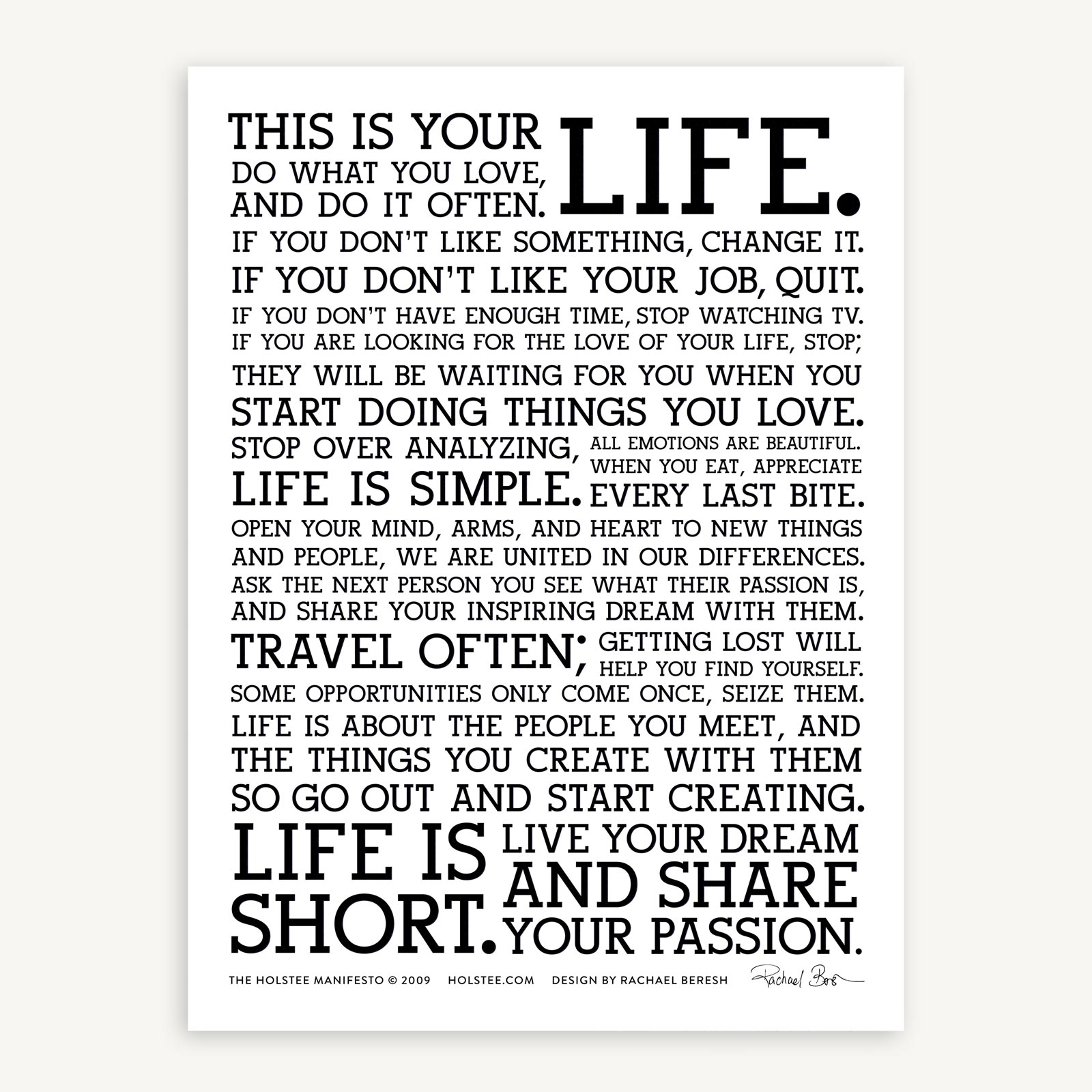
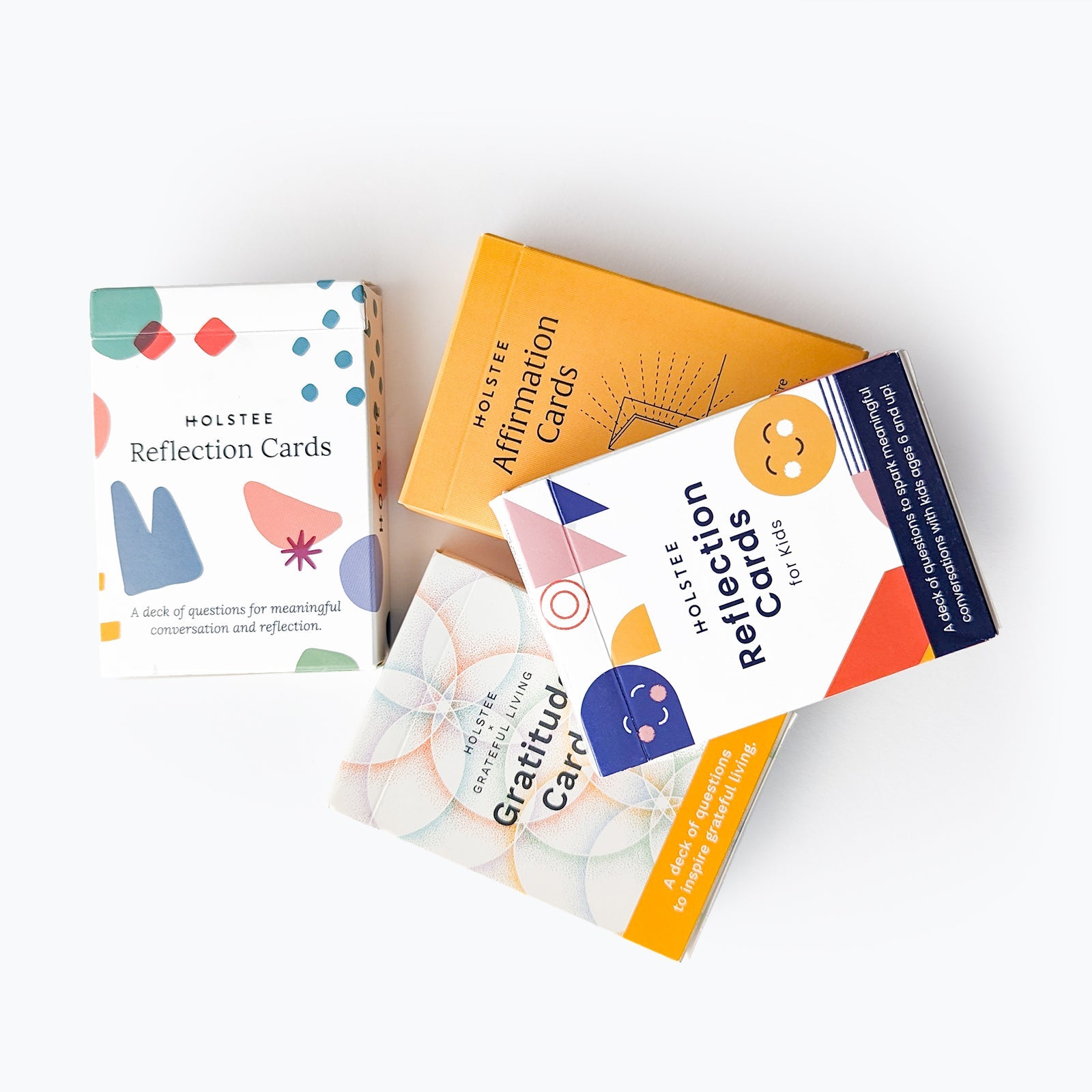
This month, we’re excited to launch a product we are really passionate about — the mobile app for our digital journaling platform, Reflection.app, now available (for free!) in the Apple App Store and Google Play Store. Since we started Holstee in 2009, August has historically been a month for launching new passion projects (it’s also the month we explore the theme of Passion with our members!). When I reflect back on it, many of these passion projects wound up being pivotal, impacting our business (and our lives) in unexpected ways. So before sharing all that went into this month’s mobile launch, I’d love to take a walk down memory lane… August 2010 — We began selling our Upcycled Wallets. Holstee started out as a t-shirt company, but in August 2010, we decided to expand our range to include wallets. The idea sparked from a personal pain point; Mike and I couldn’t find a wallet that met our minimalist design requirements and were made sustainably. So we decided to design one ourselves, and we partnered with an NGO in India to produce them from upcycled plastic bags. It wasn’t an easy decision; not only were accessories a departure from t-shirts, but the project required high minimums and trusting a new partner we had never worked with before. Both Mike and I felt there was something “there”, though, so we moved forward — and eventually, our wallet sales outpaced our t-shirt sales. But even more impactful for me personally was what came next. A few months later, I was interviewed by a design blog about the process of working with artisans internationally. A friend-of-a-friend interested in artisan production read that article and reached out to learn more — fast forward nearly a decade, Jess and I recently welcomed our baby Shilo into the world. August 2013 — We did a Kickstarter campaign for our Reclaim Frame. Once again we found ourselves excited about a completely new product that required us to work with new materials and a new partner. At this point, the Holstee Manifesto had grown in popularity and we were producing more posters, prints, and greeting cards. We wanted to create a new type of frame that would make it easy to swap art prints in and out, and we worked with Michigan-based social enterprise, Urban Ashes, to make it with reclaimed materials. As one of our Kickstarter reward levels, we thought it would be cool to offer an art subscription — a new letterpress print that fit perfectly into the frame, delivered to backers each month. Over time, the art subscription evolved far beyond just art. First we added a short letter from Mike and I, then a little pamphlet with questions, then eventually a monthly theme. Step by step, the art subscription has grown into what is now Holstee’s core offering — our Membership. August 2016 — We did another Kickstarter campaign for our Reflection Cards. We wanted to make our Reflection Cards for years, but we kept holding off to focus on the Holstee Membership. Eventually, we decided to just test the idea as a Kickstarter campaign to see if it resonated with our community. They have since become a community favorite. We have produced over 20,000 decks to date, we just passed 100 reviews on Amazon, and the cards are now carried at major retailers like Anthropologie and Urban Outfitters. The Reflection Cards have also opened the door to exciting partnership opportunities for us, including a collaboration with the Greater Good Science Center at the University of California-Berkeley that resulted in our recent Greater Good Toolkit launch. When I look back, I see a few patterns. For each of these projects... + We took a chance on an idea that we were very passionate about, but which was just beyond our comfort zone. + Our main motivation wasn’t financial — it always came from a deep-rooted desire to bring the project to life. We felt a creative pressure that we needed to explore. + We took on a fairly large (though calculated) risk, requiring an upfront investment of time, energy, and money. Back to today and this month’s launch… August 2020 — We launched Reflection.app for iOS and Android. 😎 For several years, we’ve made an Annual Reflection Journal to help our members (and ourselves!) reflect at the end of each year. Over time, we realized that our annual reflection would be easier and more meaningful if we had a monthly review practice… and those monthly reviews would be easier and more meaningful if we had a place to track our daily highlights and lowlights. And wouldn’t it be great if it were all digital? After speaking with hundreds of people in our community, we realized we were not alone. In November 2019, we released a beta of Reflection.app — an online journal that guides your personal growth each month. Within weeks, the top requested feature was a native mobile app to make adding on-the-go entries easier. This month, thanks to the hard work of our developers Britannio, Bryan, and Edward, we are proud to announce that Reflection.app is now available to download for iOS and Android! Like our other passion projects, building Reflection.app required us to step outside our comfort zone and take on risks to our time, energy, and finances. But also like our other passion projects, it’s been fueled by exciting creative energy and the strong belief that building this app will add value to people’s lives. Of course, we hope the app is a success and that we are able to continue to invest into its growth. But I also wonder… could Reflection.app, like our other August launches, lead to something else unexpected entirely? What doors have now been opened as a result of taking a chance, listening to our hearts, and following our passion? Excited for what lies ahead! Dave RadparvarCo-Founder, Holstee P.S. This email talks a lot about our past successes. It’s easy to talk about successes, but I also want to make really clear that we have also had some massive product launch flops! And even with (actually, especially with) these successful launches, there were many trying moments that caused us to question our path all together. It’s rarely been easy, but it’s always been worth it. Keep exploring: Passion: How to Find What Lights You Up, part of our Flourishing Life series.
Learn more
We get to do this.
A few weeks ago, I shared the news that my wife and I were expecting a baby any day now. Well, that day has arrived and I am happy to share that our family is now three. Shilo Bez Radparvar was born on July 12th at 9pm at a birthing center here in Amsterdam. We are filled with awe, wonder, gratitude, and of course, a bit of exhaustion as we adapt to his sleep schedule :-). One of my wife's mantras during the more challenging parts of her pregnancy was, “I get to do this”. It was a simple idea she picked up from author James Clear — rephrasing “I have to to do this” to “I get to do this” as a reminder of all there was to be grateful for. During these first few weeks of middle-of-the-night diaper changes, “I get to do this” has become a mantra for me as well. I don’t have to change his diaper, I get to. A reminder that every moment with Shilo, even the stinkiest ones, are moments I wouldn't trade for anything. Filled with love and likely covered in poop, Dave RadparvarCo-Founder, Holstee P.S. Here is a photo of Shilo: And here is my favorite video clip — it's one minute of him stretching and yawning after he woke up the other day. It’s minutes like these that energize me for the rest of the day :-)
Learn more
Q&A with Caren Kreger
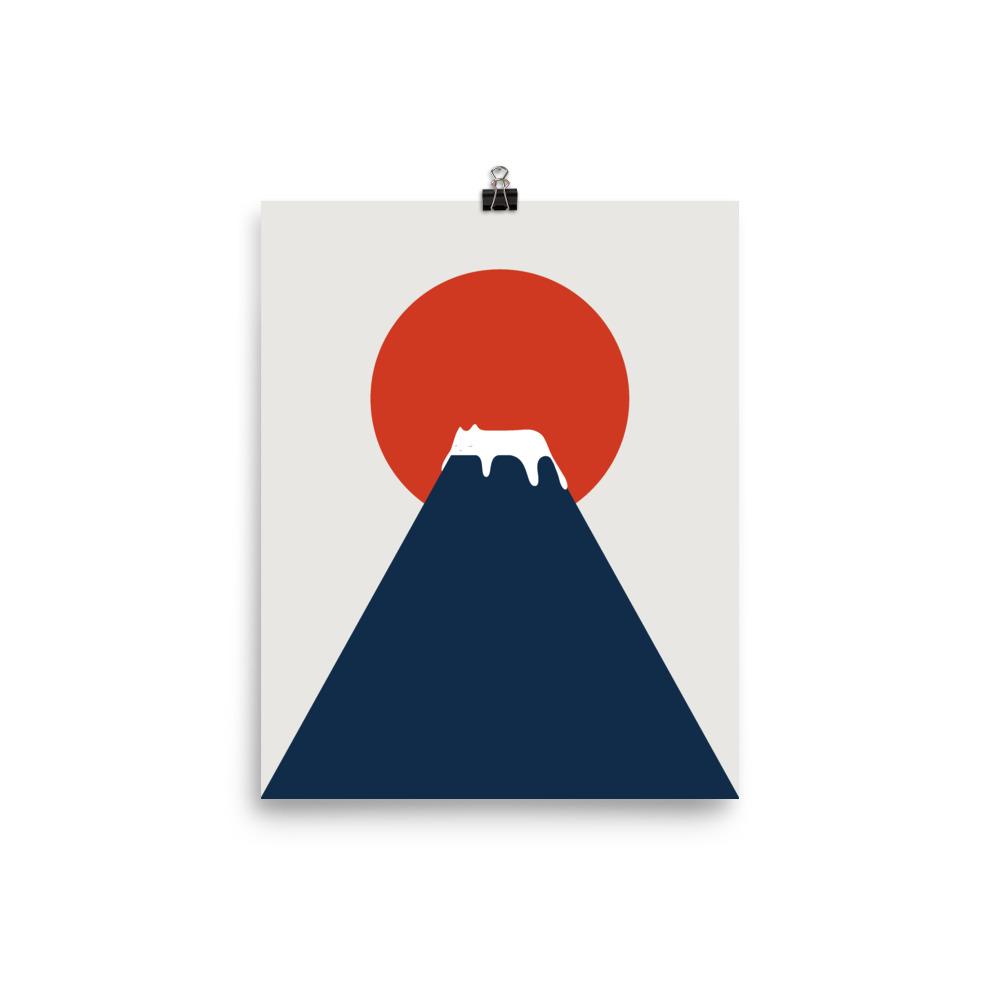
This month’s art is by Caren Kreger, the Maker, Creator and Celebrator (not to mention, incredible hand-letterer and artist) behind Everyday Hooray. She hopes her illustration serves a reminder that "Passion comes from somewhere deep inside of us and often shows up only when we allow ourselves the time and space to let it rise up and take hold". For a little more about what inspired this artwork, her process, and her life, here's a short Q&A: Where is home for you? Livermore, California (SF East Bay) What was the inspiration behind this design? Passion comes from somewhere deep inside of us and often shows up only when we allow ourselves the time and space to let it rise up and take hold. This work was inspired by the bold simplicity of this statement and the bright fire that lights inside of us when we pursue something that we are truly passionate about. What is your definition of a successful life? Oh wow, this is a big question. For me, a successful life means that I’ve taken risks, stepped outside of myself and engaged fully with the world around me. How did you get into lettering and design? I have always loved to draw and had an appreciation for design but never gave it enough time to flourish. A few years ago I experienced an emotional trauma that forced the need for a creative outlet. I began drawing again and focused on lettering as a way to release some of the emotions that I was experiencing. Now I draw every day as a way to continue growing, learning, and challenging myself. Where do you find inspiration? I find a lot of inspiration in the people around me. I am fascinated by the way people engage with each other and the emotional exchanges that we make every day. I see much opportunity to share positivity and I love the opportunity to make someone smile. What's your dream project? I’d love to create cover art for a book by someone who I admire or who has influenced me in some way. Which designers or thinkers influence/inspire you? Brene Brown’s books helped me through some difficult times and urged me to begin creating as an emotional outlet. I also really, really love Elizabeth Gilbert’s book Big Magic and I tend to pick it up when I’m feeling creatively drained. At the moment, what is your favorite… Color: Mint Food: Is Wine a food? Song: Audiobooks Quote: “Your own reasons to make art are reason enough. Create whatever causes a revolution in your heart.” - Elizabeth Gilbert, Big Magic
Learn more
Writer’s block.
To date, we’ve written over 150 Reflections as part of this email series. As much as I love the opportunity to share and discuss these topics, I still find it daunting every time I sit down to write one. What to say? Where to begin? To help, I have these words of wisdom from writer Anne Lamott written in large letters across the top of my writing screen: “Perfectionism is the voice of the oppressor, the enemy of the people. It will keep you cramped and insane your whole life, and it is the main obstacle between you and a shitty first draft.” This quote reminds me that I need to start somewhere — and that somewhere is likely a “shitty first draft”, as Lamott so perfectly puts it. As we explore the theme of Creativity this month, I am reminded of the importance of simply starting in order to get over a creative block. We need to recognize our resistance to the challenge and the discomfort that comes from trying something new and knowing that we might fail. Creativity requires us to face this fear of failure... and do it anyway. Because if we don’t start, we’ll never finish. To just starting somewhere, Mike RadparvarCo-Founder, Holstee
Learn more
Vuja De.
You have probably heard of Déjà vu — the feeling that you have experienced the current moment before, but what about the opposite? The concept Vuja De, originally coined by George Carlin during a comedy routine, caught the attention of author Adam Grant (who you may remember from last week's Reflections email) in his pursuit to better understand innovation and creativity. In his book, Originals, Grant says: “The starting point [of creativity] is curiosity: pondering why the default exists in the first place. We’re driven to question defaults when we experience vuja de, the opposite of déjà vu. Déjà vu occurs when we encounter something new, but it feels as if we’ve seen it before. Vuja de is the reverse—we face something familiar, but we see it with a fresh perspective that enables us to gain new insights into old problems.” Last week in our Online Member Gathering, as a group we discussed Vuja De and the ways it has helped us. One member described becoming aware of their white privilege, while another employed it to improve a relationship with a colleague, and a while back Dave shared his experience of really feeling music he had heard many times before. Another member observed that while Deja Vu tends to be passive, Vuja De requires you to be proactive and willing to expand your perspective. When was the last time you experienced Vuja De? To experience the world with fresh eyes, Mike RadparvarCo-Founder, Holstee P.S. This past Thursday, we announced the launch of our new Coaches Kit — a collection of several of our favorite products from the past few years, bundled together at a big discount for the coaches, facilitators, and gatherers in our community. Take a look — and if there’s anyone you think would appreciate it, we’d love if you could share it!
Learn more
3 Journal Prompts to Unleash Your Creativity
In a world with endless information at our fingertips, it can feel challenging to be original — to do things that are truly different, to be one-of-a-kind. In this month’s Creativity Guide, we share the research of Adam Grant, author of Originals: How Non-Conformists Move the World. Grant writes that the people who champion originality are the ones who propel the world forward. But originals are not so different from conformists, he argues. They feel the same fears and doubts, but instead of succumbing to these thought patterns, they explore and take action on them. Below are three ways Grant suggests we can increase our own originality, each with a corresponding prompt from this month’s guide for you to reflect on (I’ve added links so you can journal your answers in Reflection.app (our new journaling platform), if you’d like!). 1. Question the default. Ask why things are done the way they are, and see what happens when you take the road less travelled. In what ways have you challenged the default option or chosen a different route? Journal your response → 2. Broaden your interests. With a wide range of interests, you have more places to find inspiration and make connections to build new paths. What are three of your interests and how do you explore them? Journal your response → 3. Procrastinate on purpose. Grant says, “Once a task is finished, we stop thinking about it. But when it is interrupted and left undone, it stays active in our minds.” While it may feel counterintuitive, this ‘incubation period’ is typically when our subconscious connects the dots, allowing entirely new ideas to take shape. What projects are you working on that could benefit from this form of purposeful procrastination? Journal your response → To embracing your inner original and unlocking creativity in your life, Mike RadparvarCo-Founder, Holstee
Learn more
Adventure = Curiosity + Bravery
“Be brave, be curious, be determined, overcome the odds. It can be done.” - Stephen Hawking In this month’s Digital Adventure Guide and in our Online Member Gathering, we discussed the equation of Adventure: Adventure = Curiosity + Bravery Curiosity: “I seek out situations where I gain new experiences without getting in my own or other people’s way.” Bravery: "I act on my convictions, and I face threats, challenges, difficulties, and pains, despite my doubts and fears." (Definitions from the VIA Institute on Character) It might seem that adventure has been put on hold lately. But when we look at an adventure as a time when we “seek out new situations and experiences” and “face challenges despite our doubts and fears”, it becomes clear that these last few months have indeed been adventurous — for many of us, in completely new and different ways. Sometimes we get to choose the adventure, and sometimes the adventure chooses us. How are you experiencing adventure and employing curiosity or bravery this month? Mike RadparvarCo-Founder, Holstee Keep exploring: Adventure: How Curiosity and Courage Open Up Life, part of our Flourishing Life series.
Learn more
A wonder-full life.
I have some exciting news to share. In a few short weeks, I will be embarking on a very new type of Adventure as I become a father for the first time. My wife Jess and I are expecting a baby boy in early July and I am feeling all the feels — joy, nervousness, gratitude, excitement, curiosity, and so much more. Fortunately, as it has been for most of my life, my older brother Mike and sister Ramesh are a couple steps ahead of me so I have been able to learn from them both. Mike’s daughter Mala is now two years old. On a recent video call, they were outside doing one of Mala’s favorite activities — watering the plants. It’s incredible how much joy Mala experiences going from one plant to the next and carefully adding water to each one. She has turned this seemingly simple, even mundane activity into a beautiful ritual. Watching Mala reminded me of something I read in William Martin’s book, The Parent's Tao Te Ching: Ancient Advice for Modern Parents: “Do not ask your childrento strive for extraordinary lives.Such striving may seem admirable,but it is the way of foolishness.Help them instead to find the wonderand the marvel of an ordinary life.Show them the joy of tastingtomatoes, apples and pears.Show them how to crywhen pets and people die.Show them the infinite pleasurein the touch of a hand.And make the ordinary come alive for them.The extraordinary will take care of itself.” In my day-to-day, I usually view watering the plants as a chore, something to quickly check off my list so I can return to “more important” things. Mala’s love of watering plants is a welcome reminder to find wonder, beauty, and joy in life’s everyday, ordinary activities — knowing that “the extraordinary will take care of itself”. To building a wonder-full life, Dave RadparvarCo-Founder, Holstee P.S. Here is a photo of Mala doing what she love's most:
Learn more