🌱 Enjoying this? It's a taste of The Flourishing Life, our year-long Holstee membership. Every month we explore a new theme like this one together, with guided practices, reflection prompts, and live conversations. Unlock full access →
Every January, I used to write a list of resolutions. By February most of them had quietly dissolved, not because I didn't want what they promised, but because they never quite made it past the page. The year I stopped writing resolutions and started setting an intention was the year that started to actually change.
To live with intention is to act from a clear sense of who you want to become, not just what you want to accomplish. Goals point to finish lines; intentions shape how you show up on the way, and on days when there's no finish line in sight at all.
What it means to live with intention
We tend to talk about intention as a softer cousin of ambition, a wishful framing for things we haven't gotten around to doing yet. That's not what we mean here. Intention is closer to a north star. It's the answer to a quiet question we don't ask ourselves often enough: who am I becoming, and is that the person I actually want to be?
Research keeps confirming what most of us suspect. Studies of New Year's resolutions consistently find that roughly 90% are abandoned within a few months. The usual explanations (discipline, motivation, time) only tell part of the story. More often, the missing piece is clarity. We set goals we kind of want, attached to outcomes we kind of believe in. When the friction shows up, and it always shows up, there isn't enough underneath them to hold.
An intention sits underneath your goals. It's the why behind the what. When you can't muster motivation, when the calendar fills up, when life gets messy, an intention is what you can still return to. It's also a quieter, more durable measure of a good day: not "did I hit a target," but "did I live in line with the person I'm trying to become?" That shift, from outcome to identity, is small and large at once. It's the difference between living on purpose and going through the motions.
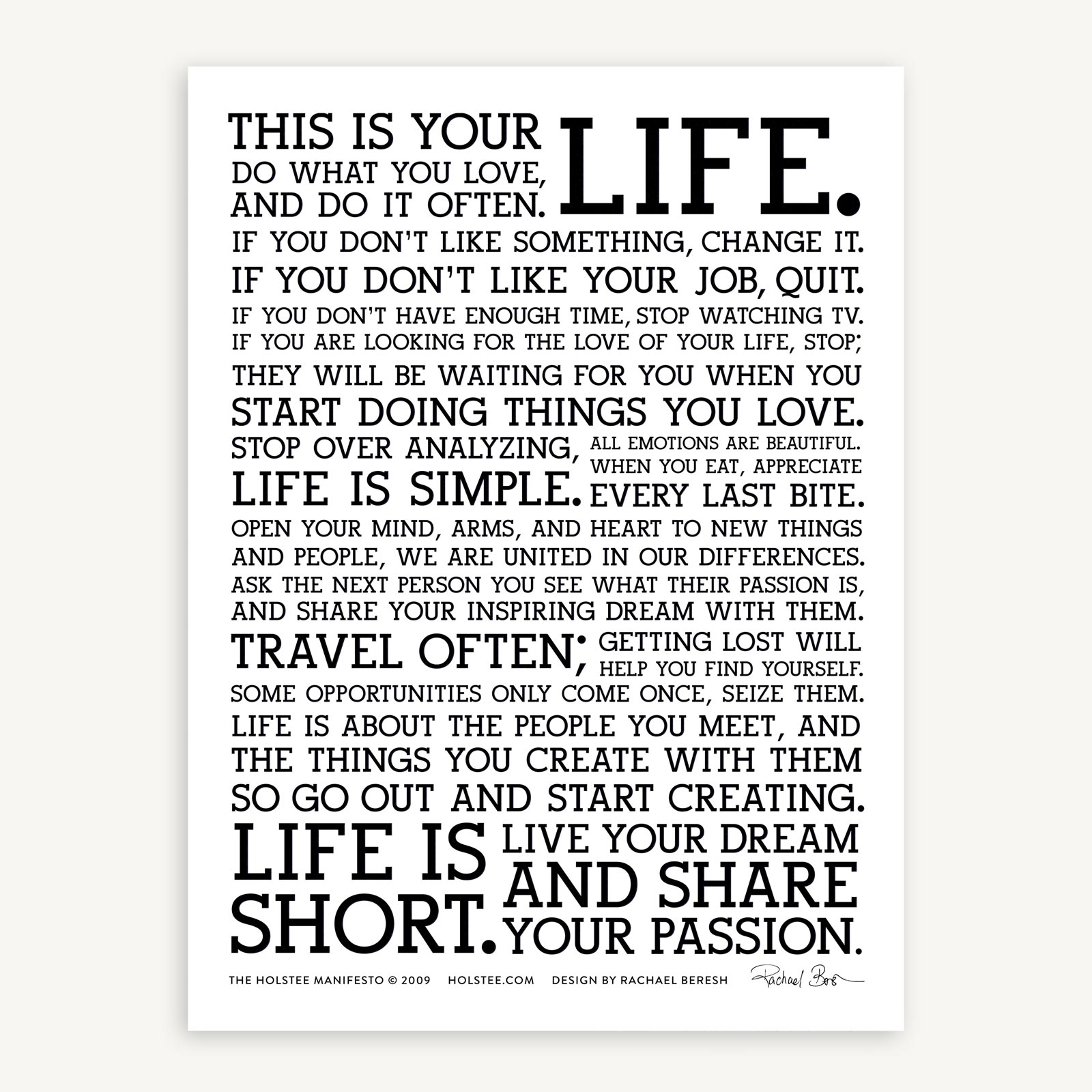
If you've ever read a Holstee Manifesto, that's the territory we're in. Less "achieve this thing by Q3," more "live this way, today, and again tomorrow."
Intention vs. goal: why you need both
This is the question that comes up most often, and it's worth being precise about. A goal is an outcome, something you want to accomplish, usually by a date, usually outside yourself. Run a marathon. Save $10,000. Publish the book. An intention is a state: how you want to be, internally, on the way to and through whatever you're doing. Be present. Stay curious. Move with kindness.
The two work best together. A goal without an intention can become hollow. You cross the finish line and feel nothing, or you bend yourself out of shape chasing something you no longer want. An intention without a goal can drift, beautiful in the abstract, untethered to anything you'd actually do this Tuesday morning.
We wrote a short piece on the difference between a goal and an intention a few years ago that's worth the two-minute read if you want this one sharper. The short version: combine them, and you get both the journey and the destination. Pick one without the other, and something important goes missing.
How to set an intention that lasts
The practice itself is simple. Most people overcomplicate it because the word feels heavy. I certainly did. For years I confused "setting an intention" with making a vague resolution and hoping it stuck. The first year I actually worked through the exercise below, the difference was immediate.
Start with a goal you actually want, large or small. Now do a small, slightly strange exercise: imagine you've achieved it. Close your eyes if you can. Get into the scene. What does that future moment feel like? Not what you've done, but what you are in that moment. Joyful? Connected? At peace? Steady? Free?
That feeling is your intention. Name it in one word, or one short phrase. Then reframe it as something you can claim right now, today, not as a future state but as a present one. I am present. I am at peace. I am steady.
This is where intention quietly turns into practice. You can start now. You don't need the marathon, the savings, the book to feel any of those things. You can choose to be at peace this morning, in the middle of an ordinary commute, with nothing solved. The goal still matters; it gives the practice a direction. But the practice doesn't have to wait for the goal.
Goals that actually serve you
If intention is the why, goals are the how, and how you frame them changes whether they'll hold up.
A few framings that have helped us, drawn from the research and from our own missteps:
Approach over avoidance. An avoidance goal describes what you're trying to escape (I will avoid junk food). An approach goal describes what you're moving toward (I will eat more seasonal vegetables). Health psychologist Kelly McGonigal has written about this for years: approach goals are more enjoyable to pursue, easier to measure, and more durable than the negative-space versions. If your goal is "I want to be on my phone less," reframe to "I want to spend an evening a week reading."

Process over outcome. An outcome goal is the finish line (run a marathon). A process goal is the practice that gets you there (run three times a week). The outcome is rarely fully in your control. The process always is. Show up for the process, and the outcome takes care of itself most of the time.
Specific enough to act on. "Be healthier" is not a goal. "Walk for 20 minutes after lunch on weekdays" is a goal. The specificity is what makes it possible to either do it or not, and you need that signal to learn from.
None of this is new. SMART goals were named in 1981. What's changed is that we're now drowning in self-improvement advice, and most of it is louder than it is useful. The basics still work.
Building the habits that carry it
Intention sets the direction. Goals describe the destination. But it's habits that actually carry you there, day by day, when motivation is gone and the new-year energy has long since faded.
James Clear's Atomic Habits made a useful framework popular: every habit follows a loop of cue → craving → response → reward. Most habit failure happens at one of those four steps. You build a good habit by making the cue obvious, the craving attractive, the response easy, and the reward satisfying. You break a bad one by doing the inverse.

Two of his tactics get most of the mileage:
The two-minute rule. When you're starting a new habit, scale it down until it takes under two minutes. Want to read more? Put one page in front of you. Want to meditate? One minute. The point is not to do the full habit. The point is to make showing up so easy that resistance has nothing to grab onto. Once showing up is routine, expansion takes care of itself.
Habit stacking. Anchor a new habit to one you already do. After I pour my coffee, I will write down three things I'm grateful for. After I brush my teeth, I will read one page. Existing habits give you cues you don't have to remember; stacking lets you ride on infrastructure you've already built.
Plenty of people have written about how to make new habits stick; the meta-lesson is the same across all of it. Make it small enough to start. Make starting easy enough that you can't talk yourself out of it. Trust that the size will grow on its own.
Returning to your intention
An intention is not a one-time decision. It's a small daily return.
The reason intentions tend to outlast resolutions isn't that they're somehow more powerful. It's that they're built to be returned to. A resolution is a verdict, passed once. An intention is a practice, taken up again every morning. You don't fail at an intention; you just notice you've drifted, and choose it again.
This is also why most useful intentions are short. Long sentences are hard to hold in mind during a busy Tuesday. I am present. I am open. I am steady. Three to five words, repeated until they shape what you notice.
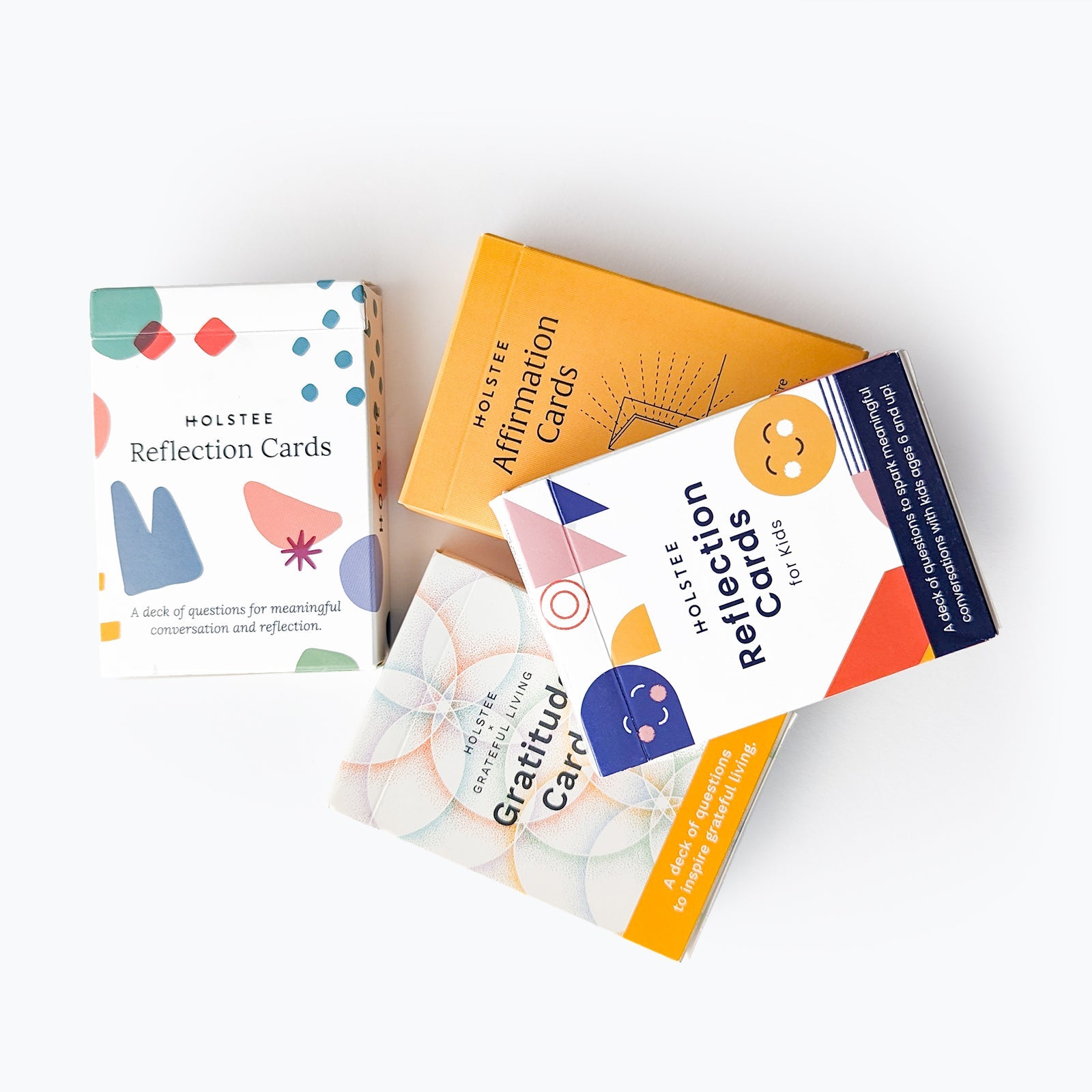
Our Reflection Cards were built around this: a small daily ritual of one good question, designed to bring you back to your own measure of a good life. Use them, use a journal, use the back of a receipt; the medium matters less than the return.
And revisit. Intentions are not chiseled in stone. The one you set in January may shift by July, and that's not a failure of commitment. It's evidence that you're paying attention. Don't be afraid to update.
Going deeper, together
Reading about intention is one thing. Living it, alongside other people who are also trying, is another. Most of what makes a practice stick is community: a quiet form of accountability, a shared vocabulary, regular returns to the same questions.
Intention is one of twelve themes in The Flourishing Life, our year-long Holstee membership, alongside Kinship, Gratitude, Compassion, and the rest. Over a year the community moves through all twelve together, and you can join any time and focus on whatever you need most right now. Each theme brings a small curriculum, fellow members working through it alongside you, and live conversations to make it real. It's not for everyone, but if you've read this far, it might be for you.
Frequently asked questions
What does it mean to live with intention?
Living with intention means acting from a clear sense of who you want to become, not just what you want to accomplish. It's the practice of orienting your daily choices around values and identity, so that the small decisions add up to a life that looks like the one you actually want.
What is the difference between an intention and a goal?
A goal is an outcome, something you want to achieve, often by a date and often measurable. An intention is a state: how you want to be, internally, while you're getting there. Goals point to finish lines; intentions describe how you walk the path. The two work best together.
How do you set an intention you'll actually keep?
Start with a goal you genuinely want. Imagine yourself having achieved it, and notice the feeling: peace, joy, connection, steadiness. That feeling is your intention. Name it as a short, present-tense phrase you can claim today (I am steady. I am open.) and return to it regularly.
What is an example of a daily intention?
Daily intentions are short and present-tense: I am patient. I am here. I notice what's good. Some people hold the same intention for a year; others set a new one each morning. The form matters less than the habit of returning to it before the day's noise begins.
How is an intention different from an affirmation?
An affirmation is usually a statement of belief: "I am worthy," "I am loved." An intention is closer to a direction: "I am present today," "I am moving with kindness this week." The two overlap, and an intention often takes the same grammatical shape as an affirmation. The difference is mostly in how you use it: an intention guides what you do; an affirmation reinforces what you already are.
Why do New Year's resolutions fail so often?
Studies consistently find that roughly 90% of resolutions are abandoned within a few months. The most common reason isn't willpower, it's clarity. Resolutions tend to be vague outcomes ("get healthier," "be more present") with no underlying intention, no specific process, and no easy daily ritual to return to. Adding any one of those moves the odds dramatically.
Michael Radparvar
Co-Founder, Holstee