🌱 Enjoying this? It's a taste of The Flourishing Life, our year-long Holstee membership. Every month we explore a new theme like this one together, with guided practices, reflection prompts, and live conversations. Unlock full access →
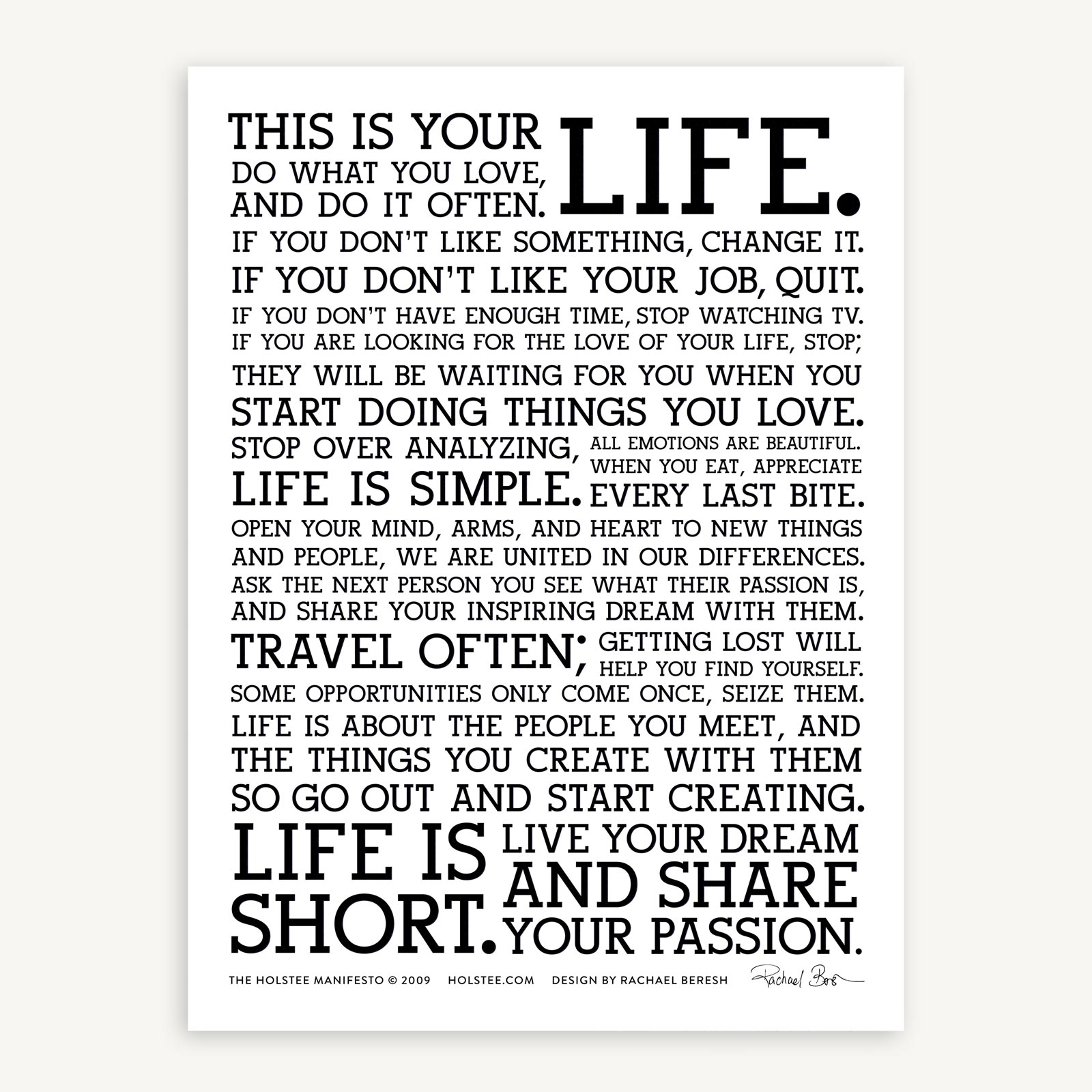
We wrote the Holstee Manifesto as we were starting the company, back in 2009. It wasn't meant to be marketing. It was a reminder to ourselves, a list of how we wanted to live now that we'd left the safe path to make something we cared about. "Do what you love," it says near the top, "and do it often." Easy to print on a poster. Harder, it turns out, to actually figure out.
Because the advice everyone gives about passion is also the least helpful. "Find your passion," as if it's a single buried treasure with a map, one true calling you discover once and follow forever. Real passion behaves more like a garden. Some interests bloom fast and fade with the season. Others root slowly and deepen over years. The work isn't to find the one flower. It's to keep tending the garden.
Passion isn't a treasure you find
The "one true calling" myth does real damage. It makes people feel broken for not having a singular obsession, and it makes them quit good things too early for not feeling like destiny. It also gets the order backwards. We're told to wait for passion to strike, then act. Usually it's the reverse: you act, you get a little good, and the passion grows in the doing.
So the better question isn't "what's my passion?" It's quieter and more answerable: what already lights me up, right now, in this season? Not what should energize you, or what would look impressive. What actually does. We've chased a few of these ourselves into passion projects that changed everything, and they rarely started as grand plans.
You build a passion, you don't just find it
Cal Newport made the most useful argument I know about this in a book bluntly titled So Good They Can't Ignore You. His claim: passion isn't a precondition for great work, it's a byproduct of it. Master a skill, become genuinely useful, gain some autonomy, and passion tends to follow. The people who love their work most are rarely the ones who found a pre-existing passion. They're the ones who got good enough that the work became worth loving.
This is freeing, because it means you don't have to feel certain before you begin. You just have to be willing to get a little better at something that interests you, and let the rest catch up.
Follow what makes you come alive
If passion grows from attention, the practice is learning to pay attention. A simple one I keep coming back to: at the end of the day, finish the sentence "I felt most alive today when…" Do it for two weeks and patterns surface that you can't see from inside a single day. The moments that show up are clues, and clues are all you really need.
It helps to know your why. Simon Sinek built a career on the observation that very few of us can clearly say why we do what we do, and that the why is what sustains us when the what gets hard. You don't need a grand mission statement. You need a reason to get out of bed that's yours. Coming back to it, especially on the ordinary days, is most of the work.
Aim for meaning, not just pleasure
Not every good feeling is the same. The ancient Greeks split it in two: hedonia, the pursuit of pleasure, and eudaimonia, the pursuit of a meaningful life. Both matter, and the research suggests the richest lives blend them. But they age differently. Pleasure is wonderful and fades fast. Meaning compounds, and it's what lets you bounce back when things get hard.
The psychologist Tim Kasser spent decades finding much the same thing in modern terms: people who prioritize intrinsic goals, growth, relationships, contribution, tend to flourish, while those who chase extrinsic ones, money, status, image, get a sugar high and a hangover. Japanese culture has a lovely word for the sweet spot: ikigai, your reason for being, found where what you love, what you're good at, what the world needs, and what sustains you overlap. You rarely land neatly in the center, and that's fine. Ikigai is a practice, not a destination.

Contribute a verse
When passion feels too grand a word, I think of Walt Whitman, who asked the oldest question, what's the point of any of this, and answered it about as well as anyone has, in his poem "O Me! O Life!":
That you are here—that life exists and identity,
That the powerful play goes on, and you may contribute a verse.
That's what living with passion really is. Not finding the one perfect calling, but deciding that the play is worth a verse, and that yours is worth writing. The Holstee Manifesto was our attempt at a verse, a daily reminder to do more of what we love. If you want one on your wall, that's what it's for. And if you'd rather write your own, even better.
Going deeper, together
Reading about passion is one thing. Practicing it alongside other people who are also trying is another, and it tends to stick better.
Passion is one of twelve themes in The Flourishing Life, our year-long Holstee membership, alongside Intention, Kinship, Gratitude, and the rest. Over a year the community moves through all twelve together, and you can join any time and focus on whatever you need most right now. Each theme brings a small curriculum, fellow members working through it alongside you, and live conversations to make it real. It's not for everyone, but if you've read this far, it might be for you.
Frequently asked questions
What does it mean to live with passion?
Living with passion means bringing genuine aliveness and engagement to what you do, rather than drifting through life on autopilot. It's less about a single dramatic calling than about noticing what energizes you and steadily weaving more of it into your days. The subject matters less than the quality of engagement.
How do I find my passion?
Rather than waiting to discover one true calling, pay attention to what already lights you up. Notice when you feel most alive, most absorbed, or most curious, and follow those clues. Passion often grows through action and skill-building, so experimenting and getting good at something usually reveals more than introspection alone.
Is passion something you find or something you build?
Largely something you build. As Cal Newport argues, passion tends to be a byproduct of developing real skill and autonomy, not a prerequisite you must feel before starting. You don't need to feel certain to begin; you become passionate about work partly by getting good enough at it that it becomes rewarding.
What is ikigai?
Ikigai is a Japanese concept meaning roughly "a reason for being," the thing that gets you up in the morning. In its popular form it sits at the overlap of what you love, what you're good at, what the world needs, and what can sustain you. It's understood as an ongoing practice of living in alignment with what gives life meaning, not a fixed destination.
What's the difference between eudaimonia and hedonia?
Hedonia is the pursuit of pleasure and enjoyment; eudaimonia is the pursuit of meaning, purpose, and growth. Pleasure tends to feel good in the moment but fades quickly, while meaning builds over time and supports resilience. Research suggests the most fulfilling lives draw on both rather than choosing one.
Should my career align with my passion?
Not necessarily. Some people thrive by building a career around what they love, while others find more freedom keeping certain passions as personal pursuits free of financial pressure. What matters is intentionality: making sure your passions have real room in your life, whether or not they pay the bills.
Michael Radparvar
Co-Founder, Holstee