🌱 Enjoying this? It's a taste of The Flourishing Life, our year-long Holstee membership. Every month we explore a new theme like this one together, with guided practices, reflection prompts, and live conversations. Unlock full access →
For years my calendar was a monument to things I'd said yes to and didn't want. A coffee here, a call there, a favor I'd half-volunteered for, each one reasonable on its own, all of them together leaving no room to breathe. I kept treating it as a scheduling problem. It was really a courage problem. I didn't yet know how to say no.
Simplicity is the practice of fixing that, not just on the calendar but in the closet, the inbox, and the mind. It isn't about owning less for its own sake. It's about clearing away the noise so the few things that actually matter have room to be heard.
Simplicity isn't deprivation
The word conjures a bare white room and a person who owns four shirts. That's a caricature. You don't have to become a minimalist monk. You just have to become the editor of your own life, choosing on purpose what gets your time, money, and attention, and letting the rest go.
We've been sold the opposite story: that more options mean more freedom, that busy means important. The research disagrees. The psychologist Barry Schwartz found that too much choice actually makes us less satisfied and more anxious, the grocery store jam aisle as a small daily portrait of modern paralysis. The abundance most of us are missing isn't more stuff. It's the spaciousness that shows up when the clutter is gone. We made a short version of this same case a while back.
Edit your commitments
Start with your time, because it's the thing you can never get back. Derek Sivers offers a brutal, useful filter: if it isn't a "hell yeah," it's a no. Most of what fills our weeks lives in the lukewarm middle, and that middle is exactly what crowds out the things we'd genuinely love.
Greg McKeown, who wrote Essentialism, calls the skill we're all missing the "graceful no," a way to decline that's firm without being unkind. And Leo Babauta names the deeper trap: the feeling that you must always do more, which he frames as a kind of greed. His antidote is generosity, giving your full presence to one thing instead of a thin slice of attention to ten. The goalposts of "more" always move. Presence is the way off the field.
Edit your stuff
Possessions are the visible version of the same problem. Marie Kondo turned tidying into a near-spiritual practice with a single question: does this spark joy? The reframe that makes it work is subtle. You're not choosing what to throw away. You're choosing what to keep, and thanking the rest on its way out.
One small practice has stuck with me more than any closet purge. The designer Tina Roth Eisenberg keeps a "Did Not Buy" list: every time she's tempted by something nonessential, she writes it down instead of buying it. Months later the list is a quiet record of all the things she was sure she needed and never missed. It turns restraint into something that feels like collecting rather than depriving.
Edit your attention
The last frontier, and the hardest, is your attention, because the noise there is engineered to be sticky. Start by retiring the myth of multitasking. A Stanford study found that heavy multitaskers were measurably worse at filtering distraction and switching tasks, not better. The brain doesn't run parallel; it just switches fast and pays a tax each time.
Cal Newport offers the cleanest fix, which he calls digital minimalism: decide what you actually value, keep only the tools that clearly serve it, and, in his words, "happily miss out on everything else." It's the graceful no, pointed at your screen. A worthwhile exercise: write down five of your values, then look at the apps you open most and ask, honestly, which ones earn their place.
Make a clearing
Underneath the tactics is an older idea. Zen calls it beginner's mind, the willingness to meet even familiar things, your commute, your kitchen, a person you love, as if for the first time. Much of our complexity is just accumulated assumption, and a lot of peace comes from setting it down. The teaching on non-attachment isn't that you stop caring. It's that you stop clinging, and let the changing things change.
The poet Martha Postlethwaite captured the whole practice better than any framework, in a poem called "Clearing":
Do not try to save
the whole world
or do anything grandiose.
Instead, create
a clearing
in the dense forest
of your life
and wait there
patiently,
until the song
that is your life
falls into your own cupped hands
and you recognize and greet it.
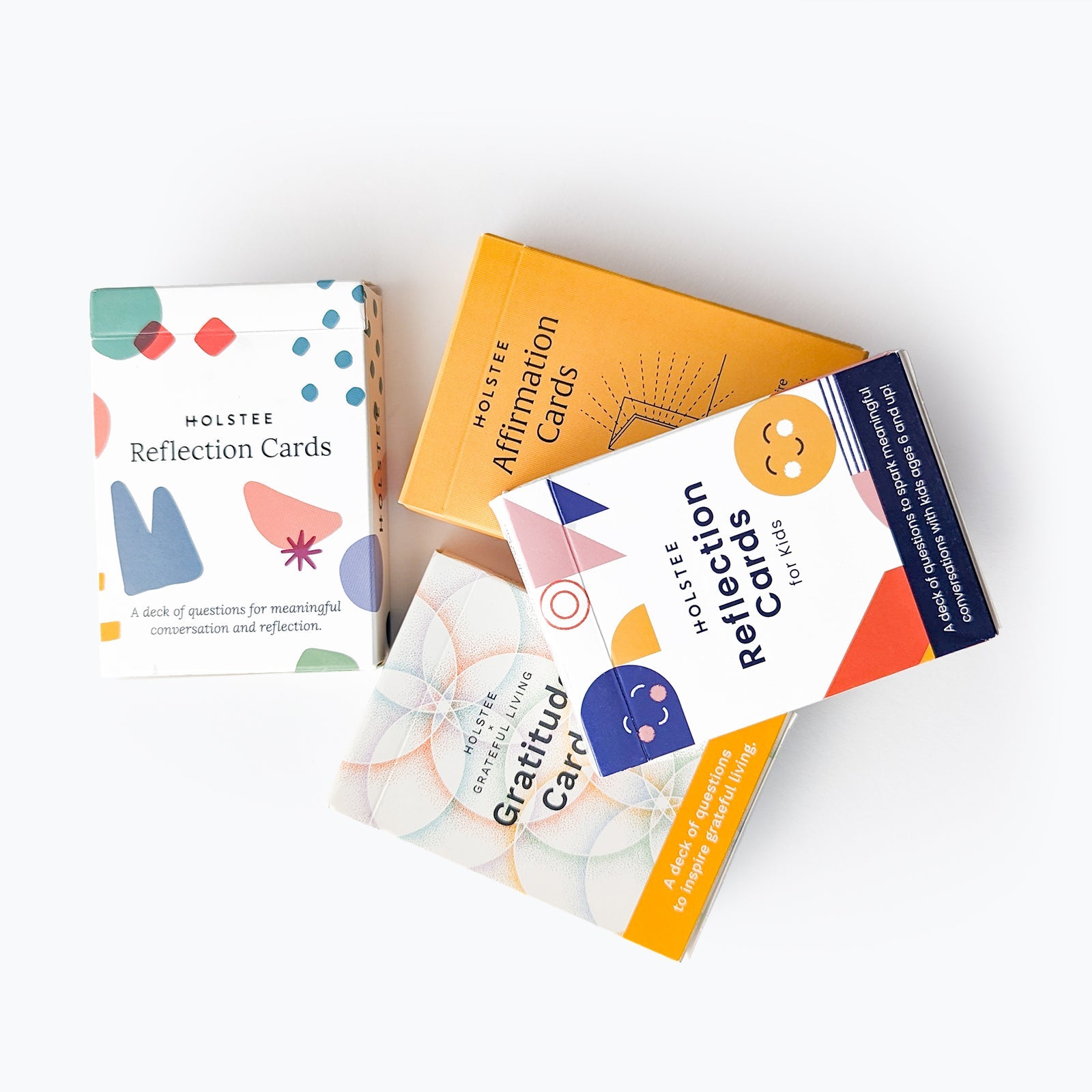
That's what simplicity is for. Not less for the sake of less, but a clearing, so the song of your life has somewhere to land. If you want a tool for hearing it, our Reflection Cards are good company in the quiet.
Going deeper, together
Reading about simplicity is one thing. Practicing it alongside other people who are also trying is another, and it tends to stick better.
Simplicity is one of twelve themes in The Flourishing Life, our year-long Holstee membership, alongside Intention, Kinship, Gratitude, and the rest. Over a year the community moves through all twelve together, and you can join any time and focus on whatever you need most right now. Each theme brings a small curriculum, fellow members working through it alongside you, and live conversations to make it real. It's not for everyone, but if you've read this far, it might be for you.
Frequently asked questions
What is simplicity?
Simplicity is the practice of consciously editing your life, deciding what truly deserves your time, energy, and attention, and letting go of the rest. It applies not just to physical possessions but to commitments, attention, and mindset. It's less about owning little than about making deliberate room for what matters most.
Is simplicity the same as minimalism?
They overlap but aren't identical. Minimalism often focuses on owning fewer things, while simplicity is broader, covering how you spend your time, where you place your attention, and how you make decisions. You can live simply without a stark, minimalist aesthetic; the goal is clarity and intention, not a particular look.
How do I simplify my life without giving up everything?
Start small and in one area. Edit your commitments by saying no to anything that isn't a clear yes, declutter one category of possessions at a time, and trim the digital tools that don't serve your values. Simplicity is about subtraction in service of what you care about, not deprivation for its own sake.
Why does having more choices make me less happy?
Psychologist Barry Schwartz found that an abundance of options can increase anxiety and decrease satisfaction, a phenomenon often called the paradox of choice. More options mean more effort to decide and more second-guessing afterward. Reducing trivial choices frees up mental energy for the decisions that actually matter.
What is digital minimalism?
Coined by Cal Newport, digital minimalism is the practice of using technology intentionally: keeping only the digital tools that clearly support your values and letting go of the rest. Rather than reacting to every app and notification, you decide in advance what deserves your attention and "happily miss out on everything else."
How does decluttering help mentally, not just physically?
Clearing physical clutter tends to reduce the low-level stress of visual noise and decision fatigue, freeing attention for what matters. The act of deciding what to keep also clarifies your values. Many people find that an external clearing, in their space, calendar, or devices, creates a corresponding sense of internal calm and focus.
Michael Radparvar
Co-Founder, Holstee