🌱 Enjoying this? It's a taste of The Flourishing Life, our year-long Holstee membership. Every month we explore a new theme like this one together, with guided practices, reflection prompts, and live conversations. Unlock full access →
We tell ourselves a flattering story about playing it safe. We call our routines wisdom and our avoidance prudence. For a long time I did too, right up until I made a big, uncertain leap of my own and realized the careful version of my life had quietly become the riskiest one.
That's the heart of adventure, and it has almost nothing to do with plane tickets or extreme sports. The word comes from the Latin for "about to happen." Adventure is really just the practice of staying open to what wants to emerge, and being willing to step toward it before you're certain.
Adventure is curiosity plus bravery
The cleanest definition I've found comes from the VIA Institute on Character, and it's a simple equation. Adventure sits at the intersection of two things: the curiosity to wonder what's over there, and the bravery to actually go and look.
You need both. Curiosity without bravery is just daydreaming, the trip you research for years and never take. Bravery without curiosity is recklessness, motion for its own sake. Where they meet, where wondering turns into willingness, is where an ordinary day becomes an adventure.
The real risk is playing it too safe
We all know the myth of Icarus, who flew too close to the sun and fell. We've used it for centuries as a warning against flying too high. Seth Godin points out that we've forgotten the other half of the warning. Daedalus told his son not to fly too low either, because the sea's damp would weigh the wings down just as surely.
Most of us are in far more danger of flying too low. We optimize for comfort and then wonder why we feel restless and small. Godin's reframe is bracing: in a world like ours, playing it safe has quietly become the riskiest game. The comfort zone feels like shelter, but spend too long in it and it becomes the thing you need an adventure to escape.
The adventures that don't need a passport
Here's the part that surprised me most. The bravest things most of us ever do don't happen on a mountain. They happen in a conversation.
There's a kind of quiet adventure that no one sees and nothing forces. The belief you've started to suspect isn't true. The part of yourself you keep not looking at. The apology you owe. The thing you keep almost saying to someone who matters. These don't make for good photographs, and they're easy to defer forever, because no flight is leaving without you. The door has no handle on the outside. The only thing that opens it is your willingness to put your hand on it.
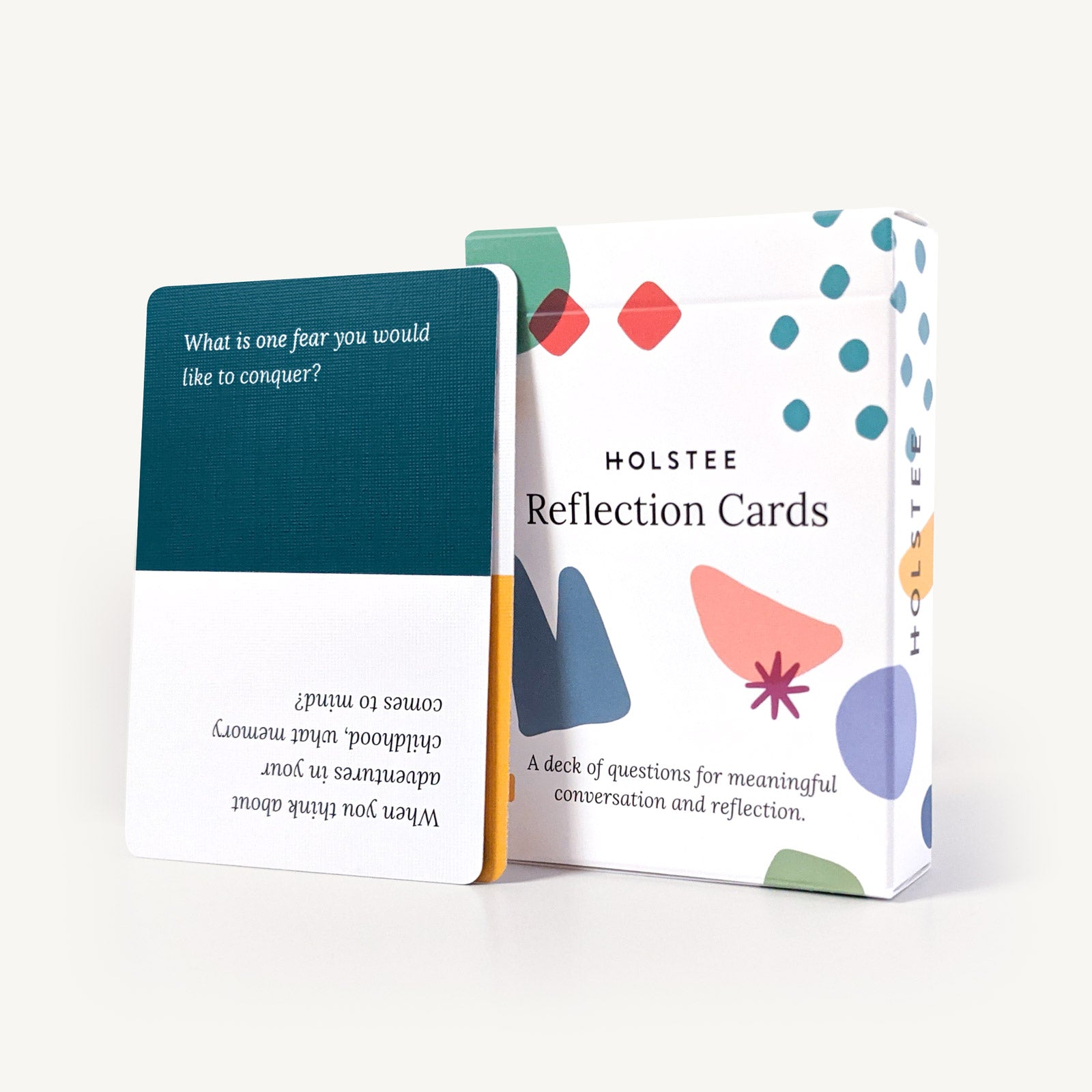
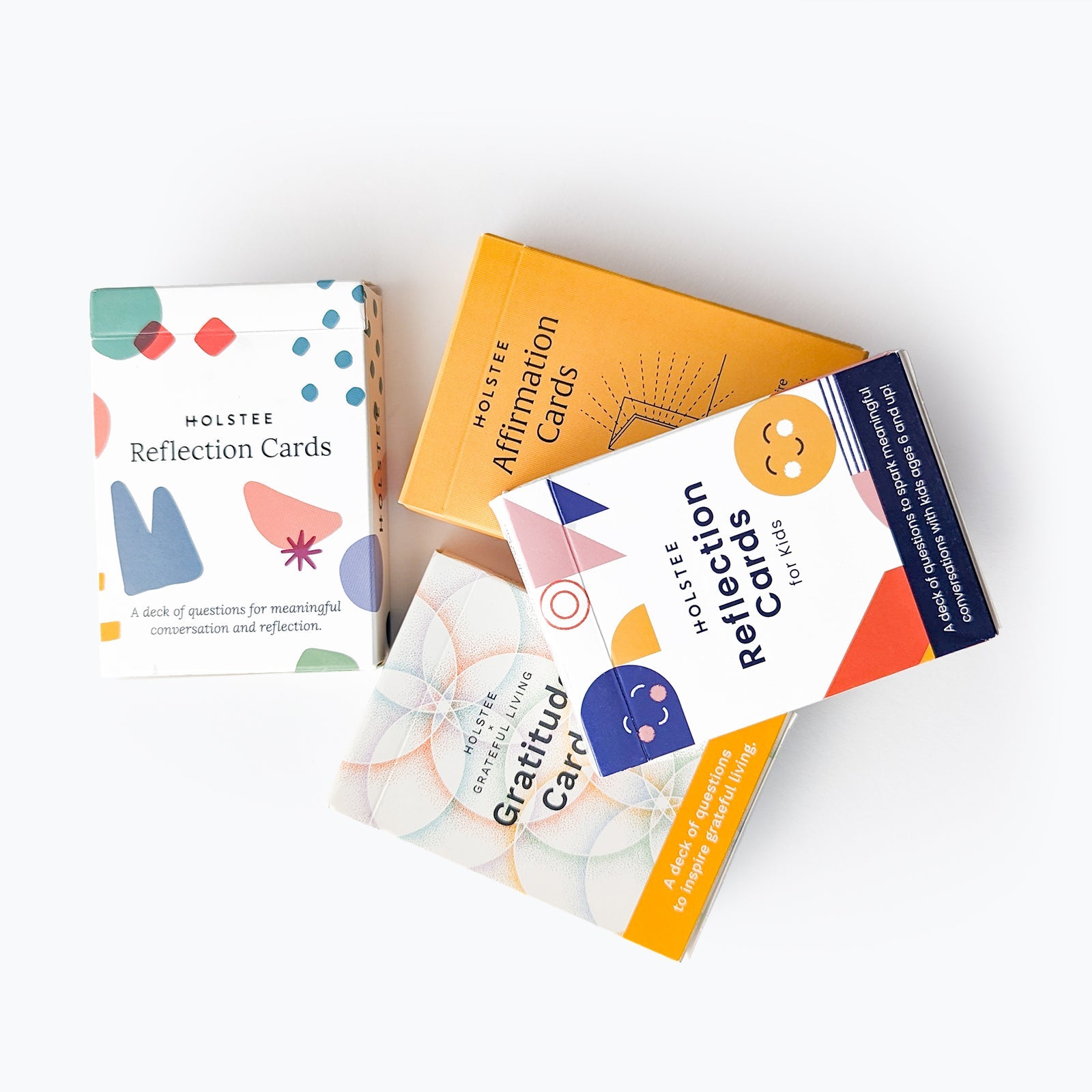
If you're looking for an adventure to begin, you can skip the question of what would be impressive. Ask the two quieter ones instead. What have I been carrying that I haven't faced? And what have I been afraid to say, and to whom? Our Reflection Cards are full of questions like these, if you want company in asking them. Sometimes the adventure that matters most is the inward one.
A richer life, not just a happier one
For most of its history, psychology offered two measures of a good life: was it happy, and was it meaningful. The psychologist Shigehiro Oishi has spent recent years arguing for a third measure he calls psychological richness, a life of varied, interesting, perspective-changing experiences.
What I love about his framing is that richness has its own logic. A life optimized for happiness alone can curdle into complacency. A life optimized for meaning alone can narrow into rigidity. Richness is the textured life, harder to summarize and harder to regret. Oishi found that some people will reliably choose interesting over easy, even when it costs them comfort, and they don't always score higher on happiness. They just say they wouldn't trade the life they're living. Every time you say yes to something unfamiliar, you're voting for that kind of richness. We've felt this firsthand chasing a more wonder-full life.
Make stress and failure your allies
Adventure asks you to be uncomfortable, which means it asks you to handle some fear and some stress. The good news is that both are more useful than we treat them.
Bravery, it turns out, isn't the absence of fear. It's a sequence: acknowledge the fear, decide to act anyway, then take the step. On stress, the health psychologist Kelly McGonigal makes a compelling case that the feeling isn't a malfunction. Stress shows up when something you care about is at stake, and that same energy can be aimed forward instead of fought.
Failure works similarly. Astro Teller, who runs Google's moonshot lab, talks about celebrating failure because so many failures are really redirections. The researcher Amy Edmondson sharpens it: the failures worth celebrating are the "intelligent" ones, the smart risks taken at the edge of what's known, where the outcome genuinely couldn't be known in advance. Those aren't the price of doing something foolish. They're the price of doing something new.
The journey is the point
The Greek poet Cavafy said it best, in his poem "Ithaka", written as advice for any voyage:
As you set out for Ithaka
hope your road is a long one,
full of adventure, full of discovery...
Keep Ithaka always in your mind.
Arriving there is what you're destined for.
But don't hurry the journey at all.
Better if it lasts for years...
Ithaka gave you the marvelous journey.
Without her you wouldn't have set out.
The destination gets you moving. The journey is what actually makes you. That's as true of a quiet adventure as a literal one.
Going deeper, together
Reading about adventure is one thing. Practicing it alongside other people who are also trying is another, and it tends to stick better.
Adventure is one of twelve themes in The Flourishing Life, our year-long Holstee membership, alongside Intention, Kinship, Gratitude, and the rest. Over a year the community moves through all twelve together, and you can join any time and focus on whatever you need most right now. Each theme brings a small curriculum, fellow members working through it alongside you, and live conversations to make it real. It's not for everyone, but if you've read this far, it might be for you.
Frequently asked questions
What is adventure?
Adventure is the practice of staying open to the unknown and being willing to step toward it. The word comes from the Latin for "about to happen." It isn't limited to travel or extreme sports; an adventure can be any experience that asks for curiosity and courage, including inner and interpersonal ones.
What is the difference between courage and fearlessness?
Fearlessness is the absence of fear; courage is feeling the fear and acting anyway. Genuine bravery doesn't require you to stop being afraid. It follows a simple path: acknowledge the fear, decide to act, and take the step despite it.
Do I have to travel to have an adventure?
No. Some of the most meaningful adventures are "quiet" ones that require no passport: having a hard conversation, facing a truth you've avoided, making an apology, or trying something you might fail at. These ask for the same courage a cliff edge does, the willingness to move when the ground feels uncertain.
What is psychological richness?
Psychological richness, a concept from psychologist Shigehiro Oishi, is a third dimension of a good life alongside happiness and meaning. It describes a life full of varied, interesting, and perspective-changing experiences. Richness often involves difficulty, and people living richly don't always report being happier, but they tend to say they wouldn't trade their lives.
Why is staying in my comfort zone risky?
Comfort feels safe, but over-optimizing for it tends to breed restlessness, stagnation, and regret. As Seth Godin argues, in a fast-changing world, playing it too safe can be the most dangerous choice. New and challenging experiences also build "cognitive reserve," mental flexibility that keeps you adaptable over time.
How can I become more adventurous?
Start small and build the muscle. Get curious by asking more questions, then practice bravery by taking one uncomfortable step, reflecting on it, and stacking small successes. Reframing stress as energy and failure as information makes the next step easier. Adventurousness grows through direct experience more than through pep talks.
Michael Radparvar
Co-Founder, Holstee