🌱 Enjoying this? It's a taste of The Flourishing Life, our year-long Holstee membership. Every month we explore a new theme like this one together, with guided practices, reflection prompts, and live conversations. Unlock full access →
You know the kind of day I mean. You weren't doing anything heroic, a few meetings, some errands, the usual, and by evening you're wrung out, shoulders up somewhere near your ears, too tired to sleep and too wired to rest. You tell yourself that tomorrow you'll exercise, eat better, get to bed early. Then tomorrow does the same thing to you.
For a long time I treated that as a discipline problem, like I just needed a stricter morning routine and more willpower. It turned out to be a listening problem. Wellness has less to do with imposing a system on yourself than with learning to hear what your body and mind are actually asking for.
Wellness isn't a finish line
Most of what gets sold as wellness is really optimization: the perfect routine, the cleanest diet, the most disciplined schedule. It treats your body like a project to be managed and you like the manager who keeps falling short.
Real wellness is messier and kinder than that. It's honoring your need for rest in a world that rewards hustle. It's finding ways to move that feel like play instead of punishment. It's noticing the difference between "I'm tired and need rest" and "I'm restless and need stimulation," which sound alike from the inside until you practice telling them apart. You never arrive at wellness and check it off. You just get a little better at the daily conversation. We've made a version of this same case before, and it still holds.
The six dimensions of a well life
One reason wellness feels slippery is that we collapse it into one thing, usually fitness, when it's really at least six. A whole life leans on its mind, body, soul, work, play, and love, and when you neglect one, the others start to wobble.

Mind. Staying curious, learning, using your attention on purpose. Being a beginner at something as an adult is good for you, ego included.
Body. Sleep, movement, food, the basics, tuned to what your body actually needs rather than what a program tells you it should.
Soul. A sense of awe and connection to something larger than your to-do list.
Work. Drawing some real fulfillment from what you spend your days on, even if a wholesale change isn't on the table.
Play. Time for the things that spark joy for no productive reason at all.
Love. Nourishing, and being nourished by, the people in your life.
You don't fill all six equally every day. The skill is noticing which one is running low and needs your attention this week.
Start with the body
When most of us finally notice the body, it's because something has gone wrong: pain, exhaustion, a knot between the shoulders. A lot of wellness is just moving that check-in earlier, before the warning light.
The fastest lever is the one you're using right now, your breath. James Nestor, who wrote a whole book on it, calls the nose "nature's air filter" and makes a strong case that most of us would feel better breathing through it more. When sleep won't come, a slow 4-7-8 breath, a long exhale through the mouth, does more to settle the nervous system than another hour of lying there doing the math on how little rest you're about to get. (If the not-sleeping part sounds familiar, we went deep on it in why you're so tired.)
Don't forget to play
Play is the dimension adults quietly delete first, and it costs us more than we think. Dr. Stuart Brown has studied play for decades and argues it isn't the opposite of work, it's part of what keeps us creative and sane.
He also found that play looks different for different people. Some of us play through movement, some through games and competition, some through making things, some through collecting, exploring, telling stories, or just being silly. If "go have fun" has never quite worked for you, it may be that you've been borrowing someone else's idea of fun. Find your own kind and protect a little time for it.
Small practices that compound
You don't overhaul a life. You run small experiments and keep the ones that work. A few worth trying:
Morning pages. Julia Cameron calls three pages of unedited longhand writing first thing in the morning "windshield wipers for the soul." You're not writing for anyone, including future you. You're just clearing the glass.
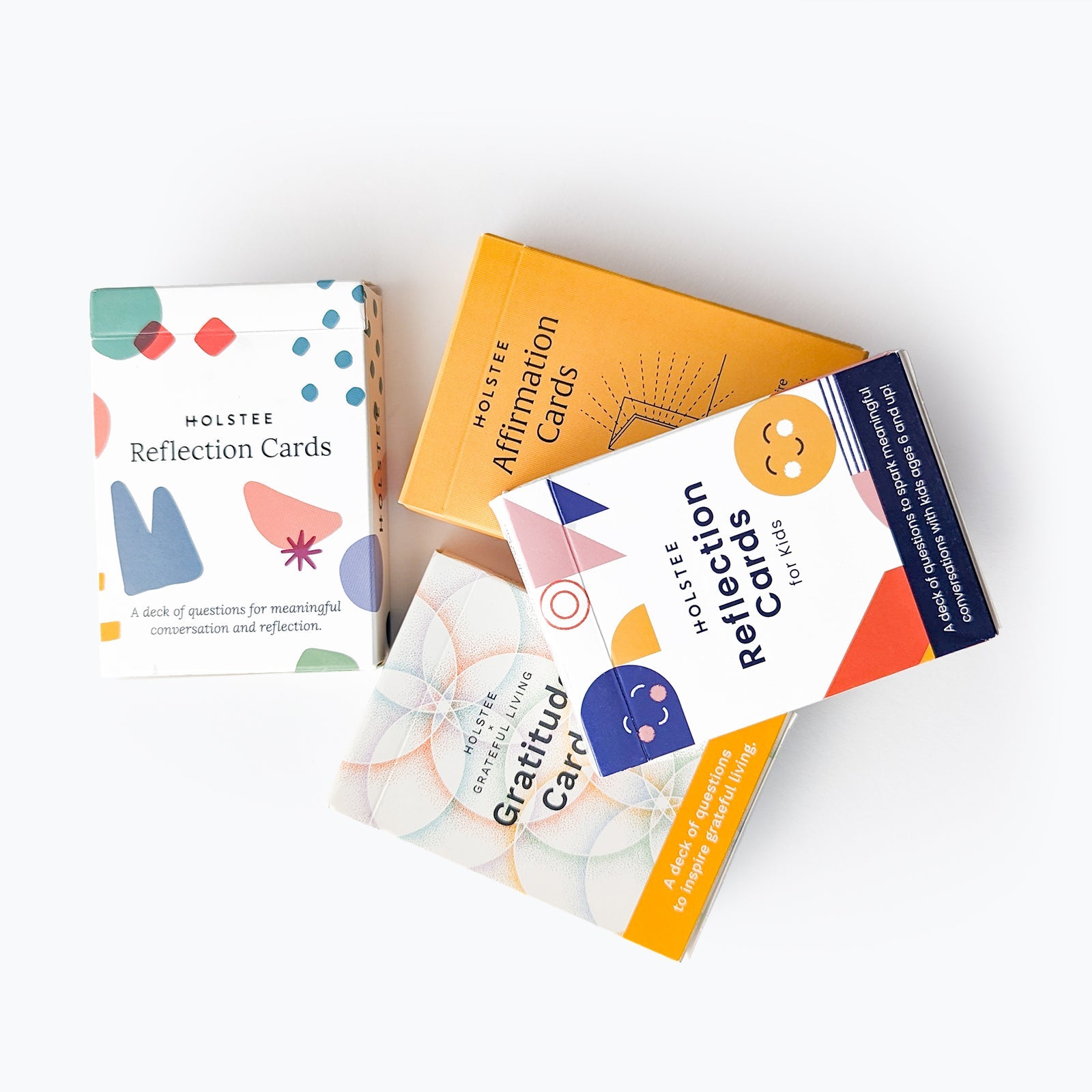
A weekly check-in. Once a week, ask what challenged you and what you want to do differently next week. Our Reflection Cards are built for exactly this kind of honest conversation with yourself.
Practice patience on purpose. Let someone go ahead of you in line. Leave the phone in your pocket at the red light. Patience is a skill, and these are the reps. The form of care you need changes week to week, so it's worth asking.
The point isn't to do all of it. It's to keep listening, and to be gentle with yourself when a week gets away from you. That gentleness is part of the practice, not a break from it.
Going deeper, together
Reading about wellness is one thing. Practicing it alongside other people who are also trying is another, and it tends to stick better.
Wellness is one of twelve themes in The Flourishing Life, our year-long Holstee membership, alongside Intention, Kinship, Gratitude, and the rest. Over a year the community moves through all twelve together, and you can join any time and focus on whatever you need most right now. Each theme brings a small curriculum, fellow members working through it alongside you, and live conversations to make it real. It's not for everyone, but if you've read this far, it might be for you.
Frequently asked questions
What is wellness?
Wellness is the ongoing practice of caring for your whole self across several dimensions of life, not just physical fitness. It's less a fixed state you achieve than a daily process of noticing what you need and responding to it. True wellness is about thriving rather than simply getting by.
What are the six dimensions of wellness?
A common framework breaks wellness into six interconnected dimensions: mind (curiosity and mental engagement), body (sleep, movement, and nourishment), soul (awe and connection), work (fulfillment in what you do), play (joy for its own sake), and love (nourishing relationships). Neglecting one tends to throw the others off balance.
How do I improve my wellness without a perfect routine?
Start by noticing which dimension feels most depleted right now, then run one small experiment to support it rather than overhauling everything at once. Small, repeatable practices like a few minutes of slow breathing, a weekly check-in, or protecting time for play tend to compound far better than an ambitious routine you can't sustain.
Why am I exhausted even when I get enough sleep?
Tiredness isn't always about hours in bed. It can stem from chronic stress, an under-supported nervous system, lack of restorative downtime, or neglecting non-physical dimensions of wellness like play and connection. Simple practices such as nose breathing, a wind-down routine, and slowing your exhale before bed can meaningfully improve how rested you feel.
Is wellness the same as self-care?
Self-care is one piece of wellness, the practices that restore you, but wellness is broader. It includes how you work, learn, play, connect, and find meaning, not just how you rest and recharge. Self-care tends to be the moment-to-moment maintenance; wellness is the whole-life picture.
How do I know which area of my life needs attention?
Body awareness is the key skill. Check in regularly, through a body scan, journaling, or a simple weekly review, and notice where you feel depleted, numb, or out of balance. Over time you get better at distinguishing what you actually need, like rest versus stimulation or solitude versus connection.
Michael Radparvar
Co-Founder, Holstee