Mindful Matter


How to Make Friends as an Adult: A Practical Guide
A practical, research-backed guide to making friends as an adult: where to meet people, how to take the first step, and how long friendship really takes to build.
Learn more
The Strength of Weak Ties: Why Your Loose Connections Matter More Than You Think
Your acquaintances, neighbors, and regulars do more for your happiness and your opportunities than you think. The surprising science of weak ties and third places.
Learn more
Belonging vs. Fitting In: Why the Difference Changes Everything
Fitting in means changing yourself to be accepted. Belonging means being accepted as you are. Why that difference quietly shapes every relationship you have.
Learn more
The Science of Belonging: Why We're Wired to Need Each Other
Belonging isn't a luxury, it's a biological need. What the research reveals about why we're wired to connect, and what it means for health and happiness.
Learn more
Why Adult Friendship Is So Hard (and What Actually Helps)
Making friends as an adult feels harder for a reason. Here's the science of why adult friendship fades, and the boring, hopeful fix that actually rebuilds it.
Learn more
Reflection: How Looking Back Helps You Move Forward
🌱 Enjoying this? It's a taste of The Flourishing Life, our year-long Holstee membership. Every month we explore a new theme like this one together, with guided practices, reflection prompts, and live conversations. Unlock full access → Recently I stepped back from running the company I'd spent fifteen years building, and for the first time in a long while I had room to think. What struck me almost immediately was how much had happened that I'd never actually processed. Whole years had gone by in motion, win to loss to whatever was next, and I'd extracted almost none of the wisdom they were offering. I'd lived them. I hadn't really learned from them. That gap is what reflection is for. Most of us accumulate experiences without ever turning them into insight. Reflection is the practice of slowing down long enough to ask the questions that do the converting: What just happened? What did I learn? How am I different now? It's the difference between growing older and growing wiser. Reflection turns experience into wisdom Everything behind you is raw material. Every hard conversation, every project that worked or didn't, every unexpected joy, all of it is data waiting to become understanding. But the transforming doesn't happen on its own. Left alone, experience just piles up. When you do reflect regularly, patterns start to surface that you can't see from inside a single day. You notice what consistently gives you energy and what drains it, which relationships nourish you and which leave you empty, what brings out your best self and what triggers your worst. That awareness isn't for judging yourself. It's for designing a life that actually fits who you are. We've felt this slowly, over years, that time brings perspective and reflection brings clarity. Reflecting, not ruminating There's an important line here, because reflection has an evil twin: rumination, the loop where you replay the same painful moment without ever getting anywhere. One builds wisdom; the other just deepens the rut. The difference is mostly direction and tone. Productive reflection is curious rather than critical, and it always bends forward. You're not asking "why am I like this" on repeat. You're asking "what can I learn, and how do I want to grow?" The research backs this up: reflection helps most when it's regular, gently structured, and forward-looking, and it can tip into harm when it becomes endless, harsh self-interrogation. Approach yourself the way you'd approach a good friend who was working something out. That tone change is most of the work. How to actually do it There's no single right way to reflect, only the way that's sustainable for you. Some people think best on the page, some out loud on a walk, some while moving or making something. The best practice is the one you'll actually keep. A few that hold up: The daily three. At the end of the day, answer three questions: What went well? What could I have done differently? What did I learn? Two minutes, and it compounds. Start absurdly small. Five minutes of regular reflection beats a three-hour session you do once and never repeat. Anchor it to a habit you already have, like your morning coffee or the walk to the train. Use a prompt when the blank page is too big. A good question does half the work. Our Reflection Cards exist for exactly this, and we built Reflection.app for people who'd rather keep the practice on their phone. We also went deep on the best journaling apps if you want to compare. The year in review, through twelve lenses Daily reflection keeps you honest. Once a year, though, it's worth zooming all the way out, because some changes only become visible over months. A year-end review lets you see the patterns, create closure on what's done, and step into what's next with some clarity. The trouble with reviewing a whole year is knowing where to look. The frame we use is the twelve themes of this very series, each one a different lens on the same twelve months. What did you set out to do, and who did you become along the way (Intention)? Who sustained you (Kinship)? What tested you, and what did it teach (Resilience)? What lit you up (Passion), what did you make (Creativity), where did you grow kinder, simpler, braver, more whole? Run your year through all twelve and a fuller picture appears than any single "year in review" ever captures. Which is also how this series comes full circle. We began with intention, setting a direction for who you want to become. We end with reflection, looking back to see how far that intention carried you, and then setting the next one. That loop, intention and reflection, is the engine of a flourishing life. If you want a guided way through it, our Annual Reflection Journal walks you through the whole year, theme by theme. What reflection is really for Mary Oliver, who paid closer attention to the world than almost anyone, ends her poem "In Blackwater Woods" with the hardest and most useful lesson reflection has to teach: To live in this world you must be able to do three things: to love what is mortal; to hold it against your bones knowing your own life depends on it; and, when the time comes to let it go, to let it go. That's the deepest work of looking back. Not to cling to what was, and not to regret it, but to love it fully, learn what it came to teach, and then let it go so your hands are free for what's next. Reflection isn't about perfecting the past. It's about harvesting it, and walking forward a little wiser. Going deeper, together Reading about reflection is one thing. Practicing it alongside other people who are also trying is another, and it tends to stick better. Reflection is one of twelve themes in The Flourishing Life, our year-long Holstee membership, alongside Intention, Kinship, Gratitude, and the rest. Over a year the community moves through all twelve together, and you can join any time and focus on whatever you need most right now. Each theme brings a small curriculum, fellow members working through it alongside you, and live conversations to make it real. It's not for everyone, but if you've read this far, it might be for you. Frequently asked questions What is self-reflection? Self-reflection is the practice of pausing to examine your experiences, thoughts, and feelings in order to learn from them. Rather than simply moving through life, you turn experience into insight by asking what happened, what it taught you, and how you want to grow. Done regularly, it's how you become wiser, not just older. What is the difference between reflection and rumination? Reflection is curious and forward-looking; it asks what you can learn and how you can grow. Rumination is the repetitive, often harsh replaying of negative thoughts without resolution. Reflection builds insight and resilience, while rumination tends to deepen distress. The key differences are tone (kind versus critical) and direction (forward versus stuck). How do I start a reflection practice? Start small and make it consistent. Even five minutes a day is valuable. A simple format is to ask three questions each evening: What went well? What could I have done differently? What did I learn? Anchor the habit to something you already do, choose a method that suits you (writing, talking, or moving), and approach yourself with curiosity rather than judgment. What are the benefits of self-reflection? Regular reflection is linked to better emotional regulation, stronger alignment with your values, healthier relationships, and a more growth-oriented mindset. It activates the brain networks involved in meaning-making and self-awareness, helping you recover from setbacks faster and make decisions that fit who you are. How do I do a year-end reflection? Set aside unhurried time and look back across the whole year through several lenses rather than trying to capture everything at once. Holstee's twelve themes, from Intention and Kinship to Resilience and Gratitude, offer a comprehensive framework. Look for recurring threads and patterns, honor both the struggles and the wins, and use what you find to set intentions for the year ahead. Is journaling the only way to reflect? No. Writing works well for many people, but reflection can also happen through talking (voice memos or conversations with a trusted friend), moving (walking meditation), or creating. The best method is whichever one you'll actually sustain. The goal is regular, gentle self-examination, not a particular format. Michael Radparvar Co-Founder, Holstee
Learn more
Resilience: How to Bend Without Breaking
🌱 Enjoying this? It's a taste of The Flourishing Life, our year-long Holstee membership. Every month we explore a new theme like this one together, with guided practices, reflection prompts, and live conversations. Unlock full access → There's a Japanese tradition called kintsugi. When a ceramic bowl breaks, instead of hiding the repair, the craftsman rejoins the pieces with gold. The crack isn't disguised. It's gilded, made part of the object's story, and the bowl ends up more beautiful and more valuable for having been broken. I think about that bowl a lot. Most of us, when life cracks us, spend enormous energy hiding the seam, hoping no one notices the place we fell apart. Resilience is the slow turn from hiding the crack to filling it with gold. It isn't about being unbreakable. It's about learning to break, and to come back together in a way that's stronger than before. Resilience isn't being unbreakable The word gets used like it means armor, the ability to take any hit and feel nothing. That version is brittle, and it's also exhausting to maintain. Real resilience is closer to a reed in a storm than a wall: it bends, it survives, it springs back. Some people even come through hardship more capable than before, not despite the difficulty but partly because of it. That isn't a reason to go looking for suffering, and it doesn't mean every hard thing is secretly a gift. It just means resilience is a skill, not a fixed trait you're born with or without. You can practice it, and it grows. We've felt this in our own hardest stretches, the ones that taught us per aspera ad astra, through hardships to the stars. The space between what happens and how you respond The most important idea I know about resilience comes from Viktor Frankl, who survived a Nazi concentration camp and wrote Man's Search for Meaning about it. Stripped of everything, family, possessions, dignity, he found one thing that couldn't be taken: the freedom to choose his response to what was happening to him. Between every stimulus and our reaction, Frankl saw, there's a space. It can be vanishingly small, a single breath, but inside it lives all our freedom. Most of our suffering comes from reacting on autopilot, straight from event to response with no pause between. Resilience is mostly the practice of widening that gap, even slightly, so that you get to choose instead of just react. Focus on what you can control The Stoics built an entire philosophy around one division: some things are within our control, and most things are not. Epictetus taught that peace comes from putting your energy where it can actually do something, your choices, your effort, your response, and releasing your grip on the rest, other people's opinions, the market, the weather, the past. It sounds simple and it's surprisingly hard, because anxiety loves to fixate on exactly the things we can't change. A practice that helps: when you're overwhelmed, literally split a page into two columns, what's within my control and what isn't. Then spend your energy only on the first column. The relief is often immediate. Be a kinder narrator A surprising amount of resilience comes down to how you explain things to yourself. The psychologist Martin Seligman found that people who bounce back tend to read setbacks as temporary, specific, and not entirely their fault, while people who struggle read the same setback as permanent, pervasive, and personal. "I failed at this one thing" is recoverable. "I'm a failure" is a trap. You can edit that inner narration, which is the whole idea behind cognitive restructuring: catch the harsh automatic thought, question the evidence, and replace it with something more accurate and more fair. Not fake positivity, just a truer sentence. "This is impossible" becomes "this is hard, and I can break it into steps." When the feelings are too big for arguing with, the meditation teacher Tara Brach offers a gentler tool she calls RAIN: Recognize what's happening, Allow it to be there, Investigate it with kindness, and Nurture yourself the way you would a hurting friend. Our Reflection Cards can help with the noticing part when you don't know where to start. The growth on the far side Here's something the research bears out and most of us only learn the hard way. Psychologists Richard Tedeschi and Lawrence Calhoun coined the term "post-traumatic growth" after interviewing people who'd been through terrible things and found that many emerged with a deeper sense of strength, closer relationships, and a richer appreciation for life. Not all of them, and not instead of the pain. But often, alongside it. The mythologist Joseph Campbell mapped this as the hero's journey: the call, the trials, and the return, where you come back changed and carry what you learned to others. You're almost certainly in the middle of one right now. The poem the course opens with, attributed to Rumi, says it in four lines: I said: What about my heart? He said: Tell me what you hold inside it? I said: Pain and sorrow. He said: Stay with it. The wound is the place where the Light enters you. That's the whole turn from kintsugi to gold. The wound stays a wound. But it can also become the place the light gets in, and the place you finally see how strong you are. Through hardships, to the stars. Going deeper, together Reading about resilience is one thing. Practicing it alongside other people who are also trying is another, and it tends to stick better. Resilience is one of twelve themes in The Flourishing Life, our year-long Holstee membership, alongside Intention, Kinship, Gratitude, and the rest. Over a year the community moves through all twelve together, and you can join any time and focus on whatever you need most right now. Each theme brings a small curriculum, fellow members working through it alongside you, and live conversations to make it real. It's not for everyone, but if you've read this far, it might be for you. Frequently asked questions What is resilience? Resilience is the capacity to adapt and recover in the face of adversity, stress, or hardship. It isn't about being unbreakable or unaffected; it's about bending without breaking and, often, growing stronger through difficulty. Importantly, resilience is a skill that can be developed, not a fixed trait you either have or don't. Can resilience be learned? Yes. While temperament plays a role, research shows resilience is largely built through practice. Skills like reframing negative thoughts, focusing on what you can control, regulating your nervous system through breathing, and finding meaning in hardship all strengthen resilience over time, much like a muscle. What is the space between stimulus and response? It's the idea, drawn from Viktor Frankl, that between something happening to us and our reaction to it lies a moment of choice. However brief, that gap is where our freedom lives. Much of resilience involves widening that space so we can choose a thoughtful response rather than reacting on autopilot. What is the dichotomy of control? A core Stoic principle from Epictetus, the dichotomy of control teaches us to distinguish between what we can control (our choices, effort, and responses) and what we cannot (other people, outcomes, circumstances). Directing energy toward the former and accepting the latter reduces anxiety and builds resilience. What is post-traumatic growth? Post-traumatic growth, a term coined by psychologists Richard Tedeschi and Lawrence Calhoun, describes the positive psychological changes some people experience after serious adversity, such as greater inner strength, deeper relationships, and a renewed appreciation for life. It doesn't replace the pain of trauma and isn't guaranteed, but it's a common and hopeful possibility. How can I become more resilient day to day? Build small, repeatable practices: pause before reacting, separate what you can control from what you can't, challenge harsh self-talk with more balanced thoughts, and use tools like steady breathing or the RAIN method when emotions run high. Over time these habits compound into a steadier, more adaptable way of meeting hard moments. Michael Radparvar Co-Founder, Holstee
Learn more
Integrity: How to Live as One Whole Person
🌱 Enjoying this? It's a taste of The Flourishing Life, our year-long Holstee membership. Every month we explore a new theme like this one together, with guided practices, reflection prompts, and live conversations. Unlock full access → We usually hear "integrity" and think of morality, being good, doing the right thing. The word actually means something simpler and, I'd argue, harder. It comes from integer: whole, complete, undivided. Integrity is the state of being one person instead of several, of having your outer life match your inner one closely enough that you can look in the mirror and recognize who's there. Most of us know the opposite feeling intimately: the low-grade exhaustion of managing different versions of ourselves. One self for work, one for family, one for the people we're trying to impress, all of them slightly out of sync. Integrity is the slow work of collapsing those back into one. It's less about being impressive and more about being real, and the relief of it is hard to overstate. Integrity means wholeness, not perfection This is the reframe that matters. Living with integrity doesn't require you to be flawless or saintly. It requires you to be aligned, to close the gap between what you say you value and what you actually do. A whole person who admits a mistake has more integrity than a polished one who hides it. The payoff is practical, not just moral. When your actions and values line up, decisions get clearer, you stop burning energy on internal conflict, and you build a kind of self-trust that no amount of outside approval can give you. You also stop having to remember which version of yourself you were supposed to be in any given room. We've wrestled with our own version of this, publicly, in pieces like integrity on trial and our team values. If you have twenty minutes, Caroline McHugh's talk on the art of being yourself is the best thing I've found on what wholeness actually feels like in practice: First, know what you actually value You can't align with values you've never named. A useful starting point is the VIA classification of character strengths, developed by Chris Peterson, Martin Seligman, and a large team of researchers. It maps twenty-four strengths, things like honesty, curiosity, kindness, perseverance, and most of us have a handful of "signature" ones that feel core to who we are. Knowing yours gives your inner compass a needle. Aristotle added a crucial wrinkle: a virtue isn't just something you have, it's something you apply in the right amount. He called it the Golden Mean. Bravery taken too far becomes recklessness; too little becomes cowardice. Honesty without kindness becomes cruelty. Integrity isn't about maxing out a virtue. It's about expressing it well, at the right time, in the right measure. And measuring yourself against your own values beats measuring against everyone else's, which is a trap we've written about as social comparison. Then, see your blind spots The hard truth about wholeness is that you can't see all of yourself. The Johari Window, a model from the 1950s, lays this out cleanly: there are things both you and others know about you, things you hide, things neither of you has discovered yet, and, trickiest of all, a blind spot, things others see clearly that you can't. That blind spot is where integrity quietly leaks. You can value being a good listener and still interrupt constantly without knowing it. The only way to shrink the blind spot is to invite feedback from people you trust and actually stay open when it stings. It's uncomfortable, and it's the fastest route to closing the gap between who you mean to be and who you actually are. Our Reflection Cards are one low-stakes way to start those conversations. A simple code to live by If you want something more portable than a philosophy, Don Miguel Ruiz's Four Agreements are about as good as any code I've found: Be impeccable with your word. Say what's true and kind, including to yourself. Don't take anything personally. What others do is usually about their world, not yours. Don't make assumptions. Ask the question instead of inventing the answer. Always do your best. Your best varies by day, and that's fine. The effort is the point. None of them are easy. All of them, practiced, pull your outer behavior closer to your inner values, which is the whole game. The only judge that matters In 1934, Dale Wimbrow wrote a poem called "The Guy in the Glass" that has outlived almost everything else from that year. It's about who actually gets to judge a life: For it isn't your Father, or Mother, or Wife, Who judgement upon you must pass. The feller whose verdict counts most in your life Is the guy staring back from the glass... You can fool the whole world down the pathway of years, And get pats on the back as you pass, But your final reward will be heartaches and tears If you've cheated the guy in the glass. That's integrity in plain language. You can fool everyone else for a long time. You can't fool the person in the mirror, and that's the one whose opinion you'll be living with. Integrity isn't a destination you arrive at. It's a practice you return to, every day, in the small choice between who you really are and who you think you should be. Going deeper, together Reading about integrity is one thing. Practicing it alongside other people who are also trying is another, and it tends to stick better. Integrity is one of twelve themes in The Flourishing Life, our year-long Holstee membership, alongside Intention, Kinship, Gratitude, and the rest. Over a year the community moves through all twelve together, and you can join any time and focus on whatever you need most right now. Each theme brings a small curriculum, fellow members working through it alongside you, and live conversations to make it real. It's not for everyone, but if you've read this far, it might be for you. Frequently asked questions What is integrity? Integrity is living in alignment with your values, so that your actions match what you believe. The word comes from integer, meaning whole or undivided. More than just honesty or morality, integrity is the state of being one consistent person rather than several competing versions of yourself. What is the difference between integrity and honesty? Honesty is telling the truth to others; integrity is broader. It means your whole life, your choices, your words, and your private behavior, lines up with your values, whether or not anyone is watching. Honesty is one important expression of integrity, but integrity also includes self-honesty and consistency over time. How do I figure out my core values? Start by naming your character strengths, the qualities that feel most essential to who you are, such as honesty, kindness, curiosity, or courage. Frameworks like the VIA character strengths survey can help. Then notice which values you keep returning to in real decisions; those are your genuine ones, as opposed to the ones you think you should hold. Does living with integrity mean being perfect? No. Integrity is about wholeness, not flawlessness. It means acknowledging mistakes, staying aligned with your values, and returning to them when you slip, rather than performing a perfect image. A person who admits fault honestly often has more integrity than one who hides it. What are the Four Agreements? From Don Miguel Ruiz's book, the Four Agreements are a simple code for authentic living: be impeccable with your word, don't take anything personally, don't make assumptions, and always do your best. Practiced consistently, they help align your everyday behavior with your deeper values. Why is integrity important for well-being? Living in alignment with your values reduces the internal conflict and exhaustion of maintaining different personas, freeing up energy for what matters. Research links it to greater life satisfaction, stronger relationships, and more resilience. It also builds durable self-trust, a sense of being at home with yourself that external validation can't provide. Michael Radparvar Co-Founder, Holstee
Learn more
Passion: How to Find What Lights You Up (and Build Around It)
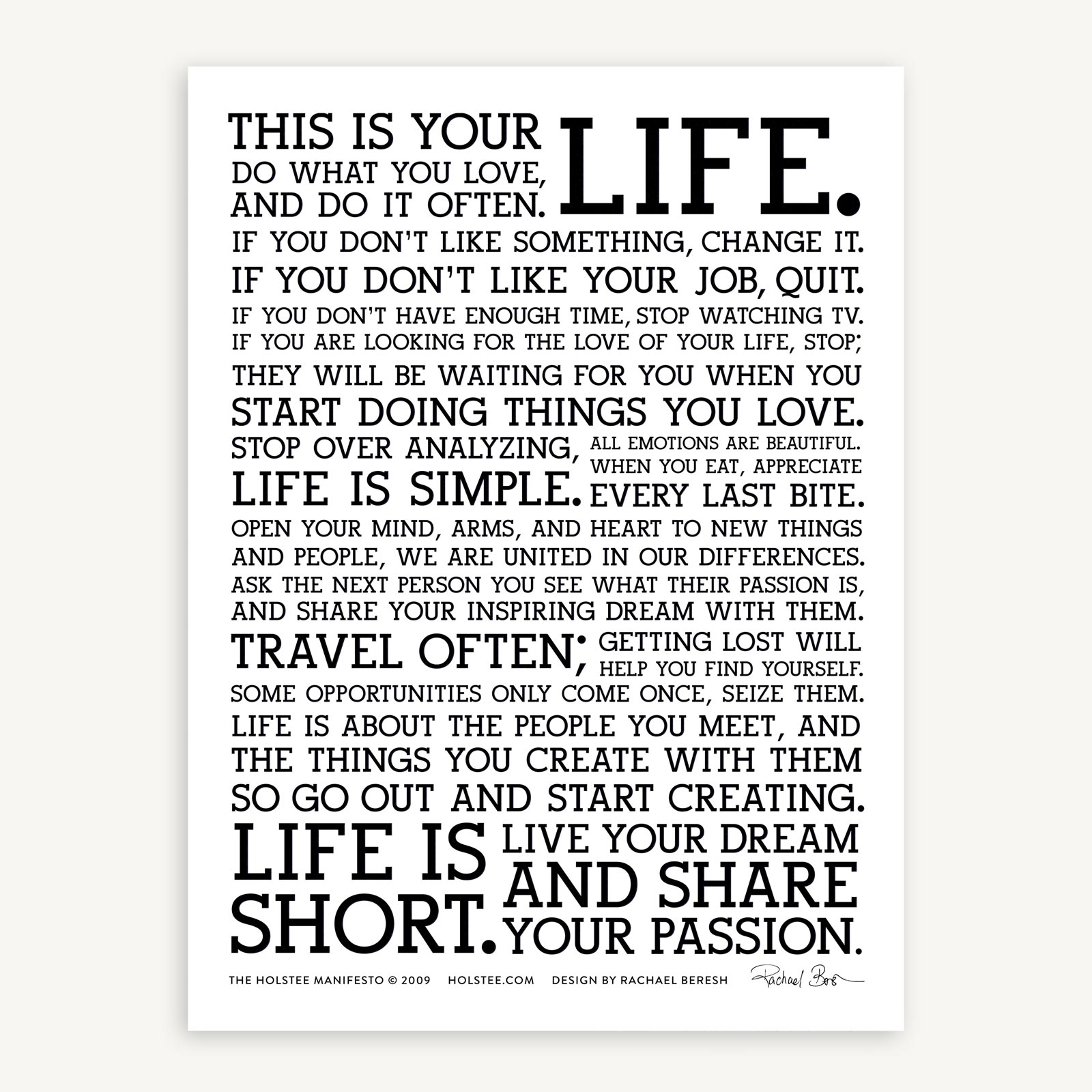
🌱 Enjoying this? It's a taste of The Flourishing Life, our year-long Holstee membership. Every month we explore a new theme like this one together, with guided practices, reflection prompts, and live conversations. Unlock full access → We wrote the Holstee Manifesto as we were starting the company, back in 2009. It wasn't meant to be marketing. It was a reminder to ourselves, a list of how we wanted to live now that we'd left the safe path to make something we cared about. "Do what you love," it says near the top, "and do it often." Easy to print on a poster. Harder, it turns out, to actually figure out. Because the advice everyone gives about passion is also the least helpful. "Find your passion," as if it's a single buried treasure with a map, one true calling you discover once and follow forever. Real passion behaves more like a garden. Some interests bloom fast and fade with the season. Others root slowly and deepen over years. The work isn't to find the one flower. It's to keep tending the garden. Passion isn't a treasure you find The "one true calling" myth does real damage. It makes people feel broken for not having a singular obsession, and it makes them quit good things too early for not feeling like destiny. It also gets the order backwards. We're told to wait for passion to strike, then act. Usually it's the reverse: you act, you get a little good, and the passion grows in the doing. So the better question isn't "what's my passion?" It's quieter and more answerable: what already lights me up, right now, in this season? Not what should energize you, or what would look impressive. What actually does. We've chased a few of these ourselves into passion projects that changed everything, and they rarely started as grand plans. You build a passion, you don't just find it Cal Newport made the most useful argument I know about this in a book bluntly titled So Good They Can't Ignore You. His claim: passion isn't a precondition for great work, it's a byproduct of it. Master a skill, become genuinely useful, gain some autonomy, and passion tends to follow. The people who love their work most are rarely the ones who found a pre-existing passion. They're the ones who got good enough that the work became worth loving. This is freeing, because it means you don't have to feel certain before you begin. You just have to be willing to get a little better at something that interests you, and let the rest catch up. Follow what makes you come alive If passion grows from attention, the practice is learning to pay attention. A simple one I keep coming back to: at the end of the day, finish the sentence "I felt most alive today when…" Do it for two weeks and patterns surface that you can't see from inside a single day. The moments that show up are clues, and clues are all you really need. It helps to know your why. Simon Sinek built a career on the observation that very few of us can clearly say why we do what we do, and that the why is what sustains us when the what gets hard. You don't need a grand mission statement. You need a reason to get out of bed that's yours. Coming back to it, especially on the ordinary days, is most of the work. Aim for meaning, not just pleasure Not every good feeling is the same. The ancient Greeks split it in two: hedonia, the pursuit of pleasure, and eudaimonia, the pursuit of a meaningful life. Both matter, and the research suggests the richest lives blend them. But they age differently. Pleasure is wonderful and fades fast. Meaning compounds, and it's what lets you bounce back when things get hard. The psychologist Tim Kasser spent decades finding much the same thing in modern terms: people who prioritize intrinsic goals, growth, relationships, contribution, tend to flourish, while those who chase extrinsic ones, money, status, image, get a sugar high and a hangover. Japanese culture has a lovely word for the sweet spot: ikigai, your reason for being, found where what you love, what you're good at, what the world needs, and what sustains you overlap. You rarely land neatly in the center, and that's fine. Ikigai is a practice, not a destination. Contribute a verse When passion feels too grand a word, I think of Walt Whitman, who asked the oldest question, what's the point of any of this, and answered it about as well as anyone has, in his poem "O Me! O Life!": That you are here—that life exists and identity, That the powerful play goes on, and you may contribute a verse. That's what living with passion really is. Not finding the one perfect calling, but deciding that the play is worth a verse, and that yours is worth writing. The Holstee Manifesto was our attempt at a verse, a daily reminder to do more of what we love. If you want one on your wall, that's what it's for. And if you'd rather write your own, even better. Going deeper, together Reading about passion is one thing. Practicing it alongside other people who are also trying is another, and it tends to stick better. Passion is one of twelve themes in The Flourishing Life, our year-long Holstee membership, alongside Intention, Kinship, Gratitude, and the rest. Over a year the community moves through all twelve together, and you can join any time and focus on whatever you need most right now. Each theme brings a small curriculum, fellow members working through it alongside you, and live conversations to make it real. It's not for everyone, but if you've read this far, it might be for you. Frequently asked questions What does it mean to live with passion? Living with passion means bringing genuine aliveness and engagement to what you do, rather than drifting through life on autopilot. It's less about a single dramatic calling than about noticing what energizes you and steadily weaving more of it into your days. The subject matters less than the quality of engagement. How do I find my passion? Rather than waiting to discover one true calling, pay attention to what already lights you up. Notice when you feel most alive, most absorbed, or most curious, and follow those clues. Passion often grows through action and skill-building, so experimenting and getting good at something usually reveals more than introspection alone. Is passion something you find or something you build? Largely something you build. As Cal Newport argues, passion tends to be a byproduct of developing real skill and autonomy, not a prerequisite you must feel before starting. You don't need to feel certain to begin; you become passionate about work partly by getting good enough at it that it becomes rewarding. What is ikigai? Ikigai is a Japanese concept meaning roughly "a reason for being," the thing that gets you up in the morning. In its popular form it sits at the overlap of what you love, what you're good at, what the world needs, and what can sustain you. It's understood as an ongoing practice of living in alignment with what gives life meaning, not a fixed destination. What's the difference between eudaimonia and hedonia? Hedonia is the pursuit of pleasure and enjoyment; eudaimonia is the pursuit of meaning, purpose, and growth. Pleasure tends to feel good in the moment but fades quickly, while meaning builds over time and supports resilience. Research suggests the most fulfilling lives draw on both rather than choosing one. Should my career align with my passion? Not necessarily. Some people thrive by building a career around what they love, while others find more freedom keeping certain passions as personal pursuits free of financial pressure. What matters is intentionality: making sure your passions have real room in your life, whether or not they pay the bills. Michael Radparvar Co-Founder, Holstee
Learn more